
What Happens During a Home Inspection in California (Buyer's Guide)
Photo: Frames For Your Heart on Unsplash

What happens during a home inspection in California?
During your contingency period, a hired inspector does a noninvasive visual review of the home's systems and structure. In Orange County, buyers usually add a termite report, sewer scope and other specialist inspections.
The home inspection is the part of buying a house where you stop looking at the home as a buyer and start looking at it like an owner. It is your chance to learn what the roof, plumbing, wiring and foundation are really like before your deposit is at risk. In California, the inspection happens inside a short, strict window in the purchase contract, so knowing what to expect ahead of time matters.
This guide is for buyers. It covers what California law says about home inspectors, how the investigation contingency works, what a general inspection does and does not cover, the specialist inspections that are common in Orange County, and how to turn findings into a repair request or a credit. If you are selling, our seller-side guides on keeping an inspection from killing your sale and pre-listing inspections are the better read.
How California Regulates Home Inspectors
California does not issue a home inspector license. As the American Society of Home Inspectors notes, the state regulates inspectors through a trade practice law instead. That law is in Business and Professions Code Sections 7195 through 7199, and it sets real standards even without a license.
What Counts as a Home Inspection
Under Section 7195, a home inspection is a noninvasive physical examination, done for a fee in connection with a sale, of the mechanical, electrical and plumbing systems and the structural and essential components of a 1-to-4 unit home. Its purpose is to identify "material defects," meaning conditions that significantly affect the home's value, desirability, habitability or safety. Style and cosmetic issues are not material defects. If the home has a pool or spa, the inspection must also note which drowning-prevention safety features are present.
The Standard of Care
Section 7196 requires an inspector to use the degree of care a reasonably prudent home inspector would exercise. And under Section 7198, a contract clause that waives that duty or limits the inspector's liability to the cost of the report is invalid. Read the inspection agreement anyway, because it will still define scope and exclusions.
Conflict-of-Interest Rules
Section 7197 bars an inspector from offering to repair, for an extra fee, a home they inspected in the past 12 months. Inspectors also cannot pay referral fees to agents, inspect a property they have a financial interest in, or take a job where the fee depends on what the report says or on escrow closing. There are narrow exceptions for licensed roofing and plumbing contractors, with required disclosures.
Time Limit on Claims
Under Section 7199, a lawsuit for breach of duty arising from a home inspection report must be brought within 4 years of the inspection date. Keep your report and photos.
Because there is no state license, checking an inspector's experience, sample reports, insurance and professional memberships is on you. We do not recommend specific inspectors, but we can tell you what a strong report looks like.
Your Investigation Window Under the C.A.R. Contract
California's standard purchase agreement sells the home in its present "as is" condition, subject to your right to inspect and investigate. According to the California Department of Real Estate's reference book chapter on disclosures and transactions, buyers typically get 17 days to inspect and investigate. That is the default investigation contingency in the current C.A.R. form, and the same 17-day window generally covers your review of seller disclosures, HOA documents and the preliminary title report.
In a competitive Newport Beach or Irvine situation, buyers sometimes shorten it. That can win an offer, but only if your inspectors can actually get in and deliver reports in time. Book them the day your offer is accepted.
What Happens at the End of the Window
By the deadline, you either remove the contingency in writing, ask the seller to extend it, or cancel. If you miss the date, the seller can serve a Notice to Buyer to Perform, which generally gives you 2 days to act before the seller can cancel. Once you remove the investigation contingency, you have accepted the property's condition, and your deposit is at risk if you later back out. Our California escrow guide covers the full timeline and deposit protections.
What a General Home Inspection Covers
A general inspection usually takes a few hours, and you should attend at least the end of it. The inspector walks the property and looks at:
- Structure: visible foundation, framing where accessible, signs of settlement or movement.
- Roof and attic: roof covering, flashing, gutters, attic ventilation and insulation, as far as can be safely seen.
- Plumbing: supply and drain lines that are visible, fixtures, water pressure, the water heater and its earthquake strapping.
- Electrical: service panel, visible wiring, outlets, GFCI protection.
- Heating and cooling: operation of the furnace and air conditioning.
- Interior and exterior: windows, doors, walls, ceilings, grading and drainage around the house.
- Safety items: smoke and carbon monoxide alarms, and pool and spa safety features.
Water heater bracing is a California-specific item worth noticing. Under Health and Safety Code Section 19211, residential water heaters must be braced, anchored or strapped against earthquake motion, and the seller must certify to you in writing that this has been done.
What a General Inspection Does Not Cover
"Noninvasive" is the key word. The inspector will not open walls, pull up flooring, move furniture or dig. A general inspector is also a generalist, not a structural engineer, roofer, geologist or pest control operator. Most reports flag conditions and recommend "further evaluation by a qualified specialist." In California, that recommendation is your cue to book the specialist before your contingency expires, not after.
Specialist Inspections Common in Orange County
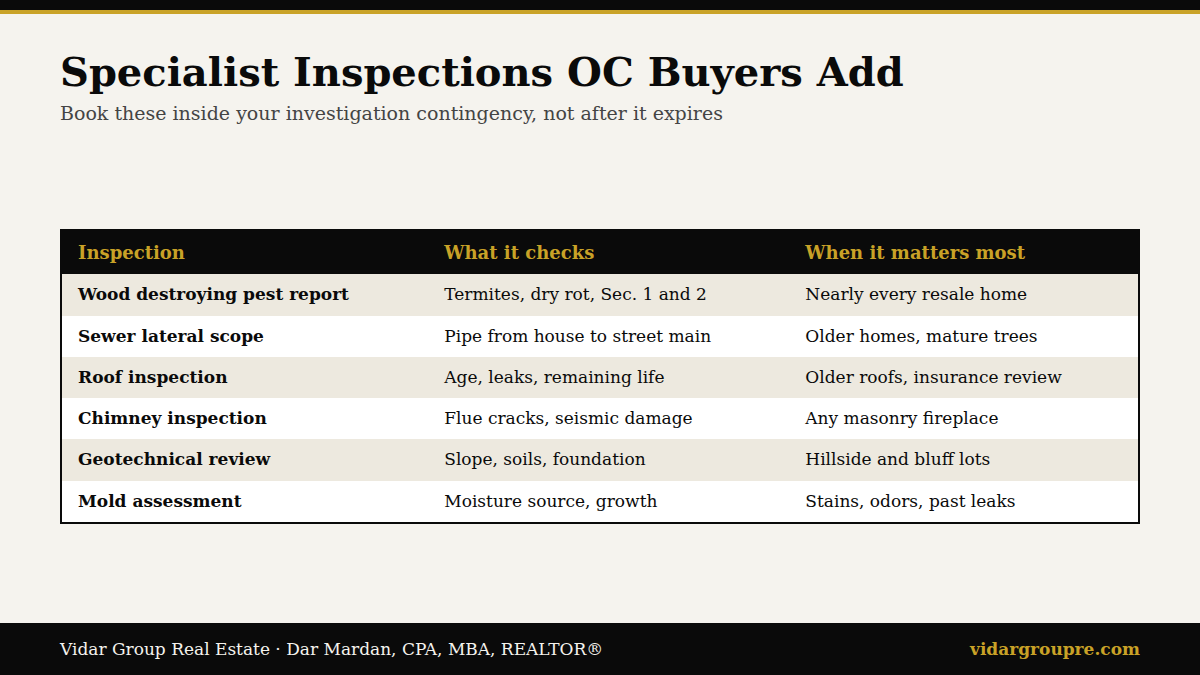
Which specialists you need depends on the home. A 1960s house in Corona del Mar raises different questions than a 2015 condo in Irvine. These are the ones buyers here order most often.
Wood Destroying Pest Report: Section 1 and Section 2
Coastal Orange County homes see termites, dry rot and fungus damage, so a Wood Destroying Pests and Organisms report is standard. It is performed by a company licensed by the Structural Pest Control Board. Under Business and Professions Code Section 8516, the report must separately identify 2 kinds of findings, which the industry labels Section 1 and Section 2:
- Section 1: active infestation or infection, or damage already present.
- Section 2: conditions likely to lead to infestation, such as earth-to-wood contact, excess moisture or faulty grade.
The report must be delivered within 10 business days of the start of the inspection and filed with the Board. Section 1 work usually gets the most negotiating attention because it is present damage. Who pays for what is negotiated, often on the C.A.R. Wood Destroying Pest Inspection and Allocation of Cost Addendum. If the contract requires a pest report, Civil Code Section 1099 requires the seller to deliver a copy to you before title transfers, along with notice of any completed work.
Sewer Lateral Video Scope
The sewer lateral is the pipe that runs from your house to the public main, usually under the yard and street. In much of Orange County, the owner is responsible for it. The Costa Mesa Sanitary District, for example, makes property owners responsible for the lateral up to the connection with the district's main, usually in the middle of the street. Older homes with clay pipe and mature trees are prime candidates for root intrusion and cracks, and a camera scope costs little compared to replacing a line. Rules differ by city and sewer agency, so ask who owns what for the specific address.
Roof Inspection
A general inspector looks at the roof from where it is safe to stand. A roofing contractor can walk it, estimate remaining life and spot problems with flashing and underlayment. Roof condition can matter for insurance too. Our post on how an inspection can affect your insurance cost goes deeper.
Chimney Inspection
Masonry chimneys are vulnerable in earthquake country. If the home has a fireplace, a chimney specialist can run a camera through the flue to look for cracks, gaps and damage the general inspector cannot see from the firebox.
Foundation and Geotechnical Review on Hillside and Bluff Lots
Many homes in Newport Coast, Laguna Beach and parts of Corona del Mar sit on slopes or near coastal bluffs. The California Seismic Hazards Program maps zones of required investigation for liquefaction and earthquake-induced landslides, and sellers must disclose when a property sits in one. If your Natural Hazard Disclosure shows a mapped zone, or the inspector sees cracking, sloping floors or retaining wall problems, a structural engineer or geotechnical engineer should look before you remove contingencies.
Mold
If the inspector finds water stains, musty odors or signs of past leaks, a mold assessment may make sense. The EPA's guide to mold and moisture stresses that moisture control is the key, and that sampling is usually unnecessary when mold is visible. For a buyer, the real question is where the water came from and whether it has been fixed.
Reading the Report Without Panicking
Every inspection report on a resale home is long. Even well-kept Mission Viejo homes produce reports full of photos and notes. Sort the findings into 3 groups:
- Safety issues: electrical hazards, gas leaks, missing pool barriers, structural concerns.
- Big-ticket systems: roof, foundation, sewer line, HVAC, plumbing supply lines.
- Maintenance items: caulking, loose fixtures, minor grading. Normal for any home.
The first 2 groups drive your negotiation. The third is your to-do list after you move in. If you are buying in an HOA, check which items are the association's responsibility before asking the seller to fix them. Our Orange County HOA fees guide explains how association maintenance works.
Request for Repair vs. a Credit
After your inspections, you can ask the seller to address what you found. In California, this is typically done on the C.A.R. Request for Repair form, which lets you request specific repairs, a credit toward closing costs, or a price reduction. The form itself notes that the seller has no obligation to respond to your request.
When a Credit Is the Better Choice
Many Orange County buyers prefer a credit. You control who does the work and how well it is done, and you are not relying on a seller's lowest bid days before closing. Lenders set limits on seller credits, so coordinate the amount with your loan officer before you ask. Our buyer closing costs guide shows what a credit can offset.
When a Repair Makes Sense
Some items need to be fixed before closing, especially anything that affects insurability, lender requirements or safety. If the seller agrees to repair, get it in writing, ask for receipts and licensed contractors, and confirm the work at your final walkthrough.
If the seller refuses and you cannot agree, you can still cancel within the contingency period and get your deposit back. For negotiating tactics, see our guide to negotiating price in Orange County.
The Seller's Disclosure Duties in California
Your inspection works alongside the seller's disclosures, not instead of them. California's disclosure rules are among the strongest in the country.
The Transfer Disclosure Statement
Sellers of 1-to-4 unit homes must give you a Real Estate Transfer Disclosure Statement, or TDS. Under Civil Code Section 1102.1, the TDS cannot be waived in an "as is" sale, and sellers must still disclose facts that materially affect the home's value and desirability. Most Orange County sellers also complete the C.A.R. Seller Property Questionnaire, which asks more detailed questions.
Your Right to Cancel After Late Disclosures
If the TDS arrives after you sign the contract, Civil Code Section 1102.3 gives you 3 days after in-person delivery, or 5 days after delivery by mail, to terminate by written notice.
The Agent's Visual Inspection
Under Civil Code Section 2079, real estate agents must do a reasonably competent and diligent visual inspection of the accessible areas of a 1-to-4 unit home and disclose material facts. That inspection is limited and does not replace a professional one.
Compare the disclosures to the inspection reports line by line. A roof leak that the seller marked "repaired" should look repaired. Our Orange County home buyer checklist is a useful companion for this step.
Frequently Asked Questions About Home Inspections in California
Are home inspections required in California?
No law requires a buyer to get one. But the purchase contract sells the home "as is" subject to your right to investigate, so skipping the inspection means accepting whatever you do not find.
Do California home inspectors need a license?
No. California has no home inspector license. Inspectors are governed by Business and Professions Code Sections 7195 to 7199, which set a standard of care and ban certain conflicts of interest.
How long do I have to do inspections?
The default in the current C.A.R. purchase agreement is 17 days after acceptance. It is negotiable, so check your contract.
Who pays for the home inspection?
The buyer usually pays for the inspections they order. Who pays for Section 1 pest work and other repairs is negotiated.
Can I back out after a bad inspection?
Yes, if you cancel in writing before you remove the investigation contingency. After removal, backing out generally puts your deposit at risk.
What is the difference between Section 1 and Section 2 in a termite report?
Section 1 lists active infestation or existing damage. Section 2 lists conditions likely to lead to future infestation. Section 1 items usually get more attention in negotiations.
Should I get a sewer scope on a newer home?
It is less critical on a newer home, but many buyers still do it. Construction debris and root intrusion can affect newer lines too, and a scope is inexpensive compared to a repair.
Do I need a separate inspection for a condo?
Yes. A condo inspection focuses on the unit's interior and systems. The HOA usually covers roofs, exteriors and common areas, so read the HOA documents and reserve study too.
Does the seller have to fix what the inspector finds?
No. California sellers are not required to make repairs, except as the contract or local law requires. Repairs and credits are negotiated.
Can a home inspection affect my insurance?
It can. Insurers may ask about the roof, electrical panel and plumbing, and the inspection tells you in advance what they might flag.
Buy With Your Eyes Open
A good inspection period is organized: inspectors booked on day 1, specialists lined up for anything flagged, and a clear, reasonable request back to the seller well before the deadline. Dar Mardan, CPA, MBA, and REALTOR® with Real Broker, and the Vidar Group Real Estate team guide buyers through the investigation period in Newport Beach, Corona del Mar, Newport Coast, Irvine and Mission Viejo, and help turn inspection findings into a repair or credit that makes financial sense.
Schedule a complimentary consultation with Dar Mardan.
This article is general information about California home inspections and disclosure practice, not legal advice or a substitute for a professional inspection. Contract forms and local rules change, and every property is different. Consult a California real estate attorney and qualified inspectors about your specific purchase.
Categories
- All Blogs (92)
- Buy home (12)
- buy home insurance (2)
- buyer agent (1)
- divorce (6)
- downsizing (24)
- estate planning (18)
- Estate Real estate (6)
- First time home buyer (12)
- home buying advice (6)
- Home buying tips (21)
- Home inspection (3)
- Home Inspections and Repairs (2)
- home insurance (1)
- home selling advice (15)
- Home Selling Tips (47)
- Home upgrades (2)
- how to sell your home (13)
- Lower home insurance cost (2)
- Lower insurance premiums (1)
- market update (4)
- Newport Center (3)
- Orange county homes (72)
- Pre Listing Preparation (7)
- probate sale (5)
- proposition 19 (4)
- Realtor tips (13)
- Rental Income (1)
- retirement planning (19)
- ROI upgrades (2)
- seller agent (1)
- Selling tips (9)
- transfer tax basis (2)
Recent Posts