
Buyer Closing Costs in Orange County: A Line-by-Line Guide
Photo: Ariel Blanco on Unsplash

What closing costs does a buyer pay in Orange County?
In Orange County, California, buyers typically pay lender fees, the lender's title policy, half the escrow fee, recording fees, prepaid interest, insurance and tax impounds, and some HOA charges.
Most buyers know their down payment down to the dollar. Closing costs are where the surprises live. They show up as a dozen or more line items on a standardized federal form, some of them fixed by law, some set by your lender, and some that depend on nothing more than the day of the month you close.
This guide walks through buyer closing costs in Orange County line by line. You will see which costs come from your loan, which come from escrow and title, which are really prepayments of expenses you would owe anyway, and which ones a seller can help cover. Whether you are buying a condo in Irvine or a single-family home in Newport Beach, the categories are the same. Only the amounts change.
If you are new to the process itself, start with our guide to how escrow works in California. This article assumes you know the timeline and focuses on the money.
Buyer Closing Costs in Orange County at a Glance
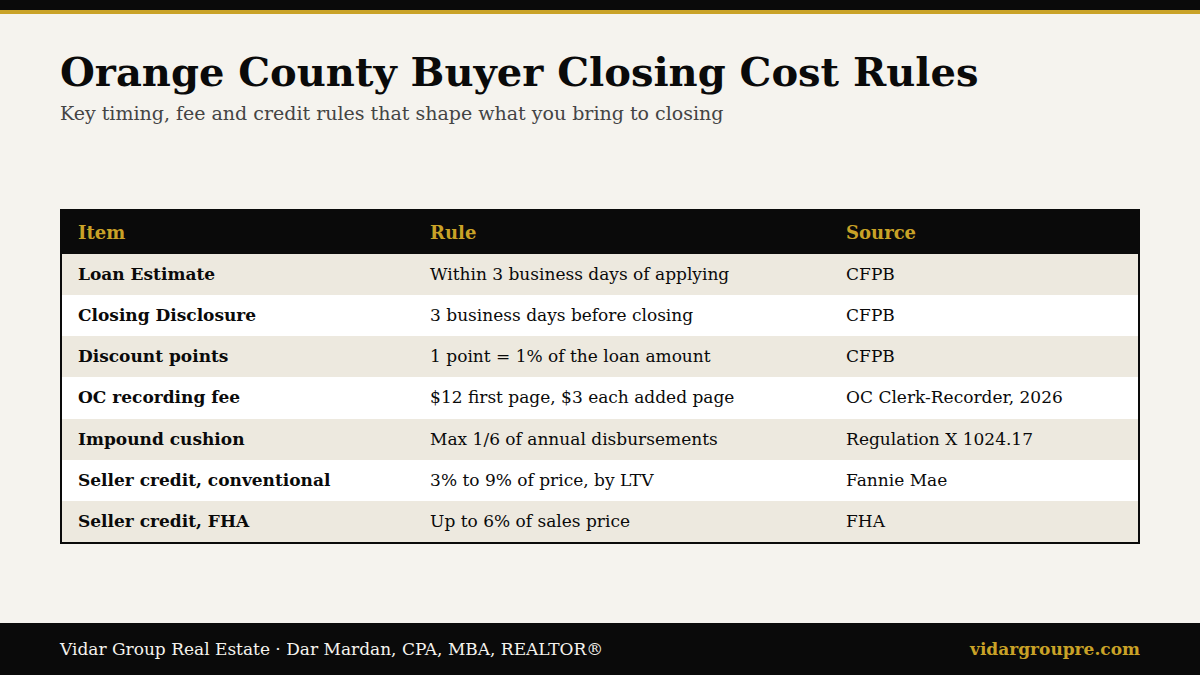
Buyer closing costs fall into 4 groups:
- Loan costs: what your lender and its required vendors charge, including origination, points, appraisal and credit report.
- Escrow, title and government costs: the lender's title policy, your share of the escrow fee and recording fees.
- Prepaids and impounds: prepaid interest, your first year of homeowners insurance and the starting balance of any tax and insurance reserve account.
- Property-specific costs: HOA charges, Mello-Roos and property tax prorations, inspections and any home warranty you choose.
As a rough national benchmark, Bankrate puts closing costs at about 2% to 5% of the loan amount, with wide variation by state. Where you land in that range depends mostly on your loan, whether you buy points and how many months of reserves your lender collects.
Your 2 Key Documents: The Loan Estimate and the Closing Disclosure
Federal rules under TRID (the TILA-RESPA Integrated Disclosure rule) require your lender to put its costs in writing twice, on standardized forms that make comparison easy.
The Loan Estimate
According to the Consumer Financial Protection Bureau, your lender must send a Loan Estimate within 3 business days of receiving your application. Page 2 lists every expected closing cost. Because every lender uses the same form, you can lay 2 or 3 estimates side by side and compare them line for line. If you are still at that stage, our guide on why pre-approval comes first in Orange County explains how to get your financing in order before you write offers.
The Closing Disclosure
By law, you must receive your Closing Disclosure at least 3 business days before closing. It shows your final loan terms and costs. For this rule, a business day counts every calendar day except Sundays and federal public holidays, so a Saturday counts.
A corrected Closing Disclosure usually does not restart the clock. According to the American Land Title Association, a new 3-business-day wait applies only if the APR rises beyond the allowed tolerance, the loan product changes or a prepayment penalty is added. In a 30-day Orange County escrow, that is why your agent and lender push to issue the Closing Disclosure early.
Which Costs Can Change Between the 2 Forms
TRID sorts fees into tolerance buckets. Lender fees, transfer taxes and fees for required services where you could not choose the provider generally cannot increase at all, while recording fees and certain third-party fees can rise up to 10% in total. Prepaid interest, insurance premiums and impound deposits can change freely, because they depend on your closing date and actual bills. When you compare the 2 forms, focus first on the zero-tolerance lines.
Loan Costs: What Your Lender Charges
Origination and Underwriting Fees
These are the lender's own charges for processing and approving your loan. They may appear as one origination fee or as several named fees. Either way, they sit in the zero-tolerance bucket, so the number on your Loan Estimate is the number you should see at closing unless there is a valid change in circumstances.
Discount Points and Lender Credits
Points let you pay more up front for a lower rate. The CFPB explains that 1 point equals 1% of the loan amount, and fractions are common. Lender credits work in reverse: a slightly higher rate in exchange for money toward your closing costs.
For context, Freddie Mac reported the 30-year fixed rate averaged 7.03% as of September 24, 2026, in its weekly mortgage market survey. At rates like that, the points decision is a real one. On a $960,000 loan, 1 point costs $9,600. Whether that pays off depends on how long you keep the loan.
Appraisal, Credit Report and Other Required Services
Your lender will order an appraisal and pull your credit, and it may require flood certification or other reports. You pay for these as a buyer, often up front for the appraisal. Our guide to the home appraisal in California covers what happens if the value comes in low. If your down payment is under 20% on a conventional loan, mortgage insurance may also show up here or in your monthly payment; our PMI guide explains how it works.
Escrow, Title and Recording Costs
Lender's Title Insurance Policy
Whenever you finance, your lender requires its own title policy, and in Southern California the buyer customarily pays for it. The seller customarily pays for the owner's policy here. For what each policy covers, see our guide to title insurance in California.
Your Half of the Escrow Fee
In Orange County, buyer and seller customarily split the escrow fee 50/50. You may also see smaller escrow charges for loan-document handling, notary services, courier fees and wire fees. The purchase agreement can change any of these allocations.
Recording Fees
Buyers customarily pay to record the grant deed and the deed of trust. According to the Orange County Clerk-Recorder's fee schedule effective January 1, 2026, recording costs $12 for the first standard page and $3 for each additional page. The schedule also lists a $75 SB 2 fee per document unless an exemption applies, and a $10 fraud fee on certain documents. A deed of trust runs many pages, so recording totals add up faster than the base fee suggests.
The county's documentary transfer tax is customarily a seller cost in Orange County, so it usually does not appear on your side of the statement.
Prepaids and Impounds: Costs You Pay in Advance
Prepaids are not fees in the usual sense. They are expenses you would owe as an owner anyway, collected at closing so your first payments are covered.
Prepaid Interest
Mortgage interest is paid in arrears, so escrow collects daily interest from your funding date through the end of that month. Your first regular payment is then typically due on the first day of the second month. On a $960,000 loan at 7.03%, daily interest is about $185, so closing with 15 days left in the month means roughly $2,773 in prepaid interest. Close near the end of the month and this line shrinks, but your first payment comes sooner.
Homeowners Insurance Premium
Your lender will generally want the first year's premium paid at or before closing. In parts of Orange County, finding coverage is itself a due-diligence item, so get quotes during your inspection period.
Initial Escrow (Impound) Deposit
If your loan has an impound account, the lender collects enough at closing to seed it for property taxes and insurance. Federal rules cap the extra reserve: under Regulation X, Section 1024.17, the extra cushion is capped at 1/6 of what the lender expects to pay out of the account over a year.
California limits when a lender can insist on impounds for an owner-occupied single-family home. Under California Civil Code Section 2954, they can generally be required only in certain cases, such as government-backed loans, loans of 90% or more of the price, combined loans above 80% of appraised value, or higher-priced mortgages. Otherwise, impounds are optional, and some lenders price the loan differently if you waive them.
Property Tax Proration and the Supplemental Bill
Orange County property taxes follow a July 1 to June 30 fiscal year, with installments due November 1 and February 1, according to the OC Treasurer-Tax Collector. Escrow credits or charges you for your share based on the closing date and whether the seller has already paid the current installment.
Then there is the bill no one budgets for. After a sale, the county reassesses the home and sends a supplemental tax bill for the difference between the old and new values. The county notes that supplemental bills usually fall outside your impound account and go to you, not your lender. It is not a closing cost, but set the cash aside anyway. For the monthly side of ownership, see our guide to the true monthly cost of a first Orange County home.
Property-Specific Costs in Orange County
HOA Transfer and Document Fees
A large share of Irvine and Mission Viejo homes sit in associations governed by the Davis-Stirling Act. Under Civil Code Section 4530, the seller pays the association for the required disclosure documents, and those fees must be listed separately from other charges. Other association charges, such as a transfer fee, a working capital contribution or prorated dues, are allocated by your purchase agreement, so read that section before you sign. Our guide to HOA fees in Orange County covers the monthly side.
Mello-Roos and Special Tax Prorations
Many newer Irvine neighborhoods carry Mello-Roos special taxes. These appear on the property tax bill, so escrow prorates them along with the regular tax. Before you close, the seller must make a good-faith effort to give you a special tax notice. Under Civil Code Section 1102.6b, it should show the current annual tax, the maximum tax, the allowed annual increase and how long the tax can be levied. Read it for the monthly cost, not just the proration.
Inspections and Home Warranty
General home inspections, and specialist inspections for the roof, sewer line or pests, are usually paid directly by the buyer during the contingency period, often outside of escrow. A home warranty is optional and frequently negotiated as a seller-paid item. If it is on your side of the statement, it will appear under "Other."
Seller Credits and Loan-Program Caps
A seller can agree to credit you money toward closing costs, which lowers the cash you need at closing. It is often easier to negotiate a credit after inspections than a price cut. Every loan program limits how large that credit can be.
| Loan type | Seller contribution limit |
|---|---|
| Conventional, more than 90% LTV | 3% of price |
| Conventional, 75.01% to 90% LTV | 6% of price |
| Conventional, 75% LTV or less | 9% of price |
| Conventional, investment property | 2% of price |
| FHA | 6% of sales price |
The conventional limits come from Fannie Mae's interested party contribution rules, which allow credits toward closing costs, prepaids and up to 12 months of HOA dues. FHA treats contributions above 6% as inducements that reduce the loan amount. VA loans have their own concession rules, so ask your lender how they apply to your offer. One more limit: a credit can never exceed your actual costs, so ask for what you can use.
If you are competing against cash offers, a smaller credit and a stronger offer elsewhere may work better. Our guide on competing with cash buyers on a low down payment explains the trade-offs.
Cash to Close vs. Closing Costs
These 2 numbers are not the same, and mixing them up leads to wire-day surprises.
- Closing costs are the fees and prepaids described above.
- Cash to close is what you actually wire. It starts with your down payment plus closing costs, then subtracts your initial deposit already in escrow, any seller credit and any lender credit, and adjusts for prorations.
Page 3 of the Closing Disclosure has a "Calculating Cash to Close" table that walks through this math. Check that your initial deposit shows as a credit, that any agreed seller credit appears and that prorations match your closing date. Then confirm the final figure with your escrow officer by phone before you wire.
Frequently Asked Questions About Buyer Closing Costs in Orange County
How much are buyer closing costs in Orange County?
A common national rule of thumb is about 2% to 5% of the loan amount. Your number depends on your loan amount, points, insurance premium and how many months of reserves your lender collects. Your Loan Estimate is the best early guide.
When will I see my final closing costs?
You must receive the Closing Disclosure at least 3 business days before closing. Compare it with your latest Loan Estimate, starting with the lender fees that are not allowed to increase.
Does the buyer pay for title insurance in Orange County?
The buyer customarily pays for the lender's policy when there is a loan. The seller customarily pays for the owner's policy in Southern California. The purchase agreement can change either allocation.
Who pays the escrow fee in Orange County?
By custom, buyer and seller split it 50/50. Some smaller escrow charges, such as loan-document handling or wire fees, may be charged only to the buyer.
Are prepaids part of closing costs?
They appear on the same form, but they are advance payments of costs you would owe anyway, such as interest, insurance and property taxes. They count toward your cash to close.
Does closing at the end of the month save money?
It lowers prepaid interest because fewer days remain in the month. It does not lower the total interest you pay over the loan. Your first payment simply comes sooner.
Can the seller pay all my closing costs?
Only up to your loan program's limit and never more than your actual costs. On a conventional loan with a 20% down payment, that limit is 6% of the price.
Do I pay the Orange County transfer tax as a buyer?
By custom, the seller pays the documentary transfer tax in Orange County, including in Irvine and Newport Beach. Like every other cost, it can be reassigned in the purchase agreement, so check your contract.
Is the supplemental property tax bill paid at closing?
No. It arrives after closing and is generally not paid from your impound account. Set money aside so it does not become a surprise.
Are closing costs tax-deductible?
Some items, such as property taxes and certain mortgage interest or points, may be deductible, and some other settlement fees are added to your cost basis instead. Ask a tax professional to review your final settlement statement.
Know Your Number Before You Write the Offer
The buyers who feel calm on closing day are the ones who knew their cash-to-close figure weeks earlier. Dar Mardan, CPA, MBA, and REALTOR® with Real Broker, and the Vidar Group Real Estate team help buyers in Newport Beach, Corona del Mar, Newport Coast, Irvine and Mission Viejo read their Loan Estimate, negotiate seller credits that actually fit their loan program and check every line of the Closing Disclosure with a CPA's eye.
Schedule a complimentary consultation with Dar Mardan.
This article is general information about California real estate and mortgage practice, not legal, tax, lending or financial advice. Fees, rates and loan-program rules change, and every transaction is different. Consult your lender, escrow officer, a California real estate attorney or a tax professional about your situation.
Categories
- All Blogs (90)
- Buy home (12)
- buy home insurance (2)
- buyer agent (1)
- divorce (6)
- downsizing (24)
- estate planning (18)
- Estate Real estate (6)
- First time home buyer (10)
- home buying advice (6)
- Home buying tips (19)
- Home inspection (3)
- Home Inspections and Repairs (2)
- home insurance (1)
- home selling advice (15)
- Home Selling Tips (47)
- Home upgrades (2)
- how to sell your home (13)
- Lower home insurance cost (2)
- Lower insurance premiums (1)
- market update (4)
- Newport Center (3)
- Orange county homes (70)
- Pre Listing Preparation (7)
- probate sale (5)
- proposition 19 (4)
- Realtor tips (13)
- Rental Income (1)
- retirement planning (19)
- ROI upgrades (2)
- seller agent (1)
- Selling tips (9)
- transfer tax basis (2)
Recent Posts