Title Insurance in California: What It Covers and Who Pays in Orange County
Photo: Ariel Blanco on Unsplash

What does title insurance cover in California, and who pays for it?
California title insurance protects against hidden ownership problems, like forged deeds or old liens, for a one-time premium paid at closing. In Orange County, the seller customarily pays for the buyer's owner's policy.
Title insurance is one of the least understood line items on a California closing statement. You pay for it once and rarely think about it again. But when a problem does surface, such as a forged signature in the chain of ownership or an unpaid lien from 2 owners ago, the policy is what stands between you and a very expensive legal fight.
California handles title insurance differently from many states. Here, a title company, not an attorney, examines the records. Rates are filed with the state. And in Southern California, custom puts the owner's policy on the seller's side of the ledger. This guide explains what the preliminary title report tells you, the difference between owner's and lender's policies, CLTA versus ALTA coverage, and what to watch for whether you are buying in Irvine or selling in Newport Beach.
What Title Insurance Actually Does
Most insurance protects you against something that might happen in the future. Title insurance works the other way around. It protects you against problems with ownership that already existed before you bought the home but did not show up when the records were searched.
According to the California Department of Insurance's title insurance guide, before a policy is issued, the title company searches public records for defects such as forged documents, unknown liens, missing heirs and survey disputes. The policy then covers you against losses from covered defects that slipped through.
Typical problems a policy is designed to address include:
- A forged or fraudulent deed somewhere in the property's history.
- An unpaid tax, contractor's lien or judgment against a prior owner.
- An heir of a past owner who claims an interest in the home.
- A lack of legal access to the property.
The Preliminary Title Report: What It Is and What It Isn't
Within the first few days of escrow, the title company issues a preliminary title report, usually just called the "prelim." It is one of the most important documents in a California purchase, and one that many buyers skim.
Here is a detail most people miss. Under California Insurance Code Section 12340.11, a preliminary report is not an abstract of title and does not represent the condition of title. Legally, it is an offer to issue a policy subject to the exceptions it lists. In plain English, the prelim tells you what the title company is willing to insure, and what it is not.
What You Will See in the Prelim
- Vesting: who currently holds title and how. If the name does not match the seller on your contract, raise it immediately.
- Legal description: the formal description of the parcel, which should match the property you think you are buying.
- Property taxes: the status of the current installments and any supplemental taxes.
- Liens and deeds of trust: the seller's existing loans, which escrow will pay off at closing, and any judgments or mechanic's liens.
- Exceptions: easements, CC&Rs and other recorded matters the policy will not cover.
Why the Exceptions Matter
The exceptions list is where the real reading happens. A utility easement along the back lot line is routine. An easement running through the spot where you plan to build an ADU or a pool is not. In Irvine and Mission Viejo, where so many homes sit inside planned communities, the prelim will reference the recorded CC&Rs, which can restrict rentals, exterior changes and more. Ask for copies of any exception document you do not understand, and review them during your contingency period.
The Statement of Information
Early in escrow, both buyer and seller are asked to complete a confidential Statement of Information. Title companies use it to tell you apart from people with similar names. If a judgment or lien is recorded against a "John Smith," the form lets the title officer confirm it is not you. Returning it quickly is one of the easiest ways to avoid delays.
Owner's Policy vs. Lender's Policy
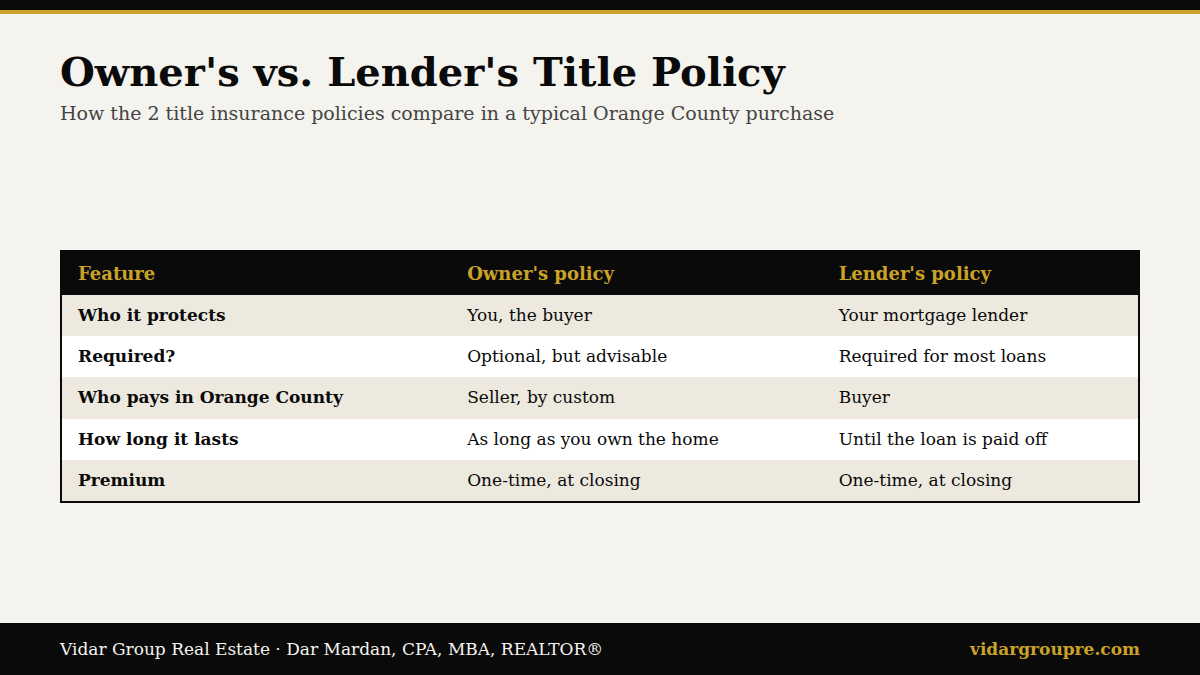
Most financed purchases involve 2 separate policies. Know which one protects you.
The Owner's Policy
The owner's policy protects you, the buyer, for as long as you own the property. According to the Consumer Financial Protection Bureau's explainer on owner's title insurance, it is technically optional, but it is the only policy that protects your own equity against claims that arose before you bought the home.
The Lender's Policy
The lender's policy protects only the lender's loan. As the CFPB explains about lender's title insurance, it is usually required to get a mortgage, but it does nothing for your equity. If a title problem wipes out your ownership, the lender's policy pays the lender, not you.
The Department of Insurance notes that buying both policies at the same time from the same insurer is typically cheaper than buying them separately. In a standard Orange County sale, that is exactly what happens: one title company issues both at closing.
CLTA vs. ALTA: Standard, Extended and Homeowner's Coverage
California title policies are written on forms published by 2 industry groups: the California Land Title Association (CLTA) and the American Land Title Association (ALTA). The names come up constantly in escrow, so it helps to know what they mean.
Standard Coverage
A standard coverage policy protects against defects that a search of the public records would reveal, plus a few specific risks such as lack of access. As the first tuesday Journal's comparison of CLTA and ALTA policies explains, a standard CLTA policy carries pre-printed exceptions for things like unrecorded easements, rights of people in possession and boundary problems a survey would have shown. In other words, "off-record" risks are left out.
Extended Coverage
Extended coverage removes those pre-printed exceptions and covers many off-record matters, including easements, encroachments and boundary disputes. The Department of Insurance notes that extended policies typically require a survey. Lenders commonly require an ALTA lender's policy, which gives them broader protection than a standard owner's policy gives you.
The Homeowner's Policy
For 1-to-4 unit residences, most Orange County buyers are offered a homeowner's policy, which adds meaningful protection beyond standard coverage. According to a title industry flyer comparing CLTA and ALTA homeowner's policies, the current CLTA and ALTA homeowner's forms are identical, and they include:
- Inflation protection: the policy amount increases by 10% of the original amount each year for the first 5 years, up to 150%.
- Post-policy forgery and encroachment: protection if someone forges your signature on a deed after you buy, or builds a structure that encroaches on your land.
- Building permit and zoning coverage: limited coverage if you are forced to correct or remove an improvement because a prior owner built it without a permit or in violation of zoning.
- Coverage for your living trust: protection continues if you later transfer the home into a trust you create.
Some of these coverages come with deductibles and caps. The same flyer lists these limits:
| Homeowner's policy coverage | Your deductible | Maximum payout |
|---|---|---|
| Building permit violations | 1% of policy or $5,000, whichever is less | $25,000 |
| Zoning violations | 1% of policy or $5,000, whichever is less | $25,000 |
| Subdivision law violations | 1% of policy or $2,500, whichever is less | $10,000 |
| Boundary wall or fence encroachment | 1% of policy or $2,500, whichever is less | $5,000 |
The practical point: an unpermitted patio cover or garage conversion in an older Newport Beach home is not fully insured. The homeowner's policy may help with a limited amount, but it is no substitute for checking permits during your investigation period.
What Title Insurance Does Not Cover
Every policy has exclusions and exceptions, and knowing them keeps expectations realistic. In general, title insurance does not cover:
- Matters listed as exceptions in your policy, such as recorded easements and CC&Rs.
- Problems you created or agreed to, or knew about and did not disclose to the title company.
- Government actions such as zoning and land-use rules, except to the limited extent a homeowner's policy covers them.
- Physical condition of the home. Foundation cracks, roof leaks and termites are inspection and insurance issues, not title issues.
Title insurance also is not homeowners insurance or a home warranty. If you are sorting out the difference between those, our guide to homeowners insurance vs. a home warranty covers it.
How Title Insurance Is Priced in California
A One-Time Premium
Unlike homeowners insurance, there is no annual bill. The Department of Insurance describes the title premium as a one-time fee paid when escrow closes, with no continuing premiums. The cost is based on the dollar amount of coverage, which for an owner's policy is usually the purchase price.
Rates Are Filed With the State
California requires title insurers to file their rates before using them. Under Insurance Code Sections 12401.1 and 12401.3, rate schedules take effect no earlier than 30 days after the Insurance Commissioner receives them, and rates may not be excessive, inadequate or unfairly discriminatory. The Department of Insurance publishes a list of title insurance rate filings, so the premiums are not a secret, and you can compare.
Rates vary by insurer and change over time, so get an actual quote from escrow rather than relying on an online estimate, especially on a high-value Newport Beach or Corona del Mar purchase.
Who Pays for Title Insurance in Orange County
In California, the purchase agreement decides who pays. Where it is silent, local custom fills the gap. The Department of Insurance confirms that in Southern California, the seller typically pays for the owner's policy, while in Northern California the buyer customarily pays or the parties split it.
In a typical Orange County sale:
- Owner's policy: paid by the seller.
- Lender's policy: paid by the buyer whenever there is a loan.
- Upgrade to a homeowner's or extended policy: who pays the added cost is negotiable, so settle it in the offer.
All of it is negotiable. Sellers can see how the owner's policy fits into their total costs in our Orange County cost-to-sell guide and the Newport Beach net-sheet breakdown. For how title fits alongside escrow fees, transfer tax and the rest of the timeline, see our guide to how escrow works in California.
Title Issues That Commonly Delay Orange County Escrows
Most title issues are routine and get cleared before closing. The ones that cause delays tend to fall into a few categories:
- Old loans that were never reconveyed. A seller paid off a loan years ago, but the lender never recorded the release. Escrow has to track down proof of payoff.
- Judgments and liens. A judgment, tax lien or mechanic's lien against the seller must be paid or resolved before title can transfer cleanly.
- Trust and estate paperwork. If the home is held in a trust or the owner has passed away, the title company will need trust documents, death certificates or court orders. Our guides on trusts and probate when selling and what to do after inheriting a California house explain what to gather.
- Name mismatches. The seller's name on title does not match the contract, or a spouse who needs to sign is missing.
Sellers can head off many of these by ordering a preliminary report before listing.
Deed Fraud and Seller Impersonation Fraud
Title fraud is no longer rare. In deed fraud, a criminal records a forged deed transferring your home to themselves, then borrows against it or sells it. The Orange County Assessor's real estate fraud alert describes this scheme and warns that a missing September property tax bill can be an early sign someone has changed your mailing address.
A related scheme, seller impersonation fraud, targets owners who are not around to notice. A scammer poses as the owner, lists the property and tries to close a sale. In a September 2026 study by the American Land Title Association, 59% of title firms reported at least 1 seller impersonation attempt in 2025, up from 28% in 2024. Vacant land was targeted in 82% of attempts, and properties without a mortgage in 68%.
How to Protect Yourself
- Watch your mail from the County. The Orange County Clerk-Recorder mails courtesy notices when a grant deed, quitclaim deed, trustee's deed or notice of default is recorded on your property, with a copy of the document's first page. If you get one you did not expect, act the same day.
- Know who to call. The Clerk-Recorder directs suspected fraud to the District Attorney's Real Estate Fraud Unit at REFraud@ocdapa.org or the Clerk-Recorder's line at (714) 834-2500.
- Buy the homeowner's policy. Its post-policy forgery coverage is one of the strongest reasons to choose it over standard coverage.
- Be extra careful with rentals, vacation homes and inherited property. Absentee, mortgage-free owners are the most common targets.
A Quick Word on Vesting
Vesting is how you hold title: as community property, community property with right of survivorship, joint tenants, tenants in common or through a trust. It is recorded on the deed and shows up on your policy. The choice affects taxes, inheritance and what happens if you separate, so it deserves a conversation with your attorney or CPA before you sign. If you are buying with a spouse, our guide to how married couples should take title in Orange County walks through the choices.
Frequently Asked Questions About Title Insurance in California
Is title insurance required in California?
No state law requires it, but lenders require a lender's policy on almost every mortgage. The owner's policy is optional. In Orange County, the seller customarily pays for it, so most buyers get one.
How long does an owner's title policy last?
It protects you for as long as you own the property, with no renewal and no additional premium. The coverage generally also protects certain successors, such as a living trust you create, under a homeowner's policy.
Is the preliminary title report a guarantee that title is clear?
No. Under California Insurance Code Section 12340.11, a prelim is an offer to insure subject to listed exceptions, not a representation of the condition of title. Read the exceptions carefully during your contingency period.
Who pays for title insurance in Orange County?
By Southern California custom, the seller pays for the owner's policy and the buyer pays for the lender's policy. Who pays for an upgrade to broader coverage is negotiable. The purchase agreement controls.
What is the difference between a CLTA and ALTA policy?
Both are standardized forms. A standard CLTA policy covers matters in the public record and excludes many off-record risks. ALTA extended policies cover more, and the current CLTA and ALTA homeowner's policies for 1-to-4 unit homes are identical.
Should I upgrade to a homeowner's policy?
For most owner-occupants, the added protection for post-policy forgery, encroachments, permits and inflation is worth pricing out. Ask escrow for the cost difference and compare it to the added coverage.
Can I shop for title insurance?
Yes. The CFPB notes that you can shop for title insurance separately from your lender. Because California insurers file their rates with the Department of Insurance, you can compare quotes.
Does title insurance cover unpermitted additions?
Only in a limited way. A homeowner's policy can cover forced correction of certain permit violations by a prior owner, subject to a deductible and a $25,000 cap. Check permits during your inspection period instead of relying on the policy.
What should I do if I suspect a fraudulent deed on my home?
Contact the Orange County District Attorney's Real Estate Fraud Unit and the Clerk-Recorder right away, then call your title insurer. A real estate attorney can help you clear the record.
Get Title Right Before It Becomes a Problem
Title problems are far cheaper to solve before closing than after. A careful read of the prelim, the right policy and early attention to trust or lien issues keep an escrow on schedule. Dar Mardan, CPA, MBA, and REALTOR® with Real Broker, and the Vidar Group Real Estate team help buyers and sellers in Newport Beach, Corona del Mar, Newport Coast, Irvine and Mission Viejo review title reports, spot issues early and close with confidence.
Schedule a complimentary consultation with Dar Mardan.
This article is general information about California title insurance and real estate practice, not legal, tax or insurance advice. Policy forms, rates and coverage terms vary by insurer and change over time. Consult a California real estate attorney, tax professional or licensed title representative about your situation.
Categories
- All Blogs (86)
- Buy home (12)
- buy home insurance (2)
- buyer agent (1)
- divorce (6)
- downsizing (24)
- estate planning (17)
- Estate Real estate (6)
- First time home buyer (7)
- home buying advice (6)
- Home buying tips (16)
- Home inspection (3)
- Home Inspections and Repairs (2)
- home insurance (1)
- home selling advice (15)
- Home Selling Tips (46)
- Home upgrades (2)
- how to sell your home (13)
- Lower home insurance cost (2)
- Lower insurance premiums (1)
- market update (4)
- Newport Center (3)
- Orange county homes (66)
- Pre Listing Preparation (7)
- probate sale (5)
- proposition 19 (4)
- Realtor tips (13)
- Rental Income (1)
- retirement planning (19)
- ROI upgrades (2)
- seller agent (1)
- Selling tips (9)
- transfer tax basis (2)
Recent Posts