How to Lower Your Home Insurance Cost in California With a Home Inspection
Can a home inspection lower your home insurance cost in California?
Yes, in many cases. An inspection focused on the roof, plumbing, electrical and wildfire hardening shows you what insurers will object to. Fixing those items and documenting the work can qualify you for discounts, including the wildfire mitigation discounts California requires insurers to offer, and it helps you keep your policy at renewal.
Most homeowners in Orange County have had the same experience in the last 2 years. The renewal arrives, the premium is up sharply, and sometimes there is a nonrenewal notice instead. You can't control the insurance market. You can control how your home looks to an underwriter, and a targeted inspection is the cheapest way to do that.
This guide covers what changed in the California market, what insurers look at, which fixes pay off, the wildfire discount rules most homeowners have never used, how small claims and deductibles really work, and what to do if you get a nonrenewal notice. The video above is the short version.
Photo: Amy Vosters on Unsplash
Why Home Insurance Got Harder to Get in California
Several large carriers have raised rates sharply, tightened what they will write, or stopped writing new policies in parts of the state. Here are the recent approved rate changes for some of the largest homeowners insurers in California:
| Insurer | Approved homeowners rate change | Timing |
|---|---|---|
| Allstate | +34.1% average | Approved late 2024 |
| State Farm General | +17%, kept in a March 2026 settlement | In effect since June 1, 2025 |
| CSAA (AAA) | +6.9% average | Effective March 2026 |
| Mercury | +6.9% average | Effective July 2026 |
| Farmers | +1.5% (6.99% was requested) | Renewals after September 15, 2026 |
Sources: Insurance Journal (State Farm), Insurance Journal (CSAA, Mercury), Newsweek (Farmers), ABC7 (Allstate).
The clearest sign of the squeeze is the California FAIR Plan, the insurer of last resort. It had 696,562 policies in force as of June 2026, up 8% from September 2025. Nationally, the NAIC reports that inflation-adjusted premiums in the West rose 43.3% from 2018 to 2024, and company-initiated nonrenewals in the region more than tripled.
What this means for you: carriers are choosing which homes to keep. A home with a newer roof, updated plumbing, a clean electrical panel and documented wildfire hardening is the one they keep, and often at a better rate.
What Insurers Actually Worry About
Nearly every underwriting question falls into 3 buckets: water, fire and structure. The claim data shows why.
- Water damage and freezing made up 22.6% of homeowners claims from 2019 to 2023, with an average claim of $15,400.
- Fire and lightning made up 21.6% of claims, but the average claim was $88,170.
Source: Insurance Information Institute.
Water is the most frequent problem. Fire is the most expensive. An inspection that targets those two risks is the one that matters for your premium.
The 5 Inspection Items That Matter Most to Insurers
This is not a full pre-purchase inspection with a 60-page report. It is a focused look at the items that drive claims and cancellations. If you are selling, some of this overlaps with a pre-listing inspection, and you can do both at once.
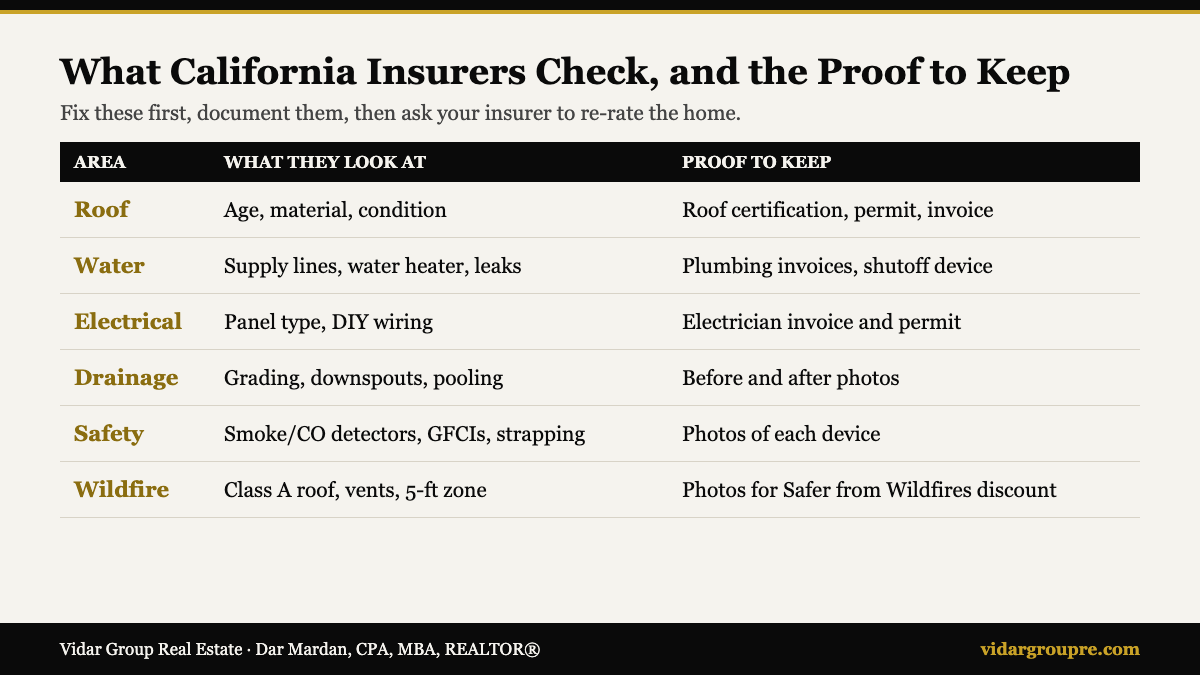
1. The Roof
The roof is the first thing an underwriter asks about, and in California it is increasingly a yes-or-no question. As of 2026, Mercury and Wawanesa generally won't insure roofs older than 25 years (tile and slate are treated differently). At Farmers, asphalt shingle roofs over 15 years old may be covered only at actual cash value, meaning depreciation comes off any payout. The FAIR Plan also limits replacement-cost coverage on roofs over 25 years old (Insurance Business, May 2026).
What to get: a roof inspection or roof certification that states the material, age, condition and remaining life. If you replaced the roof, keep the permit and invoice. Insurers also use aerial photos to judge roofs, and those photos are sometimes wrong. A dated certification is how you correct the record.
2. Plumbing and Water Leaks
Most water claims are not floods. They are burst supply lines, failed water heaters, slow leaks under sinks and shower pans that leak until the drywall shows it. Have the inspector check supply lines, the water heater's age and strapping, water pressure, and any signs of moisture. Braided steel supply lines and a leak detector or automatic water shutoff valve are inexpensive fixes. Many insurers offer a discount for shutoff devices. Ask yours what it gives.
3. Electrical Panel
Insurers dislike older panels, DIY wiring and anything exposed or improvised, because it is fire risk. Some older panel brands are a known underwriting issue. If the inspector flags the panel, have a licensed electrician correct it and keep the invoice and permit.
4. Drainage and Foundation
Water pooling against the foundation, grading that slopes toward the house, and downspouts that empty next to the slab combine water risk and structural risk. These are usually cheap to fix: downspout extensions, regrading a planter bed, clearing a drain.
5. Safety Devices
Smoke detectors, carbon monoxide detectors, GFCI outlets where code calls for them, and water heater strapping cost little and remove easy underwriting objections. The Insurance Information Institute says smoke detectors, burglar alarms or deadbolts can earn a discount of at least 5%, and a sprinkler system with a monitored alarm can earn 15% to 20% (III).
California's Wildfire Discount Most Homeowners Never Claim
California has a rule most homeowners don't know about. Under the Safer from Wildfires regulation (10 CCR §2644.9), in place since October 2022, insurers must file rates that include discounts for specific wildfire mitigation work, and they have had to offer them since April 2023 (California Department of Insurance).
Qualifying work at the home includes:
- A Class A fire-rated roof
- A 5-foot ember-resistant zone around the house
- 6 inches of noncombustible material at the base of exterior walls
- Ember- and fire-resistant vents
- Double-pane windows or shutters
- Enclosed eaves
- Clearing vegetation and debris from under decks
- Moving sheds and outbuildings at least 30 feet from the house
- Trimming trees to defensible-space standards
Living in a Firewise USA community or a certified Fire Risk Reduction Community can also qualify. Details are in the Department of Insurance FAQ.
How to claim it: do the work, send proof to your insurer or agent (photos, invoices, or an inspection if they require one), and ask for the discount in writing. It applies starting with your next policy period. The state doesn't set a size. It varies by insurer, but Mercury has said its wildfire mitigation discounts can cut the wildfire portion of the premium by up to a third.
Why this matters in Orange County: CAL FIRE released updated Fire Hazard Severity Zone maps for local areas in Southern California on March 24, 2025, the first update in about 14 years. Cities then adopted them. Mission Viejo adopted its map on May 27, 2025, with Very High zones and newly added High zones, and Laguna Beach adopted its map on June 24, 2025. If your home is in or near a hillside or canyon area, look up your address on the State Fire Marshal's map. The zone affects both your insurance and what you must disclose when you sell.
Small Claims, Your CLUE Report and Your Deductible
Why small claims can cost more than they pay
Insurers share claims history through the CLUE database, which keeps up to 7 years of home insurance claims tied to both you and the property. A string of small claims can raise your premium or put your renewal at risk, and it follows the house to the next buyer. You can get 1 free CLUE report a year from LexisNexis at 866-897-8126. If you are buying, ask the seller for the home's CLUE report during your investigation period.
A phone call to ask whether something is covered is not a claim. Under California Insurance Code §791.12, an insurer can't make an adverse underwriting decision based on a prior inquiry about coverage it learns of from a database like CLUE. Still, be deliberate: get a repair estimate first, and only open a claim when the loss is well above your deductible.
The deductible math, from a CPA's point of view
If you are not going to file small claims anyway, a low deductible means paying for coverage you won't use. The Insurance Information Institute says raising the deductible to $1,000 may save as much as 25%. The right question is how long it takes the savings to cover the extra risk.
Worked example (illustrative numbers): your annual premium is $4,000 with a $1,000 deductible. Your insurer quotes $3,600 with a $2,500 deductible, a savings of $400 a year. You are taking on $1,500 of extra risk per claim ($2,500 minus $1,000). $1,500 divided by $400 is 3.75 years. If you go 4 years without a claim, and most homeowners do, the higher deductible has paid for itself, and every year after that is money you keep.
| $1,000 deductible | $2,500 deductible | |
|---|---|---|
| Annual premium | $4,000 | $3,600 |
| Premium over 5 years | $20,000 | $18,000 |
| Extra out of pocket on 1 claim | $0 | $1,500 |
| Net over 5 years with 1 claim | $20,000 | $19,500 |
The rule: pick a deductible you could pay tomorrow without stress, and pair it with the inspection fixes above. A higher deductible without lowering the risk is just a gamble. With the fixes, it's a plan.
If You Get a Nonrenewal Notice
California gives you time and some protections:
- 75 days' notice. Under Insurance Code §678, your insurer must send a nonrenewal notice at least 75 days before the policy ends, with the specific reason. If the notice is late, coverage continues for 75 days from the date it was sent.
- Disaster protections. Under Insurance Code §675.1, after a declared wildfire emergency, insurers can't nonrenew a home for 1 year just because it is in or next to the fire perimeter. The Insurance Commissioner announces the covered ZIP codes, and Orange County ZIP codes were included after the 2024 Airport fire.
- Read the reason. If it's the roof, brush clearance or another fixable item, fix it, document it and ask the insurer to reconsider before the policy ends. If the reason is wrong, such as an old aerial photo, send proof.
- Get help. The Department of Insurance consumer hotline is 800-927-4357.
- Last resort. If no regular carrier will write the home, the FAIR Plan covers fire, usually paired with a separate "difference in conditions" policy for water, theft and liability. It costs more, so keep shopping every renewal once your fixes are done.
Build Your Proof File
Insurers price what they can verify. Keep one folder, digital is fine, with:
- Roof inspection or certification, plus the permit and invoice for any replacement
- Photos of the roof, flashing, gutters and vents
- Invoices for plumbing work, the water heater, supply lines and any leak detection or shutoff device
- Electrician invoices and permits for panel work
- Photos of smoke and CO detectors, GFCIs and water heater strapping
- Before-and-after photos of wildfire hardening: vents, the 5-foot zone, cleared decks, trimmed trees
- Your latest CLUE report
Send the relevant pieces to your agent 60 to 90 days before renewal, and ask them to re-shop the policy. At renewal you want to present proof, not argue.
Buying or Selling? Where Insurance Shows Up in the Deal
Buyers: get insurance quotes during your investigation period, not after it. In a California purchase contract that window is usually 17 days, and a home that is hard to insure can affect your loan approval and your monthly cost. The inspection report tells you what an insurer will ask about before you remove contingencies.
Sellers: a newer roof, updated panel and documented wildfire hardening make your home easier to insure, which makes it easier to sell. Buyers and their lenders notice. See how to keep a home inspection from killing your sale and which upgrades add value in Orange County.
Not sure what insurance covers and what a home warranty covers? Read homeowners insurance vs. home warranty.
A Simple 5-Step Plan
- Inspect. Book an inspection focused on the roof, plumbing, electrical, drainage, safety devices and wildfire hardening.
- Fix water and fire risks first. Supply lines, water heater, panel, vents, the 5-foot zone.
- Document everything. Photos, invoices, permits, certifications.
- Re-shop and ask for discounts. Ask about the Safer from Wildfires discount, device discounts and a higher deductible, in writing.
- Repeat every year. Maintain the home as if an underwriter is watching, because at renewal they are.
Frequently Asked Questions About Lowering Home Insurance in California
Will a home inspection automatically lower my premium?
No. The inspection itself doesn't change your rate. The fixes it leads to, and the proof you send your insurer, are what earn discounts and keep your policy renewable.
What is the Safer from Wildfires discount?
A California regulation (10 CCR §2644.9) that requires insurers to offer discounts for specific wildfire mitigation, such as a Class A roof, ember-resistant vents, enclosed eaves and a 5-foot ember-resistant zone. You have to ask for it and send proof.
How much can the wildfire discount save?
The state doesn't set a percentage. It varies by insurer and property. Mercury has said its mitigation discounts can reduce the wildfire portion of the premium by up to a third.
Will insurers cover a home with an old roof?
Often not on standard terms. Several California carriers won't write roofs over 25 years old, and some cover older asphalt roofs only at actual cash value. A roof certification showing remaining life can help.
Does calling my insurer about damage count as a claim?
An inquiry is not a claim, and California Insurance Code §791.12 bars adverse underwriting decisions based on a prior coverage inquiry reported by a database like CLUE. Get a repair estimate before opening a claim.
How long do claims stay on my record?
The CLUE database keeps up to 7 years of home claims. You can request 1 free report a year from LexisNexis.
Should I raise my deductible?
If you can comfortably pay the higher amount and you don't plan to file small claims, it usually saves money. Divide the extra deductible by the annual savings to see how many claim-free years it takes to break even.
How much notice do I get before a nonrenewal in California?
At least 75 days, with the specific reason, under Insurance Code §678.
What if no insurer will cover my home?
The California FAIR Plan covers fire as a last resort, usually paired with a separate policy for other risks. Fix what you can, document it, and re-shop at each renewal.
Should buyers get insurance quotes before removing contingencies?
Yes. Get quotes during the investigation period. A home that is hard or expensive to insure affects your monthly cost and can affect your loan.
Control What You Can
You can't control the California insurance market, but you can control your home's risk and the proof behind it. Dar Mardan, CPA, MBA, and REALTOR® with Real Broker, and the Vidar Group Real Estate team help homeowners in Newport Beach, Corona del Mar, Newport Coast, Irvine and Mission Viejo prepare their homes, whether they plan to stay or sell, and run the numbers on decisions like this one.
Schedule a complimentary consultation with Dar Mardan.
This article is general information about California homeowners insurance, not insurance, legal or tax advice. Rates, underwriting rules and regulations change, and every policy and property is different. Talk to a licensed insurance agent or broker about your specific coverage.
Categories
- All Blogs (86)
- Buy home (12)
- buy home insurance (2)
- buyer agent (1)
- divorce (6)
- downsizing (24)
- estate planning (17)
- Estate Real estate (6)
- First time home buyer (7)
- home buying advice (6)
- Home buying tips (16)
- Home inspection (3)
- Home Inspections and Repairs (2)
- home insurance (1)
- home selling advice (15)
- Home Selling Tips (46)
- Home upgrades (2)
- how to sell your home (13)
- Lower home insurance cost (2)
- Lower insurance premiums (1)
- market update (4)
- Newport Center (3)
- Orange county homes (66)
- Pre Listing Preparation (7)
- probate sale (5)
- proposition 19 (4)
- Realtor tips (13)
- Rental Income (1)
- retirement planning (19)
- ROI upgrades (2)
- seller agent (1)
- Selling tips (9)
- transfer tax basis (2)
Recent Posts