
Moving to Orange County: A Relocation Guide for Home Buyers
Photo: David deLeon on Unsplash

What should you know before moving to Orange County?
Orange County, California offers coastal and master-planned living with a median price above $1.2 million as of August 2026, widespread HOAs, toll-road and airport access, and a DMV to-do list within 10 to 20 days.
People move to Orange County for the coastline, the weather and a pace of life that is busy without feeling like Los Angeles. What surprises many newcomers is how different the cities are from each other. A harbor-front cottage in Newport Beach, a newer townhome in an Irvine village and a single-family home near the lake in Mission Viejo are all "Orange County," but they come with very different price points, HOA structures and commutes.
This guide is written for buyers relocating from another state or another part of California. It covers the main coastal and south county cities by lifestyle and housing type, current prices from sourced 2026 data, how people get around, the climate, HOAs and Mello-Roos, the California paperwork you need to handle after you arrive, and how to time a relocation purchase.
The Main Cities at a Glance
Here is how the areas we work in most compare by lifestyle and housing stock. Prices are covered in the next section.
Newport Beach
Newport Beach is built around its harbor and beaches. Housing runs from older beach cottages and bayfront homes on the Balboa Peninsula and the islands, to newer custom homes, to high-rise and mid-rise condos near Newport Center. Boating, beach life and restaurants shape the lifestyle. It is also the county's most expensive major city: Zillow's Orange County data lists Newport Beach as the county's highest-value area, with a typical home value of $3,697,219 as of August 2026. For condo living near Fashion Island, see our guide to Newport Center high-rise living.
Corona del Mar
Corona del Mar is a coastal village within Newport Beach. It is known for beaches, tide pools and a walkable stretch of shops along Pacific Coast Highway. The historic Flower Streets have closely spaced single-family homes on small lots, many rebuilt as modern custom homes, while hillside neighborhoods above offer ranch-style homes with ocean views.
Newport Coast
Newport Coast sits in the hills above Crystal Cove State Park and is part of the City of Newport Beach. It is master-planned, with gated neighborhoods, larger estate homes, ocean-view lots and some condos and townhomes. Expect HOAs, and in some neighborhoods more than one.
Irvine
Irvine is a master-planned city organized into "villages," each with its own mix of housing, parks and shopping. It was incorporated in 1971 and developed largely by the Irvine Company. Housing ranges from condos and townhomes to newer single-family homes in communities around the Orange County Great Park. It is a major employment center, which makes it popular with buyers who want a short commute. Many Irvine homes are in both an HOA and a Mello-Roos district, covered below.
Mission Viejo
Mission Viejo is a south county master-planned city built by the Mission Viejo Company and incorporated in 1988. At its center is Lake Mission Viejo, a private man-made lake open to residents through an association. Housing is mostly single-family homes and townhomes from the 1970s through the 1990s, with generally more interior space per dollar than the coast.
Costa Mesa
Costa Mesa sits between Newport Beach and the job centers of Irvine and Santa Ana. It is home to South Coast Plaza, the Segerstrom Center for the Arts and the OC Fair and Event Center. Housing is a mix of mid-century single-family homes, many remodeled or rebuilt, plus townhomes and condos, with fewer large master-planned HOAs than Irvine.
Laguna Beach
Laguna Beach began as an artists' colony and still hosts the Festival of Arts and Pageant of the Masters every summer. Its roughly 7-mile coastline is lined with beaches and coves. The town rises steeply into the hills, so housing includes hillside and canyon homes, beach cottages and some condos, with limited roads in and out.
What It Costs to Buy in Orange County in 2026
Orange County is one of the most expensive housing markets in the country, and the numbers depend on which data source and property types you look at.
- All home types: Redfin reports an Orange County median sale price of $1,220,914 in August 2026, up 3.9% from a year earlier, with a median of 43 days on market.
- Single-family homes only: the California Association of REALTORS® reports an Orange County median of $1,452,500 for August 2026, up 4.9% year over year, compared with a statewide median of $901,420.
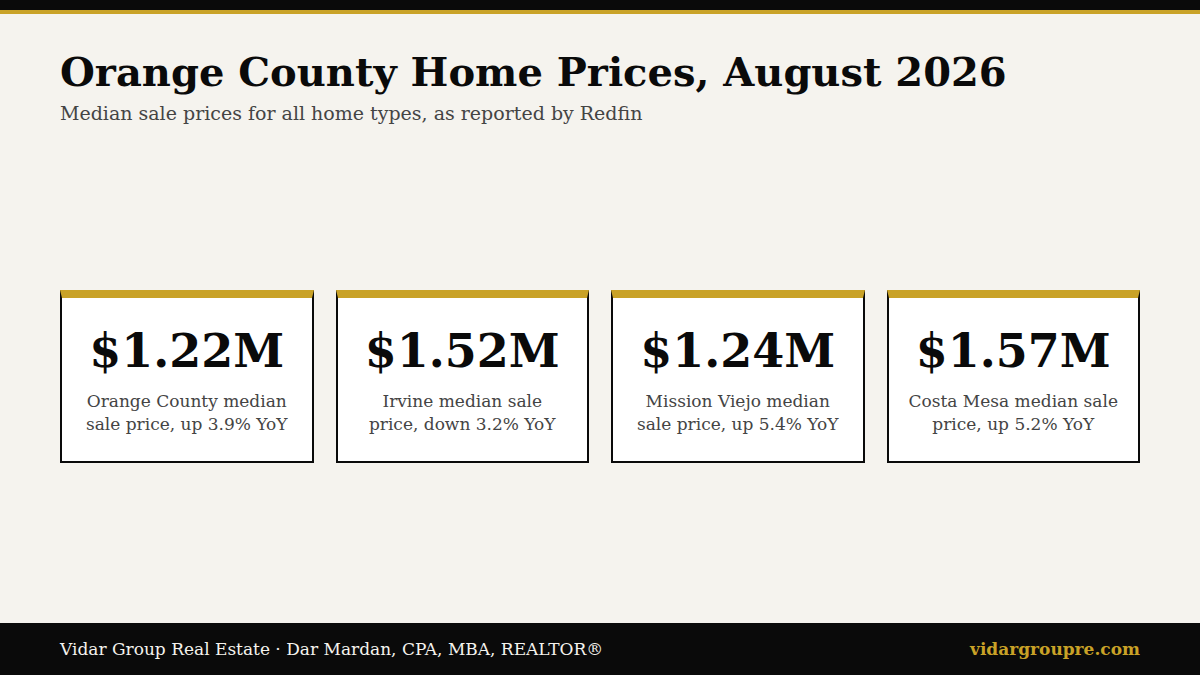
By city, as of August 2026, Redfin puts the Irvine median at about $1.52 million, down 3.2% year over year, the Mission Viejo median at $1,243,677, up 5.4%, and the Costa Mesa median at $1,567,962, up 5.2%. Medians blend condos and houses, so a single number rarely matches the home you want. Condos pull medians down in Irvine; bayfront and custom homes pull them up in Newport Beach.
Affordability and Monthly Cost
C.A.R.'s second-quarter 2026 affordability report estimated that 15% of Orange County households could afford the median-priced single-family home of $1,485,000. Its model required a minimum qualifying income of $370,000 and a monthly payment of $9,250, using a 6.54% effective mortgage rate. Those figures assume a 20% down payment on a 30-year fixed loan, so your numbers will differ.
If you are weighing whether to rent first, the same Zillow data puts the county's average rent at $3,239 a month as of August 2026. Our renting vs. buying guide runs that comparison, and our true monthly cost guide adds taxes, insurance and HOA dues to the mortgage payment.
Getting Around: Freeways, Toll Roads, Airport and Rail
Orange County is car-oriented, and your commute will shape which city fits.
Freeways
Interstate 5 and Interstate 405 are the main north-south routes, merging near Irvine and continuing south as the 5 toward San Diego. The 405 connects the coastal cities to the Los Angeles Westside and LAX. The 55 links Costa Mesa and Newport Beach with central and north Orange County.
The Toll Roads
Orange County has a 51-mile toll road network made up of State Routes 73, 133, 241 and 261, accounting for more than 20% of the county's highway system. The 73 runs parallel to the 5 and 405 through Newport Coast and Laguna, which is why many south county commuters use it. The toll roads are cashless, so set up a FasTrak transponder or a toll road account soon after you arrive.
John Wayne Airport
John Wayne Airport, next to Irvine, Costa Mesa and Newport Beach, is one of the biggest conveniences of living here. It served 11,369,865 passengers in 2025. Homes near it do come with flight-path noise, which is worth checking before you buy in parts of Newport Beach and Costa Mesa.
Metrolink and Amtrak
Commuter rail is an option for some trips. Metrolink's Orange County Line runs from Los Angeles Union Station to Oceanside, and OCTA's station list includes stops in Irvine and at Laguna Niguel/Mission Viejo. Amtrak's Pacific Surfliner serves many of the same stations.
Climate
Coastal Orange County has a mild, dry climate. The City of Newport Beach lists average highs from 62°F in January to 73°F in August, with about 10.8 inches of rain a year. Inland areas like Irvine and Mission Viejo run warmer in summer. Early summer often brings marine-layer mornings at the coast, and most of the year's rain falls in winter.
The dry climate has trade-offs. Hillside and canyon neighborhoods can carry wildfire risk, and home insurance has become harder to place in some areas. Get insurance quotes during your contingency period.
HOAs and Mello-Roos: More Common Than You Might Expect
Homeowners Associations
California has more community associations than any other state. The Foundation for Community Association Research estimates 51,700 associations in California housing about 14,489,000 residents. In master-planned cities like Irvine, Mission Viejo and Newport Coast, many homes belong to a master association and a sub-association, each with its own dues. Condos and townhomes almost always have an HOA. HOAs here are governed by California's Davis-Stirling Act, and our Orange County HOA fees guide explains dues, reserves and special assessments.
Mello-Roos
Newer communities often sit inside a Community Facilities District, known as Mello-Roos, which funds roads, parks and other infrastructure through a special tax on your property tax bill. The Orange County Treasurer-Tax Collector explains that these charges appear under special assessments on the bill, with a phone number for the agency that issued the debt, and offers a map to look up a property's district. Mello-Roos is especially common in newer Irvine neighborhoods. Always ask for the total tax bill, not just the base 1% tax, when comparing homes.
Property Taxes and Proposition 13
California property taxes work differently from most states. Under Proposition 13, the general tax rate is limited to 1% of assessed value plus voter-approved local bonds, and assessed value can rise by no more than 2% a year until the property changes ownership or has new construction, according to the State Board of Equalization's overview of California property tax.
When you buy, your home is reassessed at the purchase price, and you will receive a supplemental tax bill for the difference between the old and new values. Owner-occupants can claim the homeowners' exemption, which reduces taxable value by $7,000. Our Orange County property tax guide covers the details, including due dates and supplemental bills.
California Move-In Checklist
Once you establish residency, a few deadlines start running.
- Driver license within 10 days. The DMV's driver license fact sheet says new residents must get a California license within 10 days. It notes that filing for a homeowners' property tax exemption is one of the acts that establishes residency.
- Vehicle registration within 20 days. The DMV's new resident guide says you must register an out-of-state vehicle within 20 days of becoming a resident. Gasoline vehicles from model year 1976 and newer need a California smog certification, and every out-of-state vehicle needs a vehicle verification.
- Homeowners' exemption. File with the Orange County Assessor after you move in to get the $7,000 exemption.
- FasTrak or toll account. Set it up before your first trip on the 73 or 241.
- Utilities and trash. Water and sewer providers vary by city and district, so confirm who serves your address.
- State income tax. The Franchise Tax Board explains that California taxes residents on all income regardless of source, with part-year rules for your move year. Talk to a tax advisor about your move date.
Timing a Relocation Purchase
Get Pre-Approved Before You Visit
A California lender pre-approval tells you your real budget and makes your offer credible. At Orange County prices, many buyers need a jumbo loan, so ask about those programs early. Start with our guide on why pre-approval comes first in Orange County.
Plan a Focused Visit
If you are relocating from far away, spend a weekend driving your likely commute at rush hour and touring 2 or 3 cities. Then narrow to neighborhoods and housing types before you fly back for showings. Much of the process after that can be handled remotely, including signing escrow documents with a mobile notary.
Coordinate the Sale of Your Current Home
If you need to sell before you buy, consider a longer escrow, a rent-back from your buyer, or a short-term rental in Orange County while you shop. Each option has costs. Our California escrow guide explains how California closings work and how long they take.
Consider the Season
Listing activity and competition shift through the year, and a quieter season can mean fewer choices but more room to negotiate. For current conditions, see our buyer's vs. seller's market update.
Frequently Asked Questions About Moving to Orange County
What is the median home price in Orange County?
As of August 2026, Redfin reports a median sale price of $1,220,914 for all home types. C.A.R. reports $1,452,500 for single-family homes only.
Which Orange County city is best for a relocating buyer?
It depends on your budget, commute and the type of home you want. Coastal cities like Newport Beach and Laguna Beach cost more; master-planned cities like Irvine and Mission Viejo offer more newer and mid-age homes with HOAs.
How soon do I need a California driver license?
Within 10 days of becoming a California resident, according to the DMV. Out-of-state vehicles must be registered within 20 days.
Are HOAs common in Orange County?
Very. Most condos and townhomes, and many single-family homes in master-planned communities, belong to at least one HOA. Some belong to 2.
What is Mello-Roos?
It is a special tax from a Community Facilities District that funds local infrastructure. It appears on your property tax bill and is most common in newer developments.
How much are property taxes in Orange County?
The base rate under Proposition 13 is 1% of assessed value, plus voter-approved bonds and any special taxes. Your assessed value resets to your purchase price when you buy.
Do I need a car in Orange County?
For most people, yes. Metrolink and Amtrak help for some trips, but daily life in most cities is car-oriented.
Are the toll roads worth it?
For many south county commuters, yes, especially the 73 through Newport Coast and Laguna. They are cashless, so set up FasTrak or an account.
Can I buy a home in Orange County before I move?
Yes. Many relocating buyers view homes by video, visit for final showings and sign closing documents remotely with a mobile notary.
Make Your Move With a Local Guide
Relocating is easier when someone local helps you compare cities by what actually matters to you: commute, housing type, HOA and tax costs, and total monthly payment. Dar Mardan, CPA, MBA, and REALTOR® with Real Broker, and the Vidar Group Real Estate team help relocating buyers find the right fit in Newport Beach, Corona del Mar, Newport Coast, Irvine and Mission Viejo, with a CPA's eye on the full cost of ownership.
Schedule a complimentary consultation with Dar Mardan.
This article is general information about relocating to and buying a home in Orange County, not legal, tax or financial advice. Market data changes monthly and DMV and tax rules can change. Verify current requirements with the relevant agency and consult a lender, tax professional or attorney about your situation.
Categories
- All Blogs (90)
- Buy home (12)
- buy home insurance (2)
- buyer agent (1)
- divorce (6)
- downsizing (24)
- estate planning (18)
- Estate Real estate (6)
- First time home buyer (10)
- home buying advice (6)
- Home buying tips (19)
- Home inspection (3)
- Home Inspections and Repairs (2)
- home insurance (1)
- home selling advice (15)
- Home Selling Tips (47)
- Home upgrades (2)
- how to sell your home (13)
- Lower home insurance cost (2)
- Lower insurance premiums (1)
- market update (4)
- Newport Center (3)
- Orange county homes (70)
- Pre Listing Preparation (7)
- probate sale (5)
- proposition 19 (4)
- Realtor tips (13)
- Rental Income (1)
- retirement planning (19)
- ROI upgrades (2)
- seller agent (1)
- Selling tips (9)
- transfer tax basis (2)
Recent Posts