How Escrow Works in California: An Orange County Guide
Photo: Jeffrey Clayton on Unsplash

How does escrow work in California?
In California, a licensed, neutral escrow holder keeps the buyer's deposit and all signed documents until every condition in the purchase agreement is met, then records the deed and releases the money. In Orange County, that usually takes about 30 days.
If you have ever read an escrow article written for New York or New Jersey, you may have come away confused. In those states, attorneys run the closing and everyone sits around a conference table. California works differently. Here, a neutral escrow holder does the job, most of it happens by e-signature and notary appointment, and "closing" means the moment your deed is recorded at the Orange County Clerk-Recorder, not a meeting.
This guide walks through how escrow actually works in California, day by day, what it costs and who customarily pays in Orange County, what protects your deposit, and the mistakes that cost buyers and sellers real money. Whether you are selling a longtime home in Newport Beach or buying your first condo in Irvine, this is the process you will go through.
What Escrow Is (and Who the Escrow Officer Works For)
Escrow is a neutral holding arrangement. The buyer's money, the seller's deed, the lender's loan documents and both parties' signed instructions all go to one party who works for neither side. That escrow holder only follows written instructions that both buyer and seller have signed. It does not negotiate, give legal advice or take sides in a dispute.
That neutrality is the whole point. The seller does not hand over the deed until the money is there. The buyer's money does not go to the seller until the deed is ready to record and title is insured. Escrow makes sure both things happen at the same moment.
In California, the standard C.A.R. purchase agreement is titled "Residential Purchase Agreement and Joint Escrow Instructions," so once both parties sign it, the key terms become instructions to escrow. The escrow company then prepares its own supplemental instructions for both sides to sign.
Who Can Act as an Escrow Holder in California
California regulates escrow closely. Under the state's Escrow Law, the Department of Financial Protection and Innovation (DFPI) licenses independent escrow companies. Other escrows are "controlled" escrows, run under a different license by an attorney, a real estate broker, a title insurance company or a bank. Both are legitimate. What matters is that the company is properly licensed and regulated.
The Escrow Law itself sits in Division 6 of the California Financial Code, starting at Section 17000. Independent escrow companies must meet net-worth, bonding and audit requirements, and DFPI examines their trust accounts.
In Southern California, it is common for an independent escrow company to handle escrow while a separate title company insures the title. In much of Northern California, one title company often does both. Either way, you can check an independent escrow company's license on DFPI's website before you wire a single dollar. DFPI has warned consumers about unlicensed companies posing as real escrow firms, which is a good reason to check.
The California Escrow Timeline, Step by Step
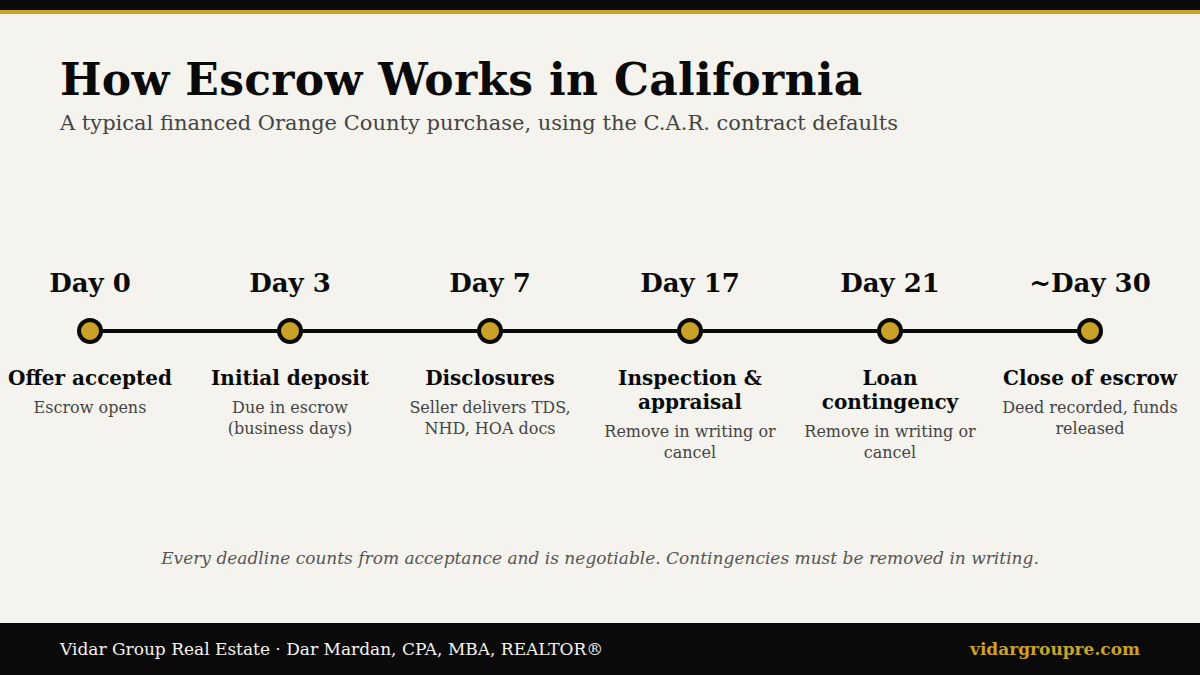
Every contract sets its own dates, but here is how a typical financed Orange County purchase runs under the default terms of the current C.A.R. purchase agreement. All of these deadlines are negotiable, and in a competitive Newport Beach or Corona del Mar bidding situation, buyers often shorten them.
Day 0: Offer Accepted, Escrow Opens
Escrow opens once both parties sign and the accepted contract is delivered. Your agent sends it to the escrow company, which assigns an escrow number and an escrow officer. From here, every deadline counts from the acceptance date, so know that date.
Days 1 to 3: The Buyer's Deposit Goes Into Escrow
Under the standard contract, the buyer has 3 business days to deliver the initial deposit to escrow. In California, that deposit is often called the "initial deposit" rather than "earnest money," and it is commonly about 1% to 3% of the price. It is credited toward the buyer's down payment at closing.
Days 1 to 7: Disclosures and the Preliminary Title Report
The seller typically has 7 days to deliver the required disclosures: the Transfer Disclosure Statement, the Natural Hazard Disclosure report and the rest of the state-required package. The title company issues a preliminary title report showing who owns the property and any liens, easements or restrictions on it. If the home is in an HOA, which describes a large share of Irvine and Mission Viejo, the association documents arrive in this window too.
Days 1 to 17: Inspections, Investigations and Appraisal
This is the buyer's due-diligence window. Under the current C.A.R. form, the defaults are 17 days for the investigation and appraisal contingencies and 21 days for the loan contingency. The buyer orders a home inspection, reviews the disclosures and title report, checks insurability, and the lender orders an appraisal. If something comes up, this is when repair requests and credits get negotiated. If you are selling, our guide on how to keep a home inspection from killing your sale covers how to get ahead of this stage.
Day 17 and Day 21: Contingency Removal
In California, contingencies do not quietly expire. The buyer has to remove them in writing, using the C.A.R. Contingency Removal form, or cancel. If a buyer misses a deadline, the seller can serve a Notice to Buyer to Perform, which generally gives the buyer 2 days to act before the seller can cancel. Once a buyer removes a contingency, the protection it gave them is gone.
About Days 21 to 28: Loan Documents and Signing
The lender sends final loan documents to escrow. The buyer signs them with a notary, usually at the escrow office or with a mobile notary. The seller signs the grant deed and the escrow paperwork, often a few days earlier. The buyer then wires the balance of the down payment and closing costs to escrow.
About Day 30: Funding, Recording and Keys
The lender funds the loan into escrow. Once escrow has all the money and all the signed documents, the title company records the grant deed with the Orange County Clerk-Recorder. Recording is the legal moment of closing. Escrow then pays off the seller's loan, pays the agents and other parties, and sends the seller their net proceeds. Keys are handed over according to the possession terms in the contract.
What Protects the Buyer's Deposit in California
California gives residential buyers more protection over their deposit than many states do. Two laws matter most.
The 3% Liquidated Damages Cap
If both buyer and seller initial the liquidated damages clause in the purchase agreement, and the buyer later defaults without a valid contingency, the seller's remedy is generally limited to keeping the deposit. Under California Civil Code Section 1675, when the buyer intended to live in a 1-to-4 unit home, an amount up to 3% of the purchase price is presumed reasonable. Anything above 3% is presumed invalid unless the seller proves it is reasonable. On a $2,000,000 Newport Beach home, 3% is $60,000, which is why a buyer offering a $100,000 deposit should understand that the extra $40,000 is treated differently.
Neither Side Can Hold the Deposit Hostage
Escrow will not release a deposit on one party's say-so. As the California Department of Real Estate notes, cancellation can be one-sided, but releasing the deposit requires both parties' signatures. To keep that from becoming leverage, Civil Code Section 1057.3 makes a buyer or seller who refuses to sign a release within 30 days of a written demand, without a good-faith dispute, liable for the funds withheld, plus damages of 3 times that amount (at least $100 and no more than $1,000), plus attorney's fees.
The practical takeaway: the contingency deadlines are what protect a buyer's deposit. Remove a contingency before you are truly satisfied, and the deposit is at risk.
Escrow Costs in Orange County: Who Customarily Pays What
In California, the purchase agreement decides who pays each cost. Where the contract is silent, local custom fills in. In Orange County, the long-standing customs are:
- Escrow fee: split 50/50 between buyer and seller.
- Owner's title insurance policy: paid by the seller in Southern California. In Northern California, the buyer customarily pays it, according to 805 Title's California closing-cost breakdown.
- Lender's title policy: paid by the buyer whenever there is a loan.
- County documentary transfer tax: customarily paid by the seller, at $1.10 per $1,000 of value in Orange County.
- Recording fees: customarily paid by the buyer.
The California Lawyers Association's transfer tax chart lists the same Orange County customs. In Orange County, cities such as Newport Beach, Irvine and Mission Viejo take a $0.55 share of that same $1.10, so the total stays at $1.10 per $1,000. Unlike several cities in Los Angeles County, they do not charge an extra city transfer tax on top.
| Sale price | OC documentary transfer tax ($1.10 per $1,000) |
|---|---|
| $1,000,000 | $1,100 |
| $1,500,000 | $1,650 |
| $2,500,000 | $2,750 |
| $4,000,000 | $4,400 |
Escrow also handles prorations. California property taxes run on a July 1 to June 30 fiscal year, with installments due November 1 and February 1, so escrow credits or charges each side for its share based on the closing date. HOA dues and any Mello-Roos special taxes, which are common in newer Irvine neighborhoods, are prorated the same way. For the full picture of seller costs, see our Orange County cost-to-sell guide and the Newport Beach net-sheet breakdown.
What Sellers Should Expect From Escrow
Sellers usually do more of their escrow work up front. Expect to:
- Sign the escrow instructions and the grant deed early, often in the first week or two.
- Give escrow your loan information so it can order a payoff demand from your lender.
- Confirm any HOA transfer and document fees, which escrow collects.
- Complete the California withholding forms. If you are selling a home that has gone up a lot in value, read our guide to capital gains, FIRPTA and California withholding before escrow opens.
- If the home is in a trust or an estate, provide the trust certification or court documents. Our trusts and probate guide explains what escrow will ask for.
What Buyers Should Expect From Escrow
- Wire or deliver the initial deposit within the contract deadline.
- Stay in close touch with your lender. The loan contingency and appraisal drive much of the timeline. If you are still shopping, start with why pre-approval comes first in Orange County.
- Read the preliminary title report and HOA documents, not just the inspection report.
- Bind homeowners insurance early. In parts of Orange County, getting coverage is itself a due-diligence item.
- Do a final walkthrough before closing to confirm the home's condition and any agreed repairs.
For a broader checklist, see our Orange County home buyer checklist.
The Biggest Escrow Risk Today: Wire Fraud
The most expensive escrow mistake is not a missed deadline. It is wiring money to a criminal. According to the FBI's Internet Crime Complaint Center, real estate fraud cost 12,368 victims more than $275 million in 2025, up from about $173 million in 2024. The usual scheme is a spoofed email that looks like it came from your escrow officer or agent, with "updated" wiring instructions.
- Get wiring instructions only from the escrow company, and confirm them by calling a phone number you already have, not one in the email.
- Treat any change to wiring instructions as fraud until proven otherwise. Legitimate escrow companies almost never change them mid-transaction.
- After you wire, call escrow to confirm the funds arrived.
- If something goes wrong, call your bank immediately and file a report at ic3.gov. Speed matters for recovering funds.
Common Reasons California Escrows Get Delayed
- Appraisal gaps: the home appraises below the price, and the parties must renegotiate or the buyer must bring more cash.
- Loan conditions: a late document request from the underwriter pushes funding back.
- Title issues: an old lien, an unreleased loan or a boundary question shows up on the preliminary report.
- HOA documents: slow delivery from the management company.
- Trust and probate paperwork: missing trustee signatures or court confirmation.
- Insurance: trouble binding a homeowners policy.
Most of these are preventable when your agent tracks every deadline and pushes the right party early.
Frequently Asked Questions About Escrow in California
How long does escrow take in California?
About 30 days is typical for a financed purchase in Orange County. Cash purchases can close in 2 weeks or less. The contract sets the date, and both parties can agree in writing to extend it.
Who chooses the escrow company in California?
Buyer and seller agree on it in the purchase agreement. In Southern California, it is often negotiated as part of the offer. Either way, choose a company that is licensed or otherwise properly regulated.
Is earnest money the same as the initial deposit?
Yes. California contracts call it the "initial deposit." It is held in escrow and credited toward the buyer's down payment at closing.
Can a seller keep my deposit if I back out?
Only if you default outside your contingencies and both parties initialed the liquidated damages clause. For an owner-occupied 1-to-4 unit home, California law presumes up to 3% of the price is reasonable. If you cancel properly within a contingency, the deposit should come back to you, less any escrow and service fees already incurred.
What happens if one party won't sign the release of funds?
Escrow will keep holding the money. Under Civil Code Section 1057.3, a party who refuses to sign within 30 days of a written demand, without a good-faith dispute, can owe the withheld amount plus up to $1,000 in damages and attorney's fees.
Who pays escrow fees in Orange County?
By custom, buyer and seller split the escrow fee 50/50, and the seller pays the owner's title policy and the county transfer tax. All of it is negotiable in the purchase agreement.
What does "close of escrow" actually mean in California?
It means the grant deed has been recorded with the County Recorder. There is usually no closing meeting. Both sides sign ahead of time, and recording is what completes the sale.
What is the difference between escrow and title?
Escrow is the neutral party that holds the money and documents and carries out the instructions. Title insurance protects against ownership problems, such as an old lien or a forged deed, that the title search did not catch. In Southern California, the two are often different companies.
Is the escrow officer on my side?
No. The escrow officer is neutral and cannot advise either party. Your agent represents your interests, and an attorney or CPA can advise you on legal and tax questions.
Can I close escrow if I'm out of state?
Usually yes. Documents can be signed with a mobile notary wherever you are. Some documents may need a wet signature, so tell escrow early.
Work With Someone Who Watches Every Deadline
Escrow rewards the side that stays organized. A missed contingency date can cost a buyer their deposit, and a slow payoff demand or trust document can push a seller's closing back by weeks. Dar Mardan, CPA, MBA, and REALTOR® with Real Broker, and the Vidar Group Real Estate team guide buyers and sellers through escrow in Newport Beach, Corona del Mar, Newport Coast, Irvine and Mission Viejo, with a CPA's eye on the numbers at every step.
Schedule a complimentary consultation with Dar Mardan.
This article is general information about California real estate practice, not legal or tax advice. Contract forms change, and every transaction is different. Consult a California real estate attorney or tax professional about your situation.
Categories
- All Blogs (86)
- Buy home (12)
- buy home insurance (2)
- buyer agent (1)
- divorce (6)
- downsizing (24)
- estate planning (17)
- Estate Real estate (6)
- First time home buyer (7)
- home buying advice (6)
- Home buying tips (16)
- Home inspection (3)
- Home Inspections and Repairs (2)
- home insurance (1)
- home selling advice (15)
- Home Selling Tips (46)
- Home upgrades (2)
- how to sell your home (13)
- Lower home insurance cost (2)
- Lower insurance premiums (1)
- market update (4)
- Newport Center (3)
- Orange county homes (66)
- Pre Listing Preparation (7)
- probate sale (5)
- proposition 19 (4)
- Realtor tips (13)
- Rental Income (1)
- retirement planning (19)
- ROI upgrades (2)
- seller agent (1)
- Selling tips (9)
- transfer tax basis (2)
Recent Posts