Home Appraisals in California: What Happens When the Value Comes In Low
Photo: Ariel Blanco on Unsplash

What happens if a home appraisal comes in low in California?
In California, a low appraisal lets you renegotiate, cover the gap in cash, request a reconsideration of value or cancel if your appraisal contingency is still open. Orange County buyers should know their deadline.
You have an accepted offer, the inspection went fine, and then the appraisal comes back $75,000 below your price. It happens more often than people expect, especially in fast-moving Irvine and Newport Beach neighborhoods where prices can climb faster than recorded sales can keep up.
A low appraisal is not the end of the deal. It is a negotiation point with a clock attached. This guide explains who orders the appraisal in California, what the appraiser looks at, how the appraisal contingency works in the C.A.R. purchase agreement, your options when the value comes in short and what sellers can do to help the appraisal go smoothly.
Who Orders the Appraisal (and Why You Can't Pick the Appraiser)
If you are getting a mortgage, your lender orders the appraisal. You usually pay for it, but you do not choose or talk to the appraiser about value. That separation is deliberate.
After the 2008 housing crisis, lenders adopted strict appraiser independence rules. Under Fannie Mae's Appraiser Independence Requirements, loan officers, other production staff and real estate agents may not order, manage or select the appraiser, and the lender will not accept an appraisal from an appraiser the borrower selected, retained or paid. Many lenders route orders through an appraisal management company (AMC) that assigns an appraiser from its panel.
Licensing in California
In California, appraisers are licensed and appraisal management companies are registered by the Bureau of Real Estate Appraisers (BREA), part of the Department of Consumer Affairs. BREA offers a public lookup where you can check an appraiser's license and any discipline. Starting January 1, 2026, BREA requires appraisers to complete a 7-hour course on valuation bias and fair housing laws to renew their licenses.
Your Right to a Copy
Federal rules give you a copy of every appraisal on a first mortgage. Under Regulation B, 12 CFR 1002.14, your lender must send it promptly when completed or 3 business days before closing, whichever comes first, and cannot charge you for the copy. The CFPB's explainer on appraisal copies covers the same right in plain language. Read the report the day you get it, because your contingency clock is running.
What Appraisers Look At
An appraisal is an independent opinion of market value as of a specific date. For a typical Orange County house or condo, the appraiser leans most heavily on the sales comparison approach: what similar homes nearby actually sold for.
Comparable Sales
Fannie Mae's comparable sales guidelines require at least 3 closed comparable sales, which generally should have closed within the last 12 months. Active listings and homes under contract can be used only as supporting data. The appraiser then adjusts each comparable up or down for differences in size, condition, lot, view, upgrades and location.
That is why appraisals can lag in a rising market. If the best recent sale in your Irvine village closed 5 months ago, the appraiser may have to justify a higher value with adjustments rather than a clean match.
The Home Itself
- Size and layout: living area, bedrooms and bathrooms, measured by the appraiser.
- Condition and quality: updates, finishes, deferred maintenance and anything that affects safety.
- Lot and site: lot size, usable yard, views and orientation. In Newport Beach and Corona del Mar, a view can move value significantly, and the appraiser has to support it with comparable sales.
- Permitted improvements: unpermitted additions may receive little or no value.
- HOA and location factors: the community, amenities and any external influences such as a busy street.
The Appraisal Contingency in the C.A.R. Purchase Agreement
Most California purchases use the C.A.R. Residential Purchase Agreement. Under its default terms, the purchase is contingent on a written appraisal by a licensed or certified appraiser at no less than the purchase price. According to the C.A.R. quick guide on contingencies, the default period for the appraisal contingency is 17 days after acceptance, and the loan contingency runs 21 days.
A few points trip people up:
- The appraisal and loan contingencies are separate. As a breakdown of the RPA's appraisal terms notes, removing the loan contingency does not remove the appraisal contingency. Each needs its own written removal.
- Contingencies do not expire on their own. After the deadline passes, the seller can deliver a Notice to Buyer to Perform, which generally gives you 2 days to remove the contingency or cancel.
- Your deposit is protected only while the contingency is open. The C.A.R. guide confirms that a buyer who cancels properly under an open contingency is entitled to the deposit back.
- Deadlines are negotiable. In a competitive Newport Beach or Irvine situation, buyers often shorten the appraisal period or waive it entirely.
For how the appraisal fits into the rest of the timeline, see our guide to how escrow works in California.
Why a Low Appraisal Matters: The Math
Lenders base your loan on the lower number. Fannie Mae's loan-to-value rules define the property value on a purchase as the lower of the sales price or the appraised value.
Here is how that plays out on a hypothetical Irvine purchase with 20% down:
| Item | Appraisal at price | Appraisal $100,000 low |
|---|---|---|
| Purchase price | $1,500,000 | $1,500,000 |
| Appraised value | $1,500,000 | $1,400,000 |
| Maximum loan at 80% of value | $1,200,000 | $1,120,000 |
| Cash needed for down payment | $300,000 | $380,000 |
A $100,000 shortfall means $80,000 more cash to keep the same 80% loan-to-value, since the lender will lend only against $1,400,000. You could instead borrow at a higher loan-to-value, but that can change your rate, trigger mortgage insurance or push the loan into different guidelines.
Your Options When the Appraisal Comes In Low
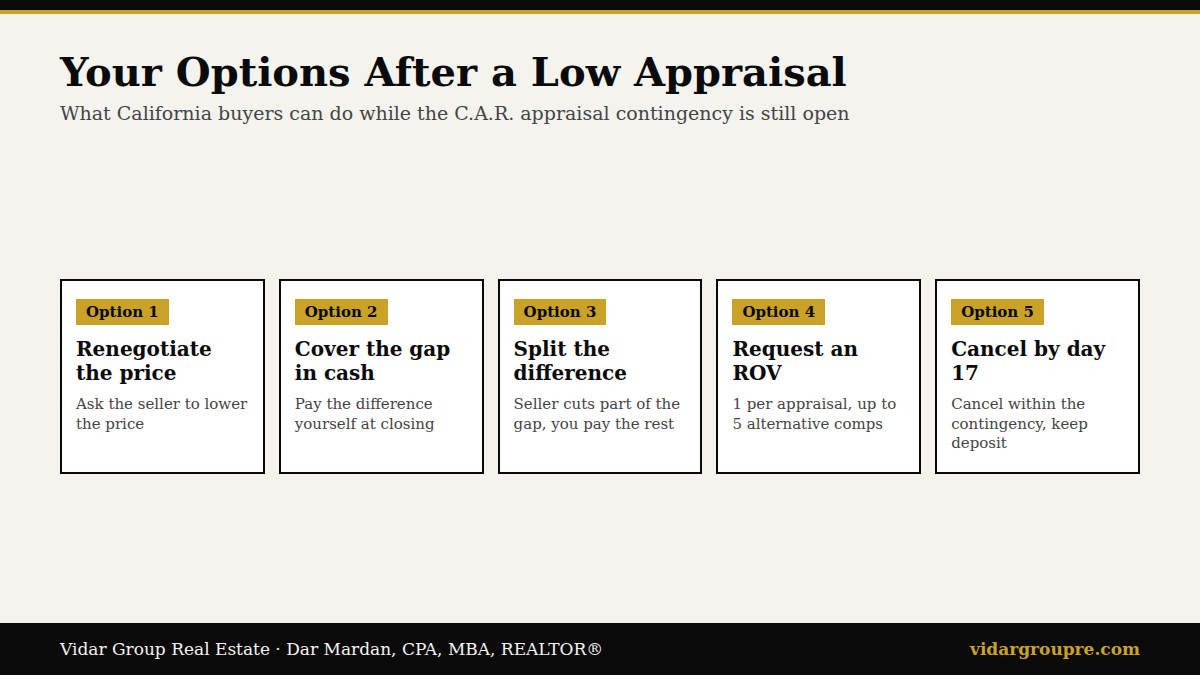
1. Renegotiate the Price
The most common path is asking the seller to reduce the price to the appraised value or meet you partway. A seller who knows the next buyer's lender will likely see a similar appraisal has good reason to negotiate. Put any agreement in a written amendment before your contingency deadline.
2. Cover the Gap in Cash
If you love the home and have the funds, you can pay the difference yourself. This keeps the deal on track, but make sure the extra cash does not drain the reserves your lender requires you to have left after closing.
3. Split the Difference
Many low-appraisal negotiations end in the middle: the seller reduces the price by part of the gap, and the buyer brings extra cash for the rest.
4. Request a Reconsideration of Value
If you believe the appraiser missed something, such as a better comparable sale or an error in square footage, you can ask your lender for a reconsideration of value (ROV). Under Fannie Mae's borrower-initiated ROV requirements, which took effect in 2024, you get 1 ROV per appraisal, you can submit up to 5 alternative comparable sales with an explanation, and the lender must tell you how the process works when it delivers the appraisal. ROVs are not allowed after closing.
Your agent can help pull stronger comparable sales and point out factual errors. Keep it factual: an ROV that simply asks for a higher number rarely succeeds.
5. Cancel Within the Contingency
If none of those work, and your appraisal contingency is still open, you can cancel and generally get your deposit back. Once you have removed the contingency, that option is gone, and walking away could put your deposit at risk.
Appraisal Gap Clauses in Competitive Orange County Markets
In multiple-offer situations, some buyers promise to cover part or all of any appraisal shortfall. A California real estate law firm's explanation of appraisal gaps describes common approaches: the buyer covers the full gap, covers it up to a set dollar amount or splits it with the seller. Removing the appraisal contingency outright means you take on the full risk.
A capped gap guarantee, such as covering up to $50,000 over appraised value, can make an offer stand out without exposing you to unlimited risk. Before you offer one, confirm with your lender how much cash you would need if the gap is triggered, and make sure you still meet reserve requirements. Our guides to savvy buyer strategies in Orange County and competing with cash buyers on a low down payment cover other ways to strengthen an offer.
Jumbo Loans and Second Appraisals
Much of coastal Orange County is jumbo territory. As of September 2026, the 2026 conforming loan limit is $832,750 for most of the country, with a high-cost ceiling of $1,249,125, which is the limit that applies in Orange County according to FHFA's county-level loan limit file. Loans above that are jumbo loans with lender-specific rules.
Jumbo lenders often require more appraisal scrutiny. Some lenders require 2 appraisals on loans of $1,500,000 or more, and the underwriter uses the lower of the 2 values, as explained in this lender's article on jumbo appraisal requirements. Thresholds vary by lender, so ask early. A second appraisal can add time, so build that into your contingency period on a Newport Coast or Corona del Mar purchase. Our guide to jumbo pre-approval in Newport Beach goes deeper on financing at this level.
When There Is No Appraisal at All
On some conforming loans, Fannie Mae may accept the value without an appraisal. Under its value acceptance program, eligible purchases of primary residences and second homes can qualify up to 90% loan-to-value, but homes with a purchase price or estimated value of $1,000,000 or more are not eligible. In most of coastal Orange County, you should expect a full appraisal.
Tips for Sellers: Helping the Appraisal Go Smoothly
Sellers cannot influence the appraiser's opinion, but they can make sure the appraiser has the facts.
- Price with the appraisal in mind. A list price supported by recent sales is the best protection. Our guide to pricing strategy that sells homes fast explains the approach.
- Prepare a list of upgrades. Include dates and approximate costs for major work such as a new roof, HVAC, windows or a remodel. Your agent can provide it for the appraiser.
- Have permits ready. Documented, permitted improvements are easier to value.
- Handle visible maintenance. Peeling paint, broken fixtures or safety items can draw attention in the report. Our guide on what to fix before selling helps you prioritize.
- Provide access. Make sure the appraiser can reach every room, the attic access, the garage and the yard.
- Share relevant sales. Your agent can provide recent comparable sales, especially pending or off-market data the appraiser might not see.
Frequently Asked Questions About Home Appraisals in California
How long does an appraisal take in Orange County?
Timing depends on appraiser workload, the property and the loan type, so ask your lender for an estimate when you apply. Make sure the appraisal is ordered right after acceptance so you have time to respond before your appraisal contingency deadline.
Who pays for the appraisal in California?
The buyer usually pays, as part of the loan costs. The lender orders it and the buyer is entitled to a free copy.
Can I choose my own appraiser?
Not for a mortgage. Appraiser independence rules require the lender, or an appraisal management company it uses, to select the appraiser. The lender will not accept an appraisal from an appraiser the borrower selected or paid.
What is the default appraisal contingency in California?
Under the C.A.R. purchase agreement, it is 17 days after acceptance, unless the parties change it. The loan contingency is 21 days by default. Both must be removed in writing.
Can I challenge a low appraisal?
Yes. You can request 1 reconsideration of value per appraisal through your lender on Fannie Mae loans, supported by up to 5 alternative comparable sales and a clear explanation of the errors.
Does a low appraisal mean I overpaid?
Not necessarily. Appraisals rely on past sales, which can lag a rising market. But it is a signal to review the comparable sales carefully before deciding whether to pay more.
Do cash buyers need an appraisal?
No lender, no required appraisal. Some cash buyers order one anyway for peace of mind, and the purchase agreement terms determine whether an appraisal contingency applies.
Do jumbo loans need 2 appraisals?
Some do. Some lenders require a second appraisal on larger loans, such as $1,500,000 or more, and use the lower value. Ask your lender about its threshold before you write an offer.
Is an appraisal the same as a home inspection?
No. An appraisal estimates value for the lender. An inspection evaluates the home's condition for you. You need both.
Plan for the Appraisal Before You Write the Offer
The best time to prepare for a low appraisal is before it happens: knowing the comparable sales, choosing the right contingency terms and knowing how much cash you could add if needed. Dar Mardan, CPA, MBA, and REALTOR® with Real Broker, and the Vidar Group Real Estate team help buyers and sellers in Newport Beach, Corona del Mar, Newport Coast, Irvine and Mission Viejo price, negotiate and structure offers with the appraisal in mind.
Schedule a complimentary consultation with Dar Mardan.
This article is general information about California real estate and mortgage practice, not legal, lending or financial advice. Contract forms, lending guidelines and loan limits change, and every transaction is different. Consult a licensed lender, California real estate attorney or financial professional about your situation.
Categories
- All Blogs (86)
- Buy home (12)
- buy home insurance (2)
- buyer agent (1)
- divorce (6)
- downsizing (24)
- estate planning (17)
- Estate Real estate (6)
- First time home buyer (7)
- home buying advice (6)
- Home buying tips (16)
- Home inspection (3)
- Home Inspections and Repairs (2)
- home insurance (1)
- home selling advice (15)
- Home Selling Tips (46)
- Home upgrades (2)
- how to sell your home (13)
- Lower home insurance cost (2)
- Lower insurance premiums (1)
- market update (4)
- Newport Center (3)
- Orange county homes (66)
- Pre Listing Preparation (7)
- probate sale (5)
- proposition 19 (4)
- Realtor tips (13)
- Rental Income (1)
- retirement planning (19)
- ROI upgrades (2)
- seller agent (1)
- Selling tips (9)
- transfer tax basis (2)
Recent Posts