
Orange County Property Taxes: Prop 13, Supplemental Bills and Mello-Roos
Photo: T M on Unsplash

How are property taxes calculated in Orange County?
In Orange County, California, you pay a 1% base tax on your assessed value plus voter-approved debt and any special assessments. Prop 13 resets that value when you buy and caps yearly increases at 2%.
If you are moving to Orange County from another state, California's property tax system can feel backwards. Your tax is not based on what your home is worth today. It is based on what you paid for it, plus a small capped increase each year. That is why 2 identical houses on the same Irvine street can have very different tax bills.
The system has a few surprises, too. New owners get extra bills that their lender will not pay. Many newer neighborhoods carry Mello-Roos special taxes on top of the base tax. And the bills come on a fiscal-year schedule that confuses almost everyone the first time.
This guide explains how Orange County property taxes actually work: Prop 13, reassessment when you buy, supplemental bills, installment dates, Mello-Roos, the homeowners' exemption, decline-in-value reviews, and how to read the bill itself.
Prop 13: The Foundation of California Property Taxes
Almost everything about your Orange County tax bill traces back to Proposition 13, which California voters passed in 1978. It set 2 core rules.
The 1% Base Rate Plus Voter-Approved Debt
According to the California State Board of Equalization, the statewide property tax rate is 1% of assessed value plus whatever rate is needed to repay local voter-approved bonds. In Orange County, those bond rates are mostly for school, community college and water districts. The Orange County Auditor-Controller's 2025-26 tax rate book lists the basic levy at 1.00000% for every tax rate area, with bond rates stacked on top that vary by location.
In practice, that means your total ad valorem rate in Orange County lands a little above 1%, depending on which school, college and water districts serve your address. Newport Beach, Irvine and Mission Viejo each sit in different tax rate areas, so the exact rate differs.
The 2% Annual Cap
Once your home has an assessed value, it can rise by no more than 2% per year for inflation, even if market values climb much faster. The Orange County Assessor ties that increase to the California Consumer Price Index, capped at 2%.
For the 2026-27 tax year, the cap applies in full. The Board of Equalization's inflation factor letter reports that the California CPI rose 3.307%, so assessors apply the maximum factor of 1.02, a 2% increase.
Reassessment When You Buy
Prop 13's protection belongs to the owner, not the house. When the home changes hands, the assessed value resets.
Your Purchase Price Becomes Your New Base
The Orange County Assessor's guide for buyers and sellers explains that most sales trigger reassessment, setting a new base year value equal to market value at the time of transfer. In most arm's-length sales, that is close to the price you paid. New construction also triggers reassessment of the added portion.
This is why a longtime owner in Corona del Mar might pay a fraction of what a new buyer next door pays. When you budget for a purchase, never assume the seller's current tax bill is what you will pay. Estimate from your own purchase price.
A Quick Example
Say you buy a Mission Viejo home for $1,200,000. At a 1% base rate, the general levy alone is $12,000 a year, before voter-approved bonds, Mello-Roos or other special assessments. If the prior owner's assessed value was $500,000, their base tax was about $5,000. That $7,000-a-year difference is what the supplemental bill system is designed to capture, prorated for the rest of the fiscal year.
Certain transfers can avoid reassessment or carry a base value to a new home under Proposition 19, including some parent-to-child transfers and transfers by homeowners 55 and older. We cover those rules in our Prop 19 guide and our parent-to-child transfer explainer.
Supplemental Tax Bills: The Surprise After You Close
This is the part of California property tax that catches the most new owners off guard.
What Triggers a Supplemental Bill
When you buy, the Assessor calculates the difference between your new assessed value and the prior owner's value. The Assessor's supplemental assessment page explains that the extra tax is prorated from the transfer date to the end of the fiscal year on June 30. Depending on when you close, you may receive 1 or 2 supplemental bills. If the new value is lower than the old one, you may get a refund instead.
Your Lender Will Not Pay It
Even if you have an impound account, supplemental bills go to you. The OC Treasurer-Tax Collector states that supplemental taxes cannot be sent to a lender for payment, so making sure they are paid is on you. The same page notes you have 60 days from the assessment notice to appeal the value, and that appealing does not pause the payment deadline.
The Prior Owner's Bill May Show Up Too
Your first regular annual bill may still show the previous owner's name and value. The Treasurer's property tax guide for new homeowners makes clear you still need to pay it. Escrow prorates the current-year taxes at closing, and the supplemental bill then covers the difference between the old and new values.
Set money aside for supplemental bills from the day you close. Our buyer closing costs guide and first-time buyer monthly cost breakdown show how taxes fit into your full budget.
Orange County Property Tax Due Dates
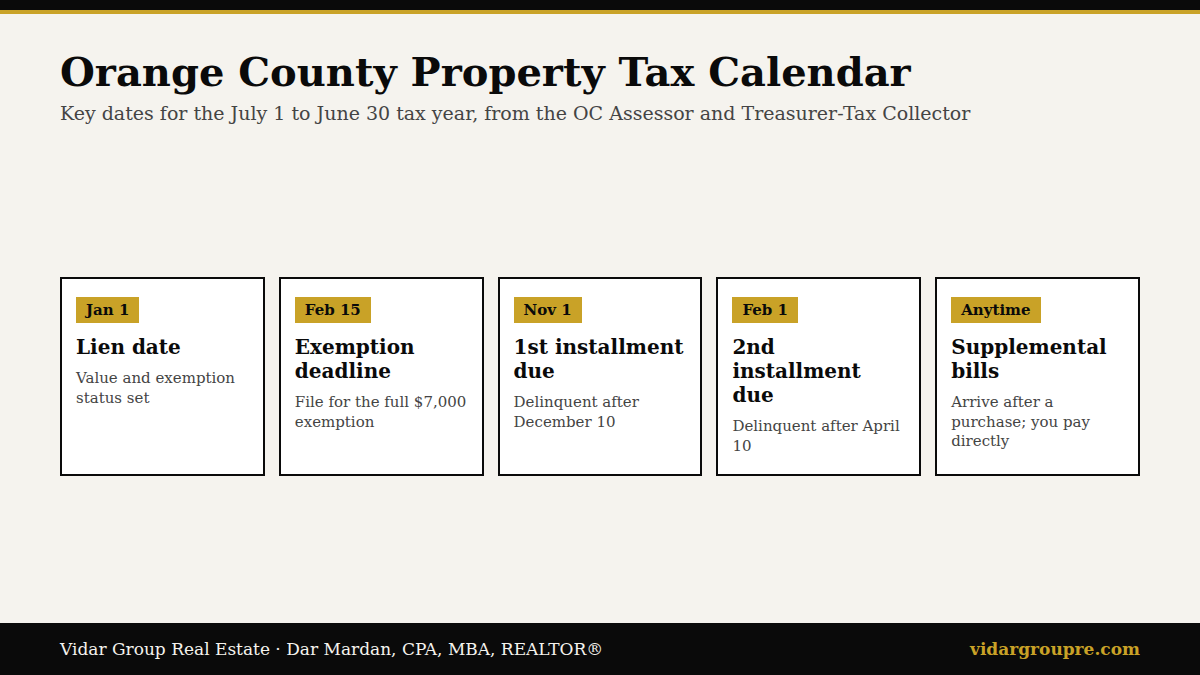
California's property tax year runs July 1 through June 30. The regular annual bill, called the secured bill, is paid in 2 installments.
| Installment | Due | Delinquent after |
|---|---|---|
| 1st installment | November 1 | December 10 |
| 2nd installment | February 1 | April 10 |
Those dates come from the OC Treasurer-Tax Collector's secured property tax page. The Treasurer's 2025-26 bill insert lists a 10% penalty on a late first installment, and a 10% penalty plus a $23 fee on a late second installment. If either is still unpaid by July 1, a $15 fee applies, plus interest of 1.5% a month on the unpaid balance. You can pay the full year with the first installment if you prefer.
Supplemental bills follow their own schedule, with due dates tied to the date the bill is issued, so read each one carefully.
Mello-Roos and Special Assessments
Mello-Roos is one of the most common reasons 2 similar Orange County homes have very different tax bills, especially in Irvine.
What Mello-Roos Is
The Mello-Roos Community Facilities Act of 1982 lets local agencies form Community Facilities Districts, or CFDs, to finance schools, fire protection, libraries and other public infrastructure in developing areas. Property owners in the district repay those bonds through a special tax that is added to the regular property tax bill. As the San Diego County Assessor's Mello-Roos overview explains, the act leaves it to each district to decide how the special tax is spread, and many base it on the benefit a parcel receives, such as a new home's square footage. That makes it different from the value-based 1% levy.
Why It Matters in Irvine
Many of Irvine's newer villages were built with CFD financing. The City of Irvine's page on the Great Park Community Facilities Districts explains that the charge there can increase by up to 2% per year, and that after the bonds are repaid, typically over 40 years, the charge drops by 65% to 82% but a portion continues indefinitely for maintenance. Every CFD has its own rules, so never assume a Mello-Roos tax will simply end.
Seller Disclosure
California requires sellers to disclose these taxes. Under Civil Code Section 1102.6b, a seller must make a good-faith effort to obtain a notice of special tax from the levying agencies, covering Mello-Roos and 1915 Act assessments, and deliver it to the buyer. The recorded special tax lien also appears on the preliminary title report during escrow. HOA dues are separate from Mello-Roos. Our guide to HOA fees in Orange County covers those.
Other Special Assessments and Fixed Charges
Your bill may also include other fixed charges levied by local agencies, and, if a past owner used it, PACE financing for energy improvements, which the Treasurer's new homeowner guide lists alongside Mello-Roos. These are not a percentage of value, and each one lists a phone number for the agency that sets it.
The Homeowners' Exemption: $7,000 Off Your Assessed Value
If the home is your principal residence, file for the homeowners' exemption. It is small, but it is free money every year.
- Amount: The California Constitution provides a $7,000 reduction in the taxable value of a qualifying owner-occupied home.
- Savings: The Orange County Assessor puts the savings at at least $70 per year.
- Eligibility: You must own and occupy the home as your principal residence on January 1.
- Deadline: File by February 15 for the full $7,000. If you miss that, filing by December 10 still gets you 80%, or $5,600.
- How to file: New owners automatically receive a claim form in the mail after purchase. File the state form, BOE-266, with the Assessor.
If you sell or move out, notify the Assessor by December 10 to end the exemption and avoid penalties.
Prop 8: When Market Value Falls Below Your Assessed Value
Prop 13 caps how fast your assessed value rises. Proposition 8 protects you when values fall.
How Decline-in-Value Works
Each January 1, the Assessor compares your Prop 13 value with your home's market value and taxes you on the lower of the 2. The Assessor's decline-in-market-value page notes that under these reductions, the taxable value can move up or down by more than 2% in a year. When values recover, your assessment is restored up to your factored Prop 13 value, and the 2% cap applies again from there.
How to Request a Review
If similar homes sold for less than your assessed value around January 1, you can request an informal review from the Assessor. The Assessor accepts these requests between January 1 and April 30 each year. If you disagree with the result, you can file a formal appeal with the Assessment Appeals Board. The OC Clerk of the Board sets the regular filing period from July 2 through November 30.
Recent buyers who paid near the peak of a local market are the ones who benefit most from watching this each year.
How to Read an Orange County Property Tax Bill
You can look up your bill online through the OC Treasurer-Tax Collector using your address or Assessor's Parcel Number (APN). Here is what to look for:
- Assessor's Parcel Number (APN): the unique ID for your property. You need it for payments and appeals.
- Tax Rate Area (TRA): identifies which combination of taxing agencies serves your parcel.
- Assessed values: land, improvements, any exemptions, and the net taxable value.
- General tax levy: the 1% base tax on net taxable value.
- Voter-approved taxes: school, college and water bond rates, listed by agency.
- Fixed charges and special assessments: Mello-Roos, PACE and other flat charges, each with a phone number for the agency that levies it.
- Installment stubs: the 2 payment amounts and their due dates.
If a fixed charge looks unfamiliar, call the agency listed next to it. The Treasurer collects those charges but does not set them.
Frequently Asked Questions About Orange County Property Taxes
What is the property tax rate in Orange County?
The base rate is 1% of assessed value countywide, plus voter-approved bond rates that vary by tax rate area. Most Orange County addresses end up with a total ad valorem rate slightly above 1%. Mello-Roos and fixed charges are added separately.
Will my property taxes go up every year?
Under Prop 13, your assessed value can rise by no more than 2% a year while you own the home. For the 2026-27 tax year, the inflation factor is the full 2%. Voter-approved bonds and special charges can change separately.
Why did I get a supplemental tax bill?
Because your purchase reset the assessed value. The supplemental bill covers the difference between your new value and the prior owner's value, prorated to June 30. Your lender will not pay it from your impound account.
When are Orange County property taxes due?
The first installment is due November 1 and becomes delinquent after December 10. The second is due February 1 and becomes delinquent after April 10.
Does Mello-Roos ever go away?
It depends on the district. Some CFDs end when the bonds are repaid. Others, like Irvine's Great Park CFDs, drop significantly after the bonds are paid but continue at a lower level for maintenance.
How do I find out if a home has Mello-Roos?
Look at the current tax bill for special tax line items, review the seller's notice of special tax, and read the preliminary title report. Ask your agent for these early, before your investigation contingency ends.
How much does the homeowners' exemption save?
It removes $7,000 from your assessed value, which the Orange County Assessor says saves at least $70 a year. You must live in the home as your principal residence on January 1 and file by February 15 for the full amount.
Can I appeal my property taxes if values drop?
Yes. You can request an informal Prop 8 review from the Assessor between January 1 and April 30. You can also file a formal appeal with the Assessment Appeals Board between July 2 and November 30.
Do I pay the seller's property taxes at closing?
Escrow prorates the current year's taxes between buyer and seller based on the closing date. After closing, you pay the regular bill and any supplemental bills. Our California escrow guide explains how prorations work.
Can I keep my old tax base when I move?
In some cases. Proposition 19 allows homeowners 55 and older and certain other groups to transfer a base year value to a replacement home, with conditions. See our Prop 19 guides linked above for the details.
Know Your Tax Bill Before You Buy
Property taxes are one of the largest ongoing costs of owning a home in Orange County, and they are the easiest to underestimate. Dar Mardan, CPA, MBA, and REALTOR® with Real Broker, and the Vidar Group Real Estate team help buyers and sellers in Newport Beach, Corona del Mar, Newport Coast, Irvine and Mission Viejo estimate the real tax bill, including supplemental taxes and Mello-Roos, before you make an offer.
Schedule a complimentary consultation with Dar Mardan.
This article is general information about California property taxes, not legal or tax advice. Tax rates, deadlines and exemption rules change, and every property is different. Consult the Orange County Assessor, the OC Treasurer-Tax Collector or a qualified tax professional about your situation.
Categories
- All Blogs (90)
- Buy home (12)
- buy home insurance (2)
- buyer agent (1)
- divorce (6)
- downsizing (24)
- estate planning (18)
- Estate Real estate (6)
- First time home buyer (10)
- home buying advice (6)
- Home buying tips (19)
- Home inspection (3)
- Home Inspections and Repairs (2)
- home insurance (1)
- home selling advice (15)
- Home Selling Tips (47)
- Home upgrades (2)
- how to sell your home (13)
- Lower home insurance cost (2)
- Lower insurance premiums (1)
- market update (4)
- Newport Center (3)
- Orange county homes (70)
- Pre Listing Preparation (7)
- probate sale (5)
- proposition 19 (4)
- Realtor tips (13)
- Rental Income (1)
- retirement planning (19)
- ROI upgrades (2)
- seller agent (1)
- Selling tips (9)
- transfer tax basis (2)
Recent Posts