1031 Exchanges in California: Rules, Deadlines and the Clawback
Photo: Ariel Blanco on Unsplash

How does a 1031 exchange work in California?
You sell investment or business real estate, a qualified intermediary holds the proceeds, and you buy like-kind property within 45 and 180 days. California follows the federal deferral but tracks gain on out-of-state swaps.
A 1031 exchange is one of the most useful tools a California real estate investor has. It lets you sell a rental or business property, roll the proceeds into another property and defer the capital gains tax that would otherwise be due. For an owner who bought a Newport Beach duplex or an Irvine condo rental decades ago, that deferral can mean the difference between reinvesting all of the equity and handing a large share of it to the IRS and the Franchise Tax Board.
It is also easy to get wrong. The deadlines are strict, the money has to be handled a certain way, and California adds reporting and withholding rules that generic articles skip. This guide covers the federal rules, boot and debt, reverse and improvement exchanges, and the California items: the FTB Form 3840 "clawback," Form 593 withholding and converting a rental into your home.
What a 1031 Exchange Is (and What It Is Not)
Under Internal Revenue Code Section 1031, you do not pay tax on the gain when you trade business or investment real estate for other like-kind real estate that you will also hold for business or investment. The tax is deferred, not forgiven. Your old basis carries over into the new property, so the gain waits inside the replacement property until you sell it in a taxable sale.
The IRS itself warns taxpayers to be wary of anyone who calls a like-kind exchange "tax-free." Its fact sheet on Section 1031 exchanges describes the deferral accurately: you can postpone tax, and if you receive cash, debt relief or non-like-kind property, you may trigger some taxable gain.
What Qualifies as Like-Kind Real Property
"Like-kind" is broader than most people expect. According to the IRS's real estate tax tips on like-kind exchanges, real properties are generally like-kind whether improved or unimproved. A Costa Mesa fourplex can be exchanged for a Mission Viejo single-family rental, a piece of raw land or a small commercial building, as long as each one is held for business or investment.
Since January 1, 2018, only real property qualifies. The Tax Cuts and Jobs Act removed equipment, vehicles, artwork and other personal property from Section 1031. And U.S. real property is not like-kind to real property outside the United States, so you cannot exchange an Orange County rental for a villa abroad.
What Does Not Qualify
- Your primary residence. The IRS fact sheet is explicit that a primary home, a second home or a vacation home used primarily for personal purposes does not qualify.
- Property held primarily for sale. Section 1031(a)(2) excludes it, which is why fix-and-flip properties generally do not work.
- Partnership interests and personal property. These are not real property for exchange purposes.
For vacation homes that are also rented, there is a middle ground. In Revenue Procedure 2008-16, the IRS created a safe harbor: you owned the dwelling for at least 24 months before the exchange, and in each of the 2 12-month periods before the exchange you rented it at a fair rental for at least 14 days while limiting personal use to the greater of 14 days or 10% of the days rented. A similar test applies to the replacement property for the 24 months after the exchange. Falling outside the safe harbor does not automatically disqualify a property, but it removes the certainty.
The Two Deadlines: 45 Days and 180 Days
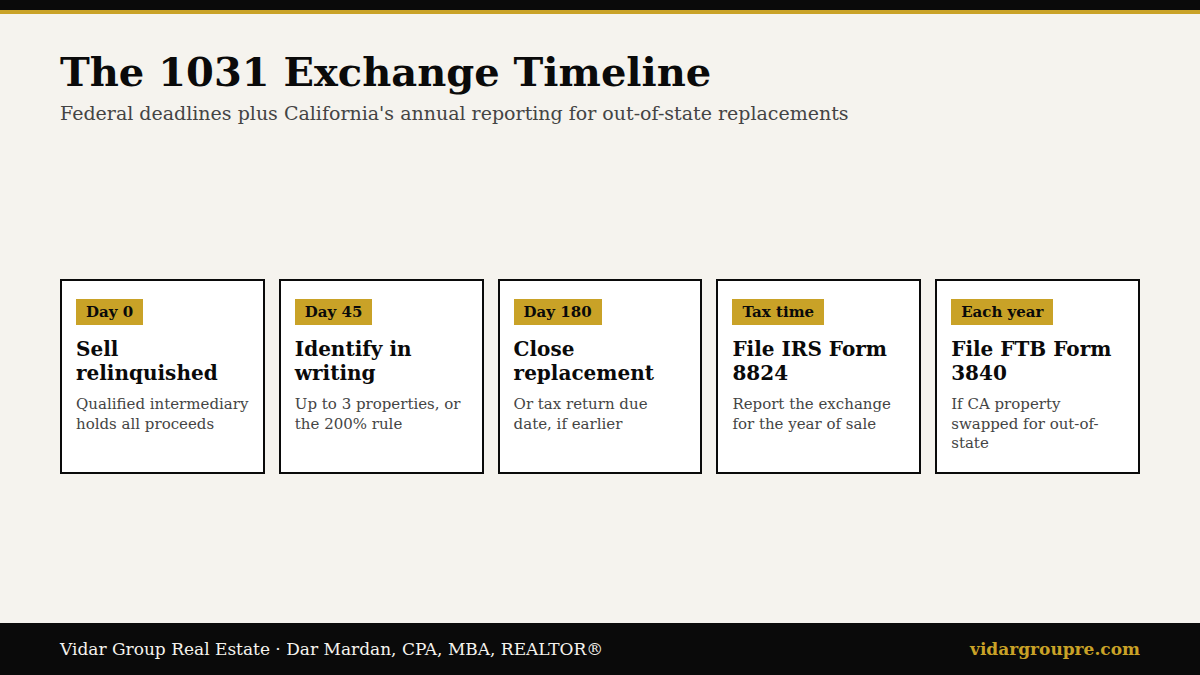
Most California exchanges are "deferred" exchanges: you sell first and buy later. Section 1031(a)(3) sets two clocks that both start on the day you transfer the property you are giving up, called the relinquished property.
Day 45: Identify Replacement Property in Writing
Within 45 days, you must identify potential replacement properties in a written document that you sign and deliver to your qualified intermediary or another party to the exchange who is not a disqualified person. The Treasury regulations on deferred exchanges limit how many properties you can name:
- 3-property rule: up to 3 properties of any value.
- 200% rule: any number of properties, as long as their combined fair market value does not exceed 200% of the value of the property you sold.
- 95% rule: if you exceed both limits, the identification is still valid only if you actually acquire at least 95% of the total value you identified.
The 3-property rule is the simplest to work with. Name backups, because a property you did not identify cannot be used later.
Day 180 (or Your Tax Return Due Date): Close
You must receive the replacement property by the earlier of 180 days after the sale or the due date, including extensions, of your tax return for the year of the sale. The Form 8824 instructions repeat this "earlier of" rule. If you sell late in the year, your return may be due before day 180, so extend it to keep the full window. The IRS fact sheet also requires you to report every exchange on Form 8824 with your return for the year of the sale. The days are calendar days, and weekends and holidays count.
The Qualified Intermediary: Why You Cannot Touch the Money
If you receive the sale proceeds, or even have the right to receive them, the exchange generally fails. The IRS fact sheet explains that using a qualified intermediary to hold the proceeds until the exchange is complete is one way to avoid premature receipt of cash. The intermediary receives the proceeds at closing and uses them to acquire the replacement property for you.
Who can serve matters. Under the regulations, a qualified intermediary cannot be you or a "disqualified person," which generally includes anyone who acted as your agent in the 2 years before the exchange, such as your real estate agent, attorney or accountant, as well as certain related parties. So your own CPA or REALTOR® cannot hold your exchange funds. Put the intermediary in place before the sale closes, and include exchange-cooperation language in both purchase agreements. Once escrow closes without an exchange agreement, it is too late. Our California escrow guide explains how the escrow side works.
California Regulates Exchange Facilitators
California is one of the states with specific rules for exchange facilitators. Under California Financial Code Section 51003, a facilitator must maintain a fidelity bond of at least $1,000,000, deposit at least $1,000,000 in cash, securities or letters of credit, or hold all exchange funds in a qualified escrow account or trust. Ask how your facilitator meets this requirement before you sign.
Boot, Debt and Replacement Value
"Boot" is anything you receive in an exchange that is not like-kind real property. Under Section 1031(b), you recognize gain up to the amount of cash and the fair market value of other property you receive. Boot does not kill the exchange. It just makes part of the gain taxable now.
Cash Boot
Leftover cash returned by the intermediary, or money you take out at the sale closing, is boot. Paying certain non-transaction items, like prorated rents, out of exchange funds can also create boot, so review the settlement statement with your tax advisor.
Mortgage Boot
Debt counts too. IRS Publication 544 treats a liability of yours that the other party assumes as money you received. The Form 8824 instructions net liabilities: liabilities relieved on the property you sold are reduced by liabilities you take on, cash you pay and the value of other property you give up. If the loan on your replacement property is smaller than the loan paid off on the property you sold, and you do not add cash to make up the difference, the shortfall is taxable boot.
The Practical Rule for Full Deferral
To defer all of the gain, most investors aim to:
- Buy replacement property of equal or greater value than the property sold, net of selling costs.
- Reinvest all of the net exchange proceeds.
- Replace any debt paid off with new debt or with additional cash of your own.
| Example (illustrative) | Amount |
|---|---|
| Irvine rental sold, net of selling costs | $1,500,000 |
| Mortgage paid off at sale | $400,000 |
| Net proceeds held by intermediary | $1,100,000 |
| Replacement property price | $1,600,000 |
| New loan on replacement | $500,000 |
| Cash boot / mortgage boot | $0 / $0 |
All $1,100,000 is reinvested and the new loan exceeds the one paid off, so there is no boot.
Reverse and Improvement Exchanges
Reverse Exchanges
Sometimes the right replacement property appears before your current property sells. In a reverse exchange, an exchange accommodation titleholder takes title to the replacement property, or to the property you are selling, and "parks" it. Revenue Procedure 2000-37 sets out the safe harbor: a written agreement within 5 business days after the titleholder acquires the property, identification of the relinquished property within 45 days, and completion within 180 days. They need more cash or financing up front.
Improvement (Build-to-Suit) Exchanges
An improvement exchange uses the same parking structure so that exchange funds can pay for construction or renovation on the replacement property before you take title. Generally, only improvements completed while the titleholder holds the property, within the 180-day window, count toward the value you need to reinvest. Work done after you take title does not count, so plan the construction schedule realistically.
California Rules You Will Not Find in a Generic 1031 Article
California conforms to Section 1031 for real property, so a valid federal exchange generally defers state tax too. That deferral matters more here than in many states, because the FTB's page on capital gains and losses confirms that California has no lower rate for capital gains and taxes them as ordinary income. But the state adds 3 important items.
FTB Form 3840: The California "Clawback"
If you exchange California property for property outside California, California keeps its claim on the gain. For taxable years beginning on or after January 1, 2014, the Form FTB 3840 instructions require every taxpayer who makes this kind of exchange, resident or not, to file Form 3840 for the year of the exchange and every later year until the California-source deferred gain is recognized. The instructions cite Revenue and Taxation Code Sections 18031.5, 18032 and 24953.
Investors call this the "clawback" because the gain from a Newport Beach rental you traded for a building in Arizona or Texas is still taxed by California when you eventually sell that out-of-state property, even if you have moved away. The FTB's Publication 1100 on nonresidents and part-year residents explains that the realized gain is sourced to California and taxed when it is ultimately recognized. If you exchange again, the filing carries forward. And the FTB's page on reporting like-kind exchanges warns that if you do not file, it may issue a Notice of Proposed Assessment for the deferred gain plus penalties and interest.
Form 593 Withholding on an Exchange
California generally requires withholding of 3 1/3% of the sales price when real property is sold, unless an exemption applies. According to the Form 593 instructions, a deferred 1031 exchange is initially exempt, and you certify that on Form 593 during escrow. But the intermediary must withhold 3 1/3% of the sales price if the exchange fails, and it must withhold on boot if more than $1,500 is distributed to you. For more on how withholding and gain work on an outright sale, see our guide to capital gains, FIRPTA and California withholding.
Property Taxes Reset on the Replacement Property
A 1031 exchange is an income tax concept. It does nothing for property tax. Your replacement property is a change in ownership, so the Orange County Assessor will reassess it at its purchase price under Proposition 13. Our Orange County property tax guide explains how that new base is set and what supplemental bills to expect.
Moving Into a Replacement Property: The Section 121 Rules
A common plan is to exchange into a rental in, say, Corona del Mar, rent it for a while, then move in and eventually sell using the home-sale exclusion of $250,000 ($500,000 for married couples filing jointly). It can work, but the rules are layered.
- Hold the replacement as an investment first. Buying replacement property with the intent to move in right away undermines the exchange. Rev. Proc. 2008-16's 24-month rental test is a useful benchmark.
- The 5-year rule. IRS Publication 523 says you cannot claim the home-sale exclusion if you acquired the home in a like-kind exchange and sell it within 5 years of that acquisition.
- Nonqualified use. Periods after 2008 when the home was not your principal residence generally reduce the gain you can exclude, with certain exceptions.
- Depreciation. Gain equal to depreciation claimed after May 6, 1997 cannot be excluded.
Run a written projection before you move in. Our post on the tax math of selling or keeping a long-held Newport Beach home shows how the exclusion and basis interact, and our guide to cost basis on a $4M Newport Beach sale walks through what adds to basis.
Other Rules Worth Knowing
- Related parties. If you exchange with a related party and either of you disposes of the property within 2 years, the Form 8824 instructions say the deferred gain generally becomes taxable in the year of that disposition.
- Same taxpayer. The taxpayer who sells must be the taxpayer who buys. If your rental is held in an LLC taxed as a partnership, the LLC must acquire the replacement. Changing how title is held mid-exchange can break it.
Frequently Asked Questions About 1031 Exchanges in California
Can I do a 1031 exchange on my primary home in California?
No. A primary residence, and a second home used mainly for personal purposes, does not qualify. Your primary home may qualify for the separate Section 121 exclusion instead.
Can the 45-day or 180-day deadline be extended?
Generally, no. The deadlines are set by statute, and weekends and holidays count. The only other limit is that the 180-day window ends early at your tax return due date unless you file an extension.
Do I have to buy a property of the same type?
No. Real property is generally like-kind to other real property, improved or unimproved. A rental condo can be exchanged for land or a commercial building, as long as both are held for investment or business use.
What happens if I cannot find a replacement property?
The exchange fails and the sale is taxed as a regular sale. For California purposes, the intermediary must withhold 3 1/3% of the sales price on a failed exchange.
Is there a minimum holding period for a 1031 property?
Section 1031 sets no fixed period. The test is intent to hold for investment or business use, and for dwellings the 24-month safe harbor is a common benchmark.
Can I exchange my California rental for a property in another state?
Yes. But you must file FTB Form 3840 every year until the California-source deferred gain is recognized, and California will tax that gain when you eventually sell, even if you no longer live here.
Can my CPA or real estate agent act as my qualified intermediary?
No. Anyone who acted as your agent within the prior 2 years, including your accountant, attorney or real estate agent, is generally a disqualified person. Use an independent intermediary.
Does a 1031 exchange avoid property tax reassessment?
No. The replacement property is a change in ownership and will be reassessed under Proposition 13. A 1031 exchange only defers income tax.
What happens to the deferred gain when I die?
Under Section 1014, heirs generally take a basis equal to fair market value at death, which can eliminate the deferred gain. Our step-up in basis guide explains how this works in California.
Plan the Exchange Before You List
Most failed exchanges fail before the property is ever listed: no intermediary in place, no realistic replacement target, or a closing date that runs into tax season. Dar Mardan, CPA, MBA, and REALTOR® with Real Broker, and the Vidar Group Real Estate team help investors sell and buy investment property in Newport Beach, Corona del Mar, Newport Coast, Irvine and Mission Viejo, coordinating the sale, the replacement search and the timeline with your tax advisor and intermediary.
Schedule a complimentary consultation with Dar Mardan.
This article is general information about federal and California tax rules for like-kind exchanges, not tax, legal or investment advice, and it does not create a client relationship. Tax laws and FTB forms change, and every exchange depends on its facts. Consult your own CPA, tax attorney and qualified intermediary before selling investment property.
Categories
- All Blogs (86)
- Buy home (12)
- buy home insurance (2)
- buyer agent (1)
- divorce (6)
- downsizing (24)
- estate planning (17)
- Estate Real estate (6)
- First time home buyer (7)
- home buying advice (6)
- Home buying tips (16)
- Home inspection (3)
- Home Inspections and Repairs (2)
- home insurance (1)
- home selling advice (15)
- Home Selling Tips (46)
- Home upgrades (2)
- how to sell your home (13)
- Lower home insurance cost (2)
- Lower insurance premiums (1)
- market update (4)
- Newport Center (3)
- Orange county homes (66)
- Pre Listing Preparation (7)
- probate sale (5)
- proposition 19 (4)
- Realtor tips (13)
- Rental Income (1)
- retirement planning (19)
- ROI upgrades (2)
- seller agent (1)
- Selling tips (9)
- transfer tax basis (2)
Recent Posts