
LESS HOUSE. MORE LIFE.
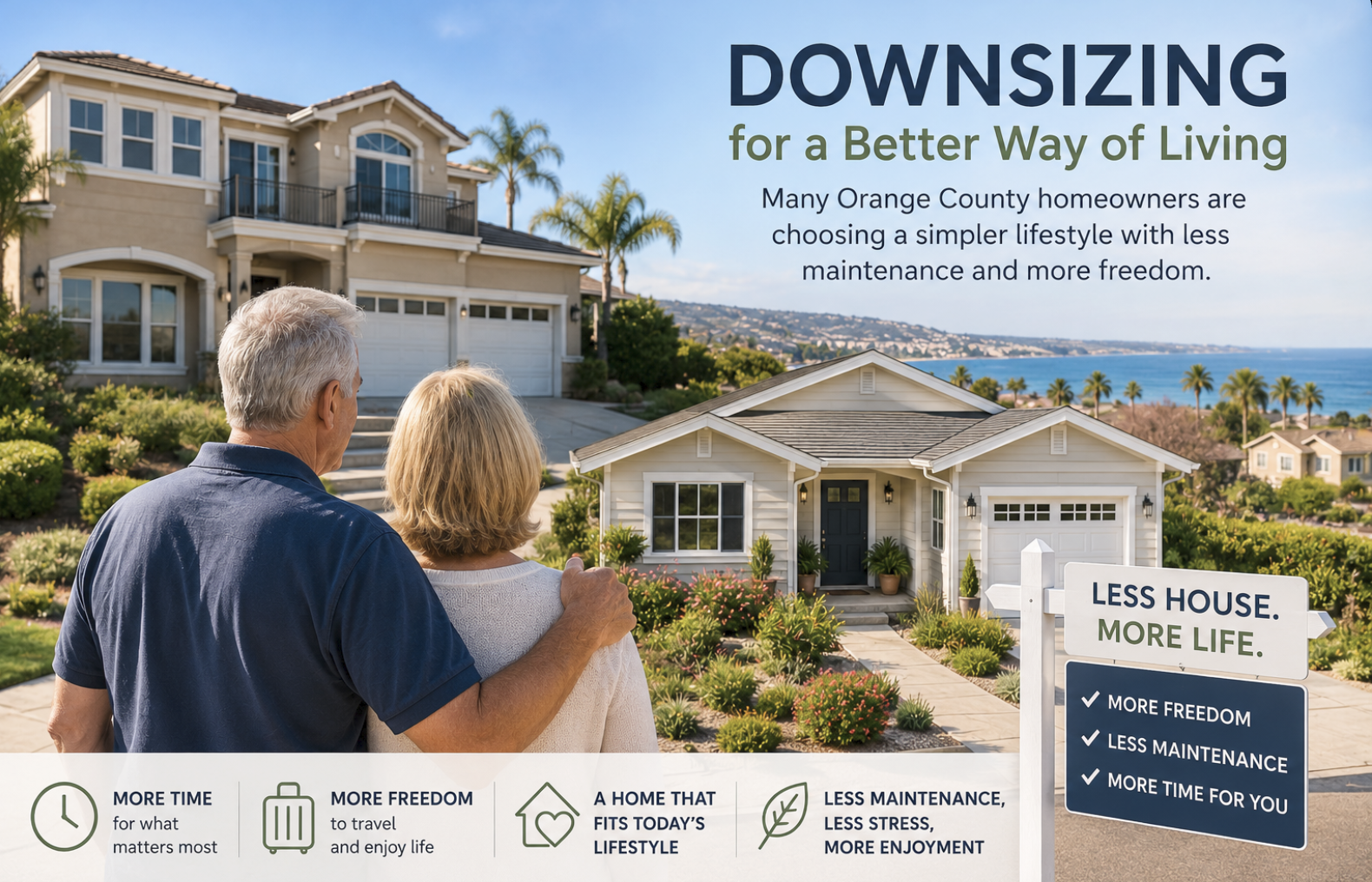
Why Downsizing Can Give Orange County Homeowners More Freedom
For years, the goal was often more house.
More bedrooms. More bathrooms. A bigger yard. More room for the kids. More space for family gatherings. Maybe a pool, a three-car garage, a formal dining room, an office, and enough storage for everything a growing family could possibly accumulate.
And for that stage of life, it may have been exactly the right home.
But eventually, life changes.
The children grow up. The house gets quieter. Rooms that were once constantly occupied sit unused. Weekends that were spent at soccer games and family activities are replaced by travel, grandchildren, hobbies, friends, or simply wanting more time for yourself.
And that is when a different question starts to become important:
Do I still need all this house—or would I enjoy my life more with less of it?
Downsizing isn't necessarily about sacrificing comfort, giving up a beautiful home, or moving into something dramatically smaller.
For many Orange County homeowners, it is about something much more valuable:
Less house to maintain.
Less responsibility.
More flexibility.
More freedom.
More life.
Downsizing Is Not About Giving Something Up
The word downsizing can sound negative.
It can make people think:
"I'm moving backward."
"I'm giving up the house I worked so hard for."
"A smaller home means I'm lowering my standard of living."
I don't think that's the right way to look at it.
The real goal is not necessarily to own fewer square feet.
The goal is to own the right amount of home for the life you live today.
There is an enormous difference.
A beautifully designed 1,800-square-foot single-level home that you use every day may provide a better lifestyle than a 4,000-square-foot two-story home where half the rooms remain closed.
A condominium close to restaurants, the beach, family, shopping, or recreation may improve your daily life even if it has fewer bedrooms.
A smaller home with less maintenance might make it easier to lock the door and travel for three weeks without worrying about the pool, landscaping, roof, sprinklers, exterior maintenance, or the list of projects waiting when you return.
Downsizing your home does not mean downsizing your life.
Done correctly, it can mean exactly the opposite.
1. Less House Can Mean More Time
One of the most overlooked costs of owning a large home isn't money.
It's time.
Large homes require attention.
There is landscaping.
There are rooms to clean.
There are windows, plumbing fixtures, appliances, flooring, HVAC systems, roofs, gutters, exterior surfaces, irrigation systems, fences, pools, patios, and dozens of other things that eventually need maintenance or replacement.
Even if you don't personally perform the work, someone has to coordinate it.
You call the contractor.
You meet the plumber.
You wait for the pool company.
You schedule the gardener.
You get estimates.
You deal with the repair.
You follow up when the repair wasn't done correctly.
A home can quietly become another job.
At some point, you may decide that your Saturday morning is worth more than maintaining a backyard you rarely use.
You may decide you would rather spend that time traveling, exercising, meeting friends, seeing grandchildren, walking to dinner, or doing absolutely nothing.
That isn't giving up.
That's choosing how you want to spend your time.
A smaller home can give you back something you cannot buy more of: your time.
2. More Freedom to Travel
This is one of the biggest lifestyle benefits I hear from homeowners considering downsizing.
They want to travel.
But leaving a large detached home for weeks at a time can involve a surprising amount of preparation.
Who's checking the house?
Who's dealing with the landscaping?
What happens if there's a plumbing leak?
What if the pool equipment stops working?
What if something happens while you're away?
A lower-maintenance property—particularly a well-managed condominium, townhome, or smaller property—can potentially provide much more of a lock-the-door-and-go lifestyle.
That's especially appealing to homeowners who want to spend more time traveling, visiting family, maintaining a second residence, or simply having the ability to leave without a long checklist.
Of course, HOA living comes with its own considerations.
You need to understand:
-
Monthly HOA dues
-
What the association maintains
-
Insurance responsibilities
-
Reserve funding
-
Special assessments
-
Rules and restrictions
-
Mello-Roos or other assessments
-
Any planned major community expenditures
So the answer isn't automatically "buy a condo."
The answer is to find the type of property that gives you the balance of privacy, convenience, cost, and freedom you actually want.
3. You Can Choose Location Over Square Footage
When you were raising a family, your real estate priorities may have looked very different.
You may have chosen a neighborhood because of:
-
Schools
-
A large yard
-
Cul-de-sac location
-
Multiple bedrooms
-
Play areas
-
Parks
-
Space for children
-
Commuting distance to work
Those priorities may no longer control your decision.
Your next home might instead be about:
-
Walkability
-
Restaurants
-
Beach access
-
Golf
-
Shopping
-
Medical facilities
-
Friends
-
Adult children
-
Grandchildren
-
Travel convenience
-
Recreation
-
Less driving
-
A neighborhood you simply enjoy
This is where downsizing can become exciting.
Instead of asking:
"How much house can I buy?"
you can start asking:
"Where do I actually want to live?"
For some Orange County homeowners, that could mean trading a larger inland home for something smaller closer to Newport Beach, Corona del Mar, Costa Mesa, Irvine, Dana Point, or another community that better fits the lifestyle they want today.
For others, it may mean staying in the same city or even the same neighborhood but moving into a single-level home with fewer maintenance demands.
The important point is this:
Your next home doesn't have to solve the problems you had 25 years ago. It should solve the problems you have today.
4. A Smaller Home Can Still Feel Bigger Where It Matters
Square footage can be misleading.
I've seen large homes that feel chopped up and smaller homes that feel open, bright, and incredibly comfortable.
What often matters more is usable space.
Consider the difference between:
A 3,500-square-foot house with:
-
Formal living room
-
Formal dining room
-
Four secondary bedrooms
-
Upstairs bonus room
-
Large unused yard
-
Multiple hallways
versus a well-designed 1,800- to 2,200-square-foot home with:
-
Open kitchen
-
Large living area
-
Primary suite
-
Guest room
-
Office
-
Outdoor patio
-
Good storage
-
Single-level living
The second home may technically be much smaller.
But it might fit your actual lifestyle better.
That's why I prefer the term right-sizing in many conversations.
You're not simply trying to find a smaller home.
You're trying to eliminate space you don't need while protecting the space that matters.
5. Your Home Equity May Give You Options
Many longtime Orange County homeowners have substantial equity in their homes.
That creates choices.
But I don't recommend making a downsizing decision based simply on:
"My home is worth $2 million."
The number that matters is what you actually have available after the transaction.
You need to understand:
-
Realistic selling price
-
Mortgage payoff, if any
-
Selling expenses
-
Negotiated brokerage compensation
-
Title and escrow costs
-
Preparation or repair costs
-
HOA-related charges
-
Other transaction expenses
-
Potential tax consequences
Our guide to what it costs to sell a house in Orange County explains the major categories sellers should consider before estimating their proceeds.
Once you have an estimated net number, you can begin asking much better questions.
Could you purchase your replacement home without a mortgage?
Could you reduce your mortgage substantially?
Would money remain available for retirement reserves?
Could you increase your liquidity?
Would you have more freedom to travel?
Could the move reduce future maintenance expenses?
Would you rather keep more of your net worth outside the house?
Those are financial-planning questions, and they should be discussed with your CPA, financial advisor, lender, or other appropriate professional when necessary.
But the real estate conversation should help you understand the numbers well enough to have those discussions intelligently.
Don't begin with "What can I sell for?"
Begin with:
"What would my life and finances look like after the move?"
6. Proposition 19 May Change the Property-Tax Conversation
One of the biggest reasons longtime California homeowners hesitate to move is property taxes.
Someone may have purchased a home decades ago and now has a relatively low assessed value under Proposition 13.
Naturally, they worry that purchasing another home will cause their property taxes to reset completely based on today's value.
For some homeowners, California Proposition 19 can materially change that conversation.
Under Proposition 19, qualifying homeowners who are at least 55 years old may transfer the taxable value of their primary residence to a qualifying replacement primary residence elsewhere in California. Eligible homeowners can generally make this type of transfer up to three times, subject to the applicable requirements.
The replacement primary residence generally must be purchased or newly constructed within two years of the sale of the original primary residence.
And the replacement property can have a higher market value than the property being sold. When it does, the amount above the applicable value of the original property can affect the new taxable value.
For Orange County homeowners, the Orange County Assessor provides information about transferring base-year value to a replacement home.
We also have a more detailed guide explaining Proposition 19, who qualifies, how the tax-basis transfer works, and how to avoid surprises.
This does not mean every homeowner will keep exactly the same total property-tax bill after moving.
The new property may have different special assessments, Mello-Roos, bonds, or other charges.
That's why I recommend determining the likely property-tax impact before committing to the move.
Don't stay in a home you no longer want simply because you assume moving will destroy your property-tax advantage.
Run the numbers first.
7. Capital Gains Should Be Part of the Plan
Another issue longtime homeowners need to understand is capital gains.
If your Orange County home has appreciated substantially, don't assume that every dollar of appreciation will automatically be tax-free.
Under current federal law, qualifying homeowners may exclude up to $250,000 of gain, or up to $500,000 for qualifying married couples filing jointly, on the sale of a main residence. Eligibility depends on IRS requirements, including ownership and use tests and other conditions.
You can review the current IRS guidance on selling your home and IRS Publication 523.
But your taxable gain is not necessarily calculated by simply subtracting the price you paid decades ago from today's selling price.
Your adjusted basis may be affected by qualifying improvements and other factors, and circumstances such as rental use or depreciation can complicate the calculation.
That's why I recommend that homeowners with substantial appreciation involve their CPA or tax professional before selling, not after escrow closes.
As Realtors, we can help establish realistic market value, selling expenses, and estimated proceeds.
Your tax professional should determine your tax liability.
When those conversations happen together, you can make a much more informed decision.
8. You Don't Have to Remodel Everything Before You Move
For homeowners who have lived in a property for 20 or 30 years, one thing can make downsizing feel overwhelming:
"Before we sell, we have to fix this entire house."
Usually, you don't.
Your home may need preparation.
It may benefit from painting, cleaning, decluttering, repairs, lighting changes, landscaping, staging, or other improvements.
But there is a big difference between preparing a property strategically and remodeling the entire house for the next owner.
The first question should be:
What actually matters to buyers?
Not:
What could theoretically be upgraded?
Before spending heavily, I prefer to evaluate the home and separate the work into three categories:
Fix the problems that create buyer fear
Leaks, electrical issues, damaged systems, obvious deferred maintenance, and other defects can create uncertainty during inspections.
Improve the items that materially affect presentation
Fresh paint, lighting, cleaning, landscaping, decluttering, and selective improvements can sometimes dramatically change how buyers perceive a home.
Leave alone what doesn't justify the cost
A perfectly functional kitchen doesn't automatically need to be demolished because its finishes aren't brand new.
Our guide to doing a pre-listing inspection and fixing what actually matters explains this approach in more detail.
You may also want to read Selling Your Home Isn't One Step—It's Three, which explains how preparation, marketing, and successfully navigating escrow work together.
The goal isn't to create a brand-new house.
The goal is to prepare your existing home intelligently and protect your net proceeds.
9. The Emotional Side of Downsizing Is Real
This part doesn't appear on a spreadsheet.
A longtime home may contain decades of memories.
It's where your children grew up.
There may be marks on a doorway showing how tall they were each year.
You may remember holidays, birthdays, graduations, family dinners, neighbors, pets, and thousands of ordinary moments that became part of your life.
Selling the house can feel like selling those memories.
But you're not.
The memories don't belong to the house. They belong to you.
You can appreciate everything the home represented and still recognize that it may have completed its job.
It gave your family what you needed during one chapter.
Your next home can serve the next one.
That is why I don't believe homeowners should be pressured into downsizing.
There is no age when you're supposed to leave.
If you love your home, use it, can comfortably maintain it, and want to stay there, staying may be exactly the right decision.
But if you're staying primarily because leaving feels emotionally difficult, that's worth recognizing too.
There is a difference between:
"I want to live here."
and:
"I don't know how to leave."
10. Don't Let the Stuff Make the Decision for You
This one deserves its own section.
I've spoken with homeowners who are ready for a smaller home but feel trapped because of everything they've accumulated.
Twenty or thirty years in a house creates a lot of belongings.
Closets fill up.
The garage fills up.
Children leave things behind.
Furniture that hasn't been used in years remains because there is room for it.
Boxes get moved from one corner to another.
Eventually, homeowners think:
"Moving would be great, but I can't deal with all this stuff."
Don't allow possessions you don't use to determine where you spend the next 10 or 20 years of your life.
You don't need to solve everything in one weekend.
Start gradually.
Create categories:
-
Keep
-
Give to family
-
Sell
-
Donate
-
Store
-
Discard
Start with one room.
Then another.
If necessary, professional organizers, estate-sale companies, donation services, movers, and junk-removal companies can help with the physical work.
The important thing is to separate two decisions:
Do I want to move?
and:
How do I deal with everything in the house?
The second problem has solutions.
It shouldn't automatically answer the first question for you.
11. Sometimes a Smaller Home Costs More—and That Can Still Make Sense
This surprises people.
You may sell a larger home and discover that the smaller replacement property you really want isn't dramatically cheaper.
In Orange County, location matters enormously.
A smaller property in Newport Beach, Corona del Mar, Irvine, or another highly desirable community may cost as much as—or even more than—a larger home somewhere else.
Does that mean downsizing failed?
Not necessarily.
Remember the purpose of the move.
If your only goal is to reduce your purchase price, then yes, the math needs to accomplish that.
But if your goal is:
-
Better location
-
Less maintenance
-
Single-level living
-
Walkability
-
More travel
-
Less responsibility
-
Proximity to family
-
A more enjoyable daily lifestyle
then the purchase price is only one part of the decision.
Less house does not always mean spending less money.
Sometimes it means using your housing dollars differently.
12. Make the Decision Before You Have to Make the Decision
One of the best things you can have when considering a major move is time.
If you begin planning while you are healthy, comfortable, financially stable, and under no pressure, you have choices.
You can explore neighborhoods.
You can wait for the right replacement home.
You can evaluate your current property.
You can declutter gradually.
You can consult your CPA.
You can understand Proposition 19.
You can compare buying first with selling first.
You can prepare your home properly.
You can decide not to move at all.
That last point matters.
Exploring downsizing does not obligate you to downsize.
It simply gives you information.
If you're beginning to wonder whether your current home still fits your life, read our companion article, 7 Signs It May Be Time to Downsize Your Orange County Home.
It provides a practical checklist for recognizing when the conversation may be worth having.
Less House vs. More Life: What Are You Really Trading?
| What You May Give Up | What You May Gain |
|---|---|
| Unused bedrooms | Less cleaning and maintenance |
| Large yard | More free weekends |
| Pool maintenance | Easier travel |
| Extra storage | Less accumulated clutter |
| Multiple floors | Easier everyday living |
| Large repair obligations | More predictable maintenance |
| Space designed for children | Space designed for your current life |
| More property responsibility | More flexibility |
| Equity tied up in unused space | Potential financial options |
| The house you've always known | A home designed for your next chapter |
Not every item will apply to every homeowner.
But that's exactly the point.
Downsizing should never be an automatic decision based on age.
It should be a personal comparison between what your current home gives you and what it requires from you.
Frequently Asked Questions About Downsizing in Orange County
Is downsizing really cheaper?
Not always.
A smaller property can still be expensive depending on its location, condition, amenities, HOA fees, property taxes, and financing.
The right comparison is not simply square footage or purchase price.
Compare total annual housing expenses, expected maintenance, your estimated net proceeds from the current home, and the lifestyle each property provides.
Does downsizing mean moving to a condo?
No.
Downsizing could mean moving to a smaller detached home, a single-level residence, townhome, condominium, 55+ community, or simply a property with a more functional layout.
The goal is not a particular property type.
The goal is finding a home that fits your current priorities.
Should I stay in Orange County when I downsize?
That depends entirely on your lifestyle.
Some homeowners want to remain close to their current community, friends, doctors, family, and familiar surroundings. Others want to move closer to children or explore another part of California.
If Proposition 19 is part of your plan, qualifying homeowners may transfer their base-year value to a qualifying replacement residence anywhere in California, subject to the program's requirements.
You can review the current rules directly through the California Board of Equalization's Proposition 19 information.
Can I keep my low property-tax basis when I move?
Qualifying homeowners age 55 or older may be able to transfer their taxable base-year value under Proposition 19, subject to eligibility requirements.
The Orange County Assessor's replacement-home information explains the rules for Orange County homeowners and the applicable claim process.
Does my replacement home have to cost less under Proposition 19?
No.
A qualifying replacement property can have a greater market value than the original property, although additional taxable value may be added based on the difference under the applicable Proposition 19 rules.
You can review the current requirements through the California Board of Equalization.
Will I owe capital gains tax when I sell?
Possibly.
The IRS currently allows qualifying homeowners to exclude up to $250,000 of gain, or up to $500,000 for qualifying married couples filing jointly, subject to the applicable requirements.
Your individual calculation can depend on adjusted basis, improvements, depreciation, prior use, and other circumstances.
Review the IRS guidance on selling your home and consult your CPA or tax advisor before selling.
Should I sell first or buy my replacement home first?
Both approaches have advantages.
Selling first gives you certainty about your proceeds, but it can create pressure to find another home quickly.
Buying first may give you a smoother transition, but it requires a plan for financing or temporarily owning both properties.
The best approach depends on your financial resources, the market, and availability of the type of replacement property you want.
How early should I start planning to downsize?
Earlier than you think.
You can begin exploring your options six months, one year, or even several years before moving.
Early planning gives you time to understand value, taxes, replacement-home costs, property preparation, financing, and what you want your next lifestyle to look like.
Should I completely remodel before selling?
Usually, no.
Some homes need meaningful work, but major renovations should be evaluated carefully before money is spent.
Start with the items that affect buyer confidence, marketability, and presentation.
Our guide to pre-listing inspections and avoiding unnecessary panic upgrades explains the approach.
What is the first step if I'm only thinking about downsizing?
Start with information—not a listing agreement.
Understand:
What your current home is realistically worth.
What you would likely net after selling.
What your replacement options cost.
How Proposition 19 may affect you.
Whether capital gains need to be discussed with your CPA.
And what your monthly and annual costs might look like afterward.
Once you understand those numbers, you can decide whether moving actually improves your life.
The Bottom Line
There comes a point when more house isn't necessarily more life.
The extra bedrooms don't matter if nobody uses them.
The large backyard isn't a benefit if maintaining it has become a burden.
The pool isn't an amenity if you're constantly servicing it.
And thousands of square feet aren't valuable simply because they're there.
What matters is whether your home supports the life you want to live now.
Maybe the answer is to stay.
Maybe the answer is a smaller single-level home five minutes away.
Maybe it's a townhome close to your children.
Maybe it's a condo near the beach.
Maybe it's a completely different community.
There isn't one correct version of downsizing.
But there is one principle I believe strongly:
Your home should serve your life. Your life shouldn't revolve around serving your home.
That's what LESS HOUSE. MORE LIFE. really means.
If your current home has given your family everything you needed for the last 20 or 30 years, you don't have to view leaving it as losing something.
You can look at it as completing one chapter successfully—and choosing the home that makes the next chapter easier, freer, and more enjoyable.
Start With the Numbers—Then Decide
At Vidar Group Real Estate, we help Orange County homeowners evaluate the entire downsizing decision before they commit to selling.
That includes looking at:
-
Realistic value of your current home
-
Estimated seller net proceeds
-
Property preparation
-
Repairs that matter—and those that don't
-
Replacement-home options
-
Proposition 19 considerations
-
Selling first versus buying first
-
Timing both transactions
-
Coordinating contractors and vendors
-
Preparing and marketing the property
For tax, legal, estate-planning, or financial questions, we encourage homeowners to involve their CPA, attorney, lender, or appropriate professional as part of the planning process.
If you're thinking about downsizing but you're not sure whether it makes sense yet, schedule a complimentary appointment with Vidar Group Real Estate.
There is no obligation to sell.
We can start with the numbers, explore the options, and let you decide what comes next.
About Dar Mardan
Dar Mardan leads Vidar Group Real Estate, helping longtime homeowners, empty nesters, retirees, and families make confident decisions during life's next chapter.
Whether a sale involves downsizing, Proposition 19, a trust, probate, divorce, inherited property, or a home that needs work before going on the market, Dar and the team take a hands-on, full-service approach to organize the details, coordinate trusted vendors, prepare and market the property, and guide clients through their options with patience and care.
Vidar Group Real Estate
Real Broker
Dar Mardan, REALTOR® | DRE #02121982
714-612-3870
dar@vidargroupre.com
Equal Housing Opportunity. Dar Mardan is a licensed Realtor regulated by the California Department of Real Estate. This article is provided for general informational purposes only and is not legal, tax, accounting, investment, or financial advice. Laws, tax rules, costs, rates, real estate practices, and program requirements may change. Confirm information applicable to your circumstances with the appropriate attorney, CPA, tax advisor, lender, escrow officer, county assessor, or other qualified professional before making a decision.
Categories
- All Blogs (63)
- Buy home (12)
- buy home insurance (2)
- buyer agent (1)
- divorce (5)
- downsizing (17)
- estate planning (12)
- Estate Real estate (6)
- First time home buyer (5)
- home buying advice (6)
- Home buying tips (8)
- Home inspection (3)
- Home Inspections and Repairs (2)
- home insurance (1)
- home selling advice (15)
- Home Selling Tips (34)
- Home upgrades (2)
- how to sell your home (13)
- Lower home insurance cost (2)
- Lower insurance premiums (1)
- market update (3)
- Newport Center (1)
- Orange county homes (46)
- Pre Listing Preparation (7)
- probate sale (4)
- proposition 19 (4)
- Realtor tips (13)
- Rental Income (1)
- retirement planning (10)
- ROI upgrades (2)
- seller agent (1)
- Selling tips (9)
- transfer tax basis (2)
Recent Posts