
2-1 Buydown vs. Price Cut: The Smarter Way to Sell Your Orange County Home in 2026
Watch the full breakdown in the video above.
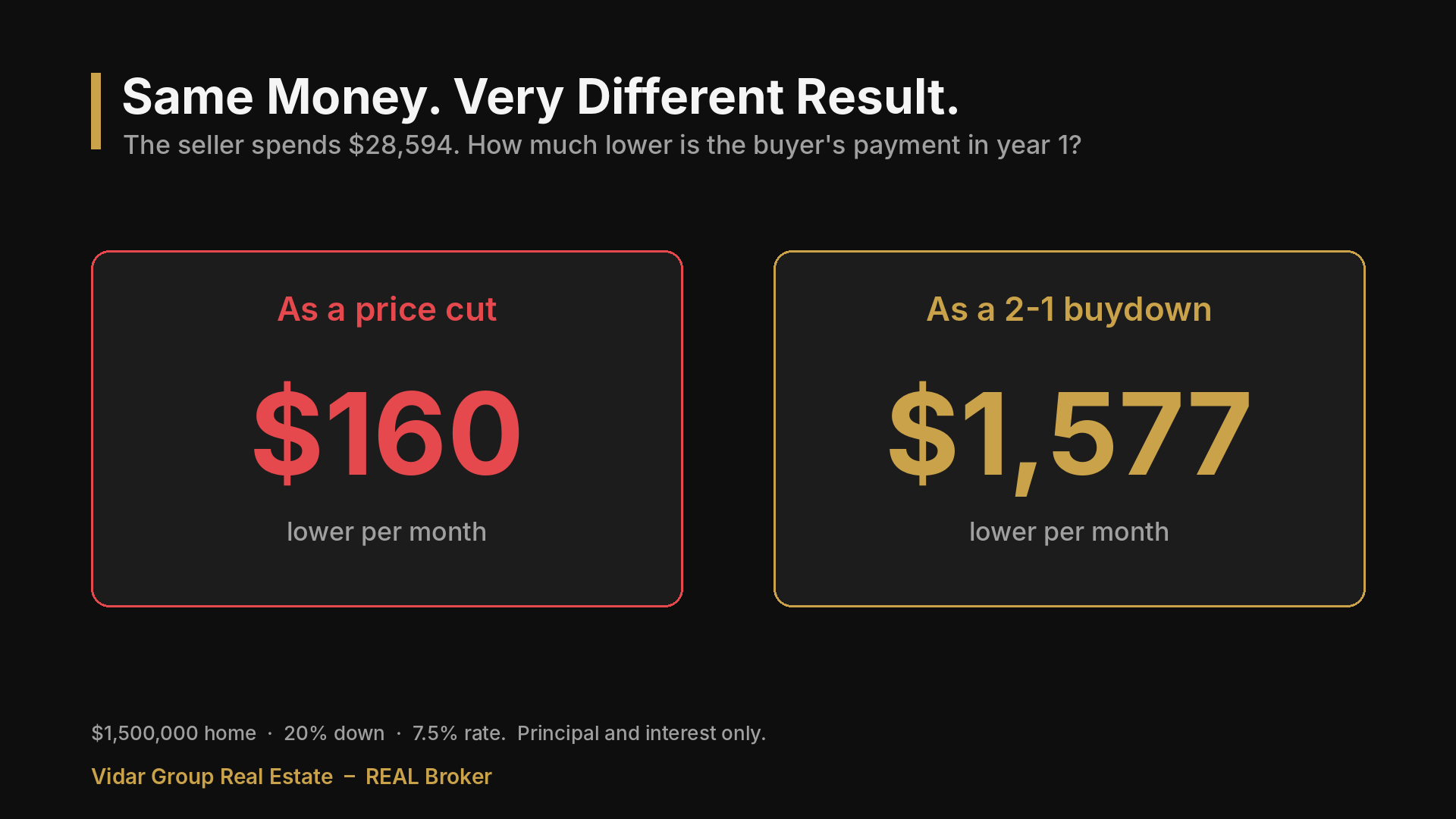
Is a 2-1 buydown better than a price cut when you sell your Orange County home?
Usually, yes. On a $1,500,000 home, a $28,594 price cut lowers the buyer's payment by about $160 a month. The same money as a 2-1 buydown lowers it by $1,577 a month in year 1.
Mortgage rates just climbed back above 7%. Freddie Mac's weekly survey put the 30-year fixed at 7.28% on October 1, 2026, up from 6.34% a year earlier. If you're planning to sell in Newport Beach, Irvine or anywhere in Orange County this fall, you're now selling to buyers who feel every one of those points in their monthly payment.
When a home sits, most sellers reach for the same tool: a price cut. This post shows you why that's often the most expensive way to get a buyer, and what to offer instead. We'll walk through the real math on a $1,500,000 home, what happens to the money if rates drop and your buyer refinances, and the one rule your buyer's lender will check before any of it can happen.
Why Higher Rates Change How You Should Sell
Rates in the low 6s a year ago and the 7s today mean fewer buyers qualify, more escrows fall apart, and homes take longer to sell. We covered the bigger picture in what the 20-year high in Treasury yields means for Orange County and how interest rates move Orange County home prices.
Here's the part most sellers miss: buyers don't buy a price. They buy a payment. A buyer pre-approved at a certain monthly number doesn't care much whether your home is listed at $1,500,000 or $1,470,000. They care whether the payment fits.
That doesn't mean price stops mattering. Your home still has to be priced right to get attention in the first place, which is why the pricing strategy that sells homes fast is always step 1. But once your price is right, the next dollar you give up should go toward the buyer's payment, not the price.
What Is a 2-1 Buydown?
A 2-1 buydown is a temporary rate reduction paid for by the seller. At closing, you give the buyer a credit. That money goes into an account that covers part of their mortgage payment for the first 2 years.
- Year 1: the buyer's rate is 2% lower than their note rate.
- Year 2: the rate is 1% lower.
- Year 3 to 30: the buyer pays the full note rate.
The buyer's loan itself never changes. The note shows the full rate, and the buydown account simply pays the difference each month. Lenders also qualify the buyer at the full note rate, not the lower starting rate, so nobody is stretched into a loan they can't afford once the buydown ends.
The Math on a $1,500,000 Orange County Home
Here's a realistic example. The purchase price is $1,500,000. The buyer puts 20% down, which is $300,000, so the loan is $1,200,000 on a 30-year fixed at 7.5%. That loan is just under Orange County's 2026 high-balance conforming limit of $1,249,125, so standard Fannie Mae and Freddie Mac rules apply.
| Year | No buydown | With a 2-1 buydown | Buyer saves |
|---|---|---|---|
| Year 1 | $8,391 (7.5%) | $6,813 (5.5%) | $1,577 a month, $18,925 for the year |
| Year 2 | $8,391 (7.5%) | $7,585 (6.5%) | $806 a month, $9,669 for the year |
| Year 3 to 30 | $8,391 (7.5%) | $8,391 (7.5%) | None |
| 2-year total | None | $28,594 seller's cost | $28,594 buyer's savings |
Principal and interest only. Taxes, insurance and HOA dues are not included.
Notice the bottom row. The buydown costs you, the seller, $28,594, which is less than 2% of the price. Every dollar of it goes straight to your buyer in lower payments.
Price Cut vs. 2-1 Buydown: Same Money, Very Different Result
Now take that same $28,594 and use it as a price cut instead. The price drops to about $1,471,400. With 20% down, the buyer's loan drops by about $22,900, and their monthly payment drops by about $160.
| Seller spends $28,594 as... | Buyer's payment in year 1 |
|---|---|
| A price cut | About $160 a month lower |
| A 2-1 buydown | $1,577 a month lower |
That's almost 10 times the payment relief for the same money out of your pocket. To a buyer scrolling listings, $160 a month is invisible. $1,577 a month is the difference between "we can't afford that one" and "let's go see it."
A price cut does have one lasting benefit: the lower payment lasts all 30 years instead of 2. But $160 a month is small, and a price cut also resets how buyers see your home. A reduced listing can look like something is wrong with it. A buydown keeps your price intact and gives you a story to market.
What Happens If Rates Drop and the Buyer Refinances?
This is the part most agents never explain, and it's what makes a buydown so easy to sell to buyers.
If rates come down and your buyer refinances during the first 2 years, the unused buydown money doesn't disappear. Under Fannie Mae's Selling Guide, when the loan is paid off early, the remaining funds are credited toward the payoff, or returned to the borrower or lender as the buydown agreement specifies.
| If the buyer refinances after | Unused buydown money |
|---|---|
| 6 months | $19,132 |
| 12 months | $9,669 |
| 18 months | $4,835 |
| 24 months | $0 (fully used) |
So the buyer can't lose. If rates stay high, they get 2 years of lower payments while they settle in. If rates drop, they refinance, and the leftover money still goes toward their loan. One caution: don't assume it comes back as cash. The buydown agreement decides how it's handled, so read it before closing.
Ask about rate-drop refinance programs
Some lenders now offer reduced-cost or even no-fee refinancing if rates drop within the first few years after a purchase. These are usually a few thousand dollars in waived fees, not a free loan, and you typically have to refinance with the same lender. Terms change often, so before choosing a lender, the buyer should ask, "Do you have a rate-drop refinance program, and what exactly does it cover?" Combined with the leftover buydown money, refinancing later can cost very little.
The One Rule Your Buyer's Lender Will Check
Every mortgage program limits how much a seller can pay toward the buyer's costs. Fannie Mae calls these interested party contributions, and a buydown credit counts toward the limit.
| Buyer's down payment (primary home, conventional loan) | Maximum seller contribution |
|---|---|
| Less than 10% | 3% of the price |
| 10% to just under 25% | 6% of the price |
| 25% or more | 9% of the price |
In our example, the buyer puts 20% down, so the ceiling is 6% of $1,500,000, or $90,000. The buydown costs $28,594, so it fits easily. The ceiling covers all seller credits together, so if you're also paying $20,000 toward closing costs, the buydown and that $20,000 together must stay under $90,000.
FHA, VA and jumbo loans have their own rules, so always have the buyer's lender confirm the credit before you promise it. If you're weighing every cost of a sale, our breakdown of what it costs to sell a home in Newport Beach shows where a buydown fits alongside commissions, escrow and transfer taxes.
How to Market a 2-1 Buydown So Buyers Notice
A buydown only works if buyers know about it. Most sellers bury it in the fine print. Here's how to put it out front:
- Lead with the payment. Put the lower monthly payment in the first line of your listing remarks and in your photos' captions.
- Tell buyers' agents directly. Agents searching for clients at a set payment need to know your home now fits.
- Show the year-by-year table. A simple chart like the one above answers the buyer's first question before they ask it.
- Mention the refinance credit. It removes the biggest objection: "What if rates drop next year?"
If your home has already been on the market a while, a buydown can be a better reset than another price drop. We explain the other levers in what must change when your home didn't sell.
When a Price Cut Still Makes Sense
A buydown isn't the answer every time. A price cut may be the better move when:
- Your home is clearly overpriced compared to recent sales. A buydown can't fix that, and buyers' appraisals won't support the price.
- Your likely buyers are paying cash or putting most of the price down, so a lower rate doesn't move them much.
- Your buyer plans to sell again within a couple of years and cares more about the purchase price.
The right answer depends on your home, your price and who's buying in your neighborhood right now. Our post on whether Orange County is a buyer's or seller's market in 2026 can help you read the conditions.
Your Quick Checklist
- Price your home right first. A buydown can't fix an overpriced home.
- Market the payment, not just the price. Put the lower monthly payment right in the listing.
- Offer a 2-1 buydown instead of a price cut. Same money, about 10 times the payment relief.
- Make sure the buyer's loan allows your credit. With 20% down, sellers can usually credit up to 6% of the price.
Getting ready to list? Our 8-week plan for preparing your Orange County home for sale walks you through everything before the sign goes up, and the best time to sell your Newport Beach home covers timing.
Frequently Asked Questions
What is a 2-1 buydown on a mortgage?
A 2-1 buydown lowers the buyer's interest rate by 2% in year 1 and 1% in year 2, then returns to the full rate for the rest of the loan. The seller usually pays for it with a credit at closing, and the money sits in an account that covers part of each monthly payment.
How much does a 2-1 buydown cost the seller?
It depends on the loan amount and rate. On a $1,200,000 loan at 7.5%, it costs about $28,594, or less than 2% of a $1,500,000 price. The buyer saves exactly the same amount over the 2 years.
Is a 2-1 buydown better than a price reduction?
For payment relief, usually yes. In our example, $28,594 as a price cut lowers the buyer's payment by about $160 a month, while the same money as a 2-1 buydown lowers it by $1,577 a month in year 1. A price cut lasts 30 years but is much smaller each month.
What happens to the buydown money if the buyer refinances?
Under Fannie Mae's guidelines, unused funds are credited toward paying off the loan, or returned to the borrower or lender as the buydown agreement specifies. If the buyer in our example refinances after 12 months, about $9,669 is still unused.
What happens to the buydown money if the buyer sells the home early?
Selling pays off the loan, so the same rule applies. The remaining funds are handled as the buydown agreement specifies, usually credited toward the loan payoff.
Does the buyer qualify at the lower rate?
No. Lenders qualify the buyer at the full note rate. The buydown lowers the payment, but it doesn't let a buyer borrow more than they could at the full rate.
How much can a seller contribute toward a buyer's costs?
On a conventional loan for a primary home, Fannie Mae allows 3% of the price with less than 10% down, 6% with 10% to just under 25% down, and 9% with 25% or more down. All seller credits count toward the limit, including a buydown.
What's the difference between a 2-1 and a 3-2-1 buydown?
A 3-2-1 buydown lasts 3 years, starting 3% lower. On the same $1,200,000 loan, it costs about $56,319, nearly twice as much as a 2-1. For most sellers, the 2-1 gives the best payment relief for the money.
Can I offer a buydown on a jumbo loan?
Often yes, but jumbo lenders set their own rules on temporary buydowns and seller credits. In Orange County, a loan above $1,249,125 in 2026 is a jumbo loan, so confirm with the buyer's lender first. Our post on pre-approval in Newport Beach's jumbo market explains how those loans differ.
Do I have to offer the buydown upfront?
No. You can advertise it in your listing to attract buyers, or hold it back and offer it during negotiation instead of a price reduction. Advertising it usually works better, because buyers search and decide based on payment.
Talk Through Your Numbers With a CPA Who Sells Homes
Every home and every buyer is different, and the right mix of price and credits depends on your neighborhood, your timeline and your bottom line. As a CPA and REALTOR®, I run these numbers for sellers every week, including what each option means for your net proceeds and taxes.
I'm Dar Mardan, REALTOR® with Vidar Group Real Estate at REAL Broker, serving Newport Beach, Corona del Mar, Irvine and all of Orange County. If you're planning to sell this fall or early next year, schedule a complimentary strategy call. We'll run the buydown math on your actual home and build it into your marketing.
This article is general information, not financial, tax or legal advice. Mortgage rates, loan limits and lender programs change often. Confirm the details of your transaction with your lender and tax advisor.
References
Categories
- All Blogs (63)
- Buy home (12)
- buy home insurance (2)
- buyer agent (1)
- divorce (5)
- downsizing (17)
- estate planning (12)
- Estate Real estate (6)
- First time home buyer (5)
- home buying advice (6)
- Home buying tips (8)
- Home inspection (3)
- Home Inspections and Repairs (2)
- home insurance (1)
- home selling advice (15)
- Home Selling Tips (34)
- Home upgrades (2)
- how to sell your home (13)
- Lower home insurance cost (2)
- Lower insurance premiums (1)
- market update (3)
- Newport Center (1)
- Orange county homes (46)
- Pre Listing Preparation (7)
- probate sale (4)
- proposition 19 (4)
- Realtor tips (13)
- Rental Income (1)
- retirement planning (10)
- ROI upgrades (2)
- seller agent (1)
- Selling tips (9)
- transfer tax basis (2)
Recent Posts