How Interest Rates Are Shaping Orange County Home Prices in 2026
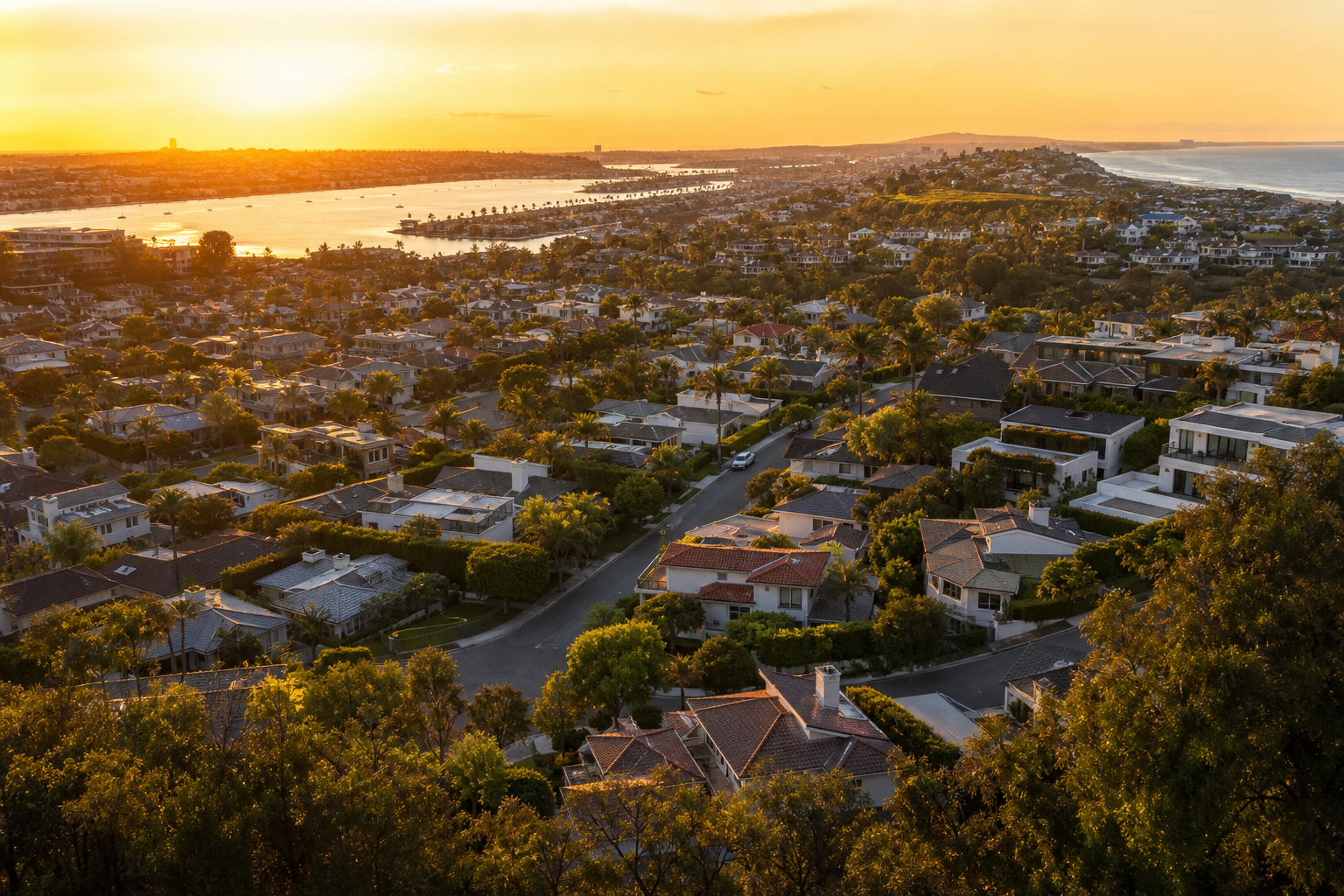
Photo: Derek Liang on Unsplash

How are interest rates affecting Orange County home prices in 2026?
Higher rates have raised monthly payments in Orange County, California, but prices have held up because low-rate owners are staying put and inventory remains tight. The August 2026 median was up 4.9% from a year earlier.
Most people assume that when mortgage rates go up, home prices come down. In Orange County, 2026 has shown that the relationship is not that simple. The average 30-year fixed rate climbed above 7% in September, yet the median price for an existing single-family home in the county was still higher than a year earlier.
The reason is that rates push on the market from two directions at once. They squeeze what buyers can afford, which pulls prices down. They also keep existing owners from selling, which keeps supply tight and pushes prices up. Which force wins depends on the neighborhood, the price point and the month.
This guide explains where rates stand as of September 2026, what actually moves them, the payment math for Orange County buyers, why so many Newport Beach and Irvine owners are staying put, and what all of it means for your next move, whether you are buying or selling.
Where Mortgage Rates Stand as of September 2026
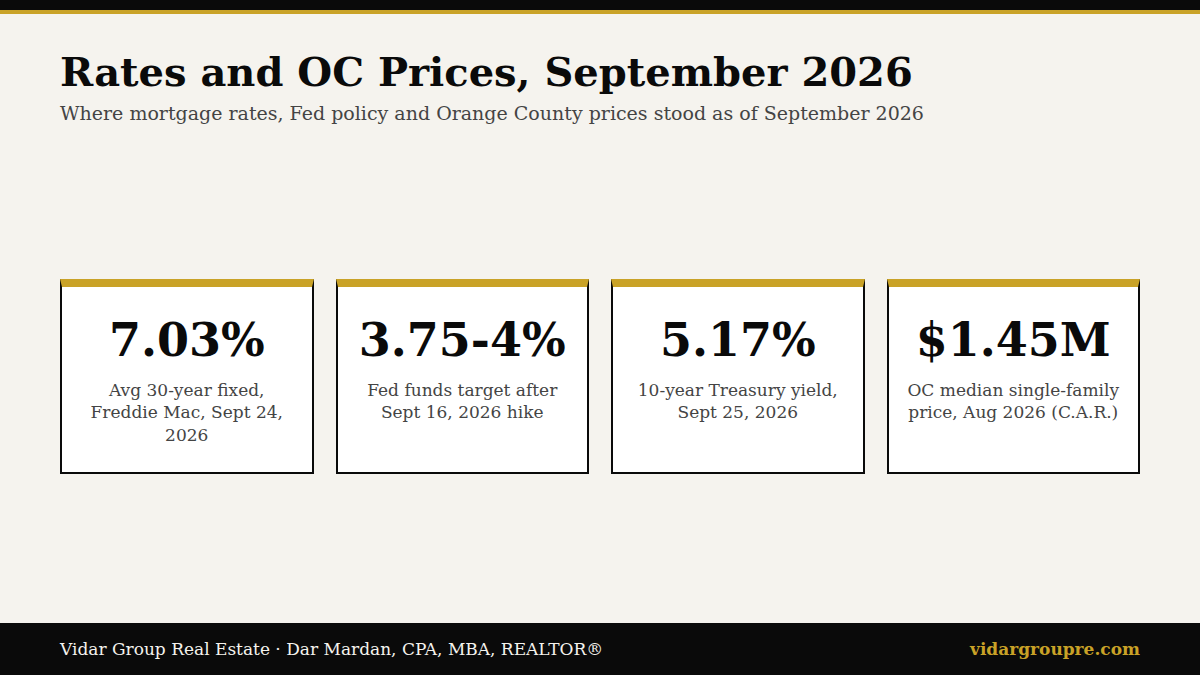
According to Freddie Mac's Primary Mortgage Market Survey, the average 30-year fixed rate was 7.03% for the week of September 24, 2026, up from 6.95% the week before and 6.30% a year earlier. The 15-year fixed averaged 6.42%. Keep in mind that the survey reflects conventional, conforming purchase loans for borrowers with excellent credit and 20% down, so your own quote can be higher or lower.
That is a sharp move in a short time. The California Association of REALTORS® August 2026 report put the August average at 6.67%, and C.A.R.'s second-quarter affordability report used 6.54%. In other words, buyers who were pre-approved over the summer may now be looking at a noticeably higher payment on the same loan amount.
A Note on Jumbo Loans in Orange County
The survey rate applies to conforming loans. For 2026, the FHFA set the high-cost area ceiling at $1,249,125 for a one-unit home, which is the limit that applies in Orange County. Many purchases in Newport Beach, Corona del Mar and Newport Coast need a jumbo loan above that amount, and jumbo pricing can differ from the survey average. Our guide to pre-approval in the Newport Beach jumbo market covers how that works.
What Actually Drives Mortgage Rates
The Federal Reserve gets the headlines, but it does not set mortgage rates. Understanding what does will help you read the news without overreacting to it.
The 10-Year Treasury Yield
As Fannie Mae's research explains, the 30-year mortgage rate is benchmarked to the 10-year Treasury note. When the 10-year yield rises, mortgage rates follow. The 10-year reflects what investors expect for inflation, economic growth, Fed policy and federal borrowing over the next decade.
On September 25, 2026, the 10-year Treasury closed at 5.17%. With the 30-year mortgage at 7.03%, the gap between the two was roughly 1.86 percentage points. Treasury yields and mortgage rates are subject to change and move daily, so treat these figures as a snapshot and check current rates before you make a decision.
The Spread Lenders Add
That gap is the spread. Fannie Mae breaks it into two parts: the cost of making and servicing the loan, and the premium investors in mortgage-backed securities demand for prepayment and credit risk. Fannie Mae notes the investor portion has averaged about 1.4 percentage points since January 2022. When markets are nervous, the spread widens, and mortgage rates can rise even if Treasury yields hold steady.
Federal Reserve Policy in 2026
The Fed controls the federal funds rate, a short-term rate for overnight bank lending. On September 16, 2026, the Federal Open Market Committee raised the target range by 1/4 point to 3.75% to 4%, in a unanimous vote, stating that inflation remains elevated. According to Advisor Perspectives' summary of the decision, it was the first increase since 2023, following 3 quarter-point cuts that began in September 2025.
The Fed's decisions matter to mortgages mostly through expectations. When investors think the Fed will keep rates higher for longer to fight inflation, long-term yields rise, and mortgage rates rise with them. That is largely what happened in September 2026.
The Affordability Math: What Each Rate Means for Your Payment
Rates are easiest to understand as a monthly payment. The table below shows principal and interest on a 30-year fixed loan for every $100,000 you borrow. These are our own calculations for illustration only. They do not include property taxes, insurance, HOA dues or mortgage insurance, and they are not a loan quote.
| Interest rate | Monthly principal and interest per $100,000 borrowed |
|---|---|
| 5.50% | $568 |
| 6.00% | $600 |
| 6.50% | $632 |
| 7.00% | $665 |
| 7.50% | $699 |
Each half-point adds roughly $32 to $34 a month per $100,000. That sounds small until you scale it to Orange County loan sizes.
An Orange County Example
As noted above, C.A.R. reported an Orange County median of $1,452,500 in August 2026. With 20% down, a buyer at that price borrows $1,162,000. As an illustration, at 6.30%, the rate a year ago, principal and interest would be about $7,192 a month. At 7.03%, it is about $7,754. That is roughly $562 more every month, or about $6,700 a year, for the same house.
Put another way, to keep the same $7,192 payment at 7.03%, that buyer could borrow only about $1,078,000 instead of $1,162,000. That lost borrowing power is how higher rates put downward pressure on prices.
How Many Households Can Afford the Median
C.A.R.'s second-quarter 2026 Housing Affordability Index found that only 15% of Orange County households could afford the median-priced home, which C.A.R. put at $1,485,000 for that quarter. The minimum qualifying income was $370,000, with a monthly payment including taxes and insurance of $9,250. Statewide, 19% of households could afford the median. For the full monthly picture as a first-time buyer, see our guide to the true monthly cost of a first Orange County home.
Orange County Prices and Inventory in 2026
Despite higher rates, Orange County prices have not fallen. Here is what the most recent reports show.
- Median price: C.A.R. reported $1,452,500 (about $1.45 million) for existing single-family homes in August 2026, up 4.9% from August 2025. Statewide, the median was $901,420, up just 0.1%.
- Sales: Orange County sales were down 3.4% from a year earlier, according to C.A.R.
- Supply: C.A.R. put Orange County's Unsold Inventory Index at 3.1 months, below the statewide 3.7 months, with a median of 27 days on market.
- Active listings: Realtor.com data published on the St. Louis Fed's FRED database counted 4,874 active single-family and condo listings in Orange County in August 2026.
- All property types: Redfin's Orange County data, which includes condos and townhomes, showed a median sale price of $1,220,914 in August 2026, up 3.9% year over year, with 31.1% of homes selling above list price.
Fewer sales at higher prices is the signature of a supply-constrained market. Buyers are fewer, but so are sellers. We break down which price points and neighborhoods favor buyers versus sellers in our Orange County buyer's or seller's market analysis, so we will not repeat it here.
The Lock-In Effect: Why Low-Rate Owners Are Staying Put
The biggest reason higher rates have not crushed Orange County prices is that they also keep homes off the market.
Rate Lock-In
Millions of owners refinanced or bought when rates were near historic lows. According to FHFA National Mortgage Database figures summarized by Calculated Risk, 49.9% of outstanding mortgages nationally had a rate below 4% in the first quarter of 2026, and 66.7% were below 5%. Only 22.1% were at 6% or higher.
An owner with a 3% loan who sells and buys again at 7% faces a much higher payment for the same loan amount. An FHFA working paper found that each 1-point gap between an owner's rate and the market rate cut the likelihood of selling by 18.1%. The researchers estimated the effect raised home prices by 5.7%, more than offsetting the 3.3% downward pull of higher rates themselves. FHFA's regional analysis found the Los Angeles-Long Beach-Anaheim area, which includes Orange County, among the most rate-sensitive markets in the country.
Prop 13 Lock-In
California owners face a second set of golden handcuffs. Under Proposition 13, property tax is generally limited to 1% of assessed value plus voter-approved bonds, and the assessed value can rise by no more than 2% a year until the property changes hands. A Newport Beach owner who bought in the 1990s may pay a small fraction of what a new buyer next door pays. Selling and buying again resets that base. Our Orange County property tax guide explains how the bill is calculated.
For owners 55 and older, Proposition 19 softens this. It lets eligible homeowners transfer their base year value to a replacement home anywhere in California, up to 3 times, if they buy within 2 years of selling. See our Prop 19 guide for the details and the traps.
Buy Now, Refinance Later? Understand the Risks
"Marry the house, date the rate" is a popular line. The idea is to buy now at today's rate and refinance when rates fall. It can work, but it is a bet, not a plan.
Rates Can Go Higher
Many buyers in 2025 expected rates to keep falling. Instead, the Fed raised rates in September 2026 and the 30-year crossed 7%. Only buy at a payment you can carry indefinitely, assuming you never refinance.
Refinancing Is Not Free
Refinance closing costs typically run 2% to 6% of the new loan amount, according to NerdWallet. As an illustration, on a $1,162,000 loan, dropping from 7.03% to 6.03% would save about $765 a month. If closing costs were 2% of the loan, about $23,240, it would take roughly 30 months to break even. At 4%, it would take about 61 months.
You Have to Qualify Again
A refinance requires a new application. If your income drops, your credit slips or your home appraises lower, you may not qualify for the best rate. Keeping your credit strong after you buy matters.
Consider the Loan Structure
Some buyers use an adjustable-rate mortgage or a rate buydown to lower the early payment. Each has trade-offs. We compare them in our fixed vs. adjustable-rate mortgage guide.
What Higher Rates Mean for Sellers
- Your buyer pool is payment-driven. Buyers shop by monthly payment. A rate jump shrinks the price they can reach, especially near the $1,249,125 conforming limit, where crossing into jumbo can change the loan terms.
- Price precisely from day 1. When rates climb, buyers are less forgiving of an ambitious list price. Our pricing strategy guide explains how to position a listing.
- Credits can beat price cuts. A seller credit toward a rate buydown can lower a buyer's payment more than an equal price reduction. Run both scenarios with your agent and the buyer's lender.
- Less competition from other sellers. Because low-rate owners are staying put, you may face fewer competing listings than you would expect.
What Higher Rates Mean for Buyers
- Get pre-approved at today's rate. A pre-approval from July may not reflect a 7% market. Read why pre-approval comes first in Orange County.
- Budget by payment, not price. Add property taxes, insurance, HOA dues and any Mello-Roos to principal and interest before you decide on a price range.
- Negotiate for rate help. In segments where homes sit longer, sellers may agree to credits toward a rate buydown instead of a price cut.
- Know when to lock. Ask your lender how long a rate lock lasts, what an extension costs, and whether there is a float-down option if rates fall before closing.
Frequently Asked Questions About Interest Rates and Orange County Home Prices
What is the current 30-year mortgage rate?
Freddie Mac reported an average of 7.03% for the week of September 24, 2026, up from 6.30% a year earlier. That figure assumes excellent credit and 20% down. Your rate depends on your credit, loan size, down payment and property type.
Does the Fed set mortgage rates?
No. The Fed sets a short-term target for overnight bank lending. Mortgage rates track the 10-year Treasury yield plus a spread, although Fed decisions influence the expectations that drive that yield.
Why haven't Orange County prices fallen with higher rates?
Supply is tight. Many owners have low mortgage rates and low Prop 13 tax bases, so they are not selling. With fewer homes for sale, prices have held up even as fewer buyers can afford them.
How much does a 1% rate increase change my payment?
As an illustration, going from 6% to 7% raises principal and interest by about $66 a month for every $100,000 borrowed. On a $1,000,000 loan, that is roughly $658 a month.
Should I wait for rates to drop before buying?
Nobody can reliably predict rates. If rates fall, more buyers may return and competition can push prices up. Buy when the payment fits your budget and you plan to stay long enough to justify the transaction costs.
Is refinancing later a safe plan?
It is possible but not guaranteed. Rates may not fall, you must qualify again, and closing costs can take years to recover. Treat a future refinance as a bonus, not a requirement.
What is the conforming loan limit in Orange County for 2026?
For a one-unit home, it is $1,249,125, the FHFA's high-cost area ceiling. Loans above that amount are jumbo loans with their own pricing and underwriting.
What is the lock-in effect?
It describes owners who stay put because selling would mean giving up a low mortgage rate. In California, Prop 13 adds a property tax version of the same effect. Both reduce the number of homes for sale.
Do higher rates help cash buyers?
They can. Cash buyers are not affected by rate changes, and financed buyers who drop out leave less competition. If you are financing, a strong pre-approval and clean terms still matter.
Make Your Move Based on the Numbers
Rates will keep moving, and headlines will keep overreacting. What matters is whether the payment, the tax picture and the timing work for you. Dar Mardan, CPA, MBA, and REALTOR® with Real Broker, and the Vidar Group Real Estate team help buyers and sellers in Newport Beach, Corona del Mar, Newport Coast, Irvine and Mission Viejo run the real numbers, from payment scenarios to Prop 13 and Prop 19 trade-offs, before they commit.
Schedule a complimentary consultation with Dar Mardan.
This article is general information about mortgage rates and the Orange County housing market, not financial, lending, legal or tax advice. Rates and market data change frequently, and the payment examples are illustrations, not loan offers. Consult a licensed mortgage lender, financial advisor or tax professional about your situation.
Categories
- All Blogs (62)
- Buy home (12)
- buy home insurance (2)
- buyer agent (1)
- divorce (5)
- downsizing (17)
- estate planning (12)
- Estate Real estate (6)
- First time home buyer (5)
- home buying advice (6)
- Home buying tips (8)
- Home inspection (3)
- Home Inspections and Repairs (2)
- home insurance (1)
- home selling advice (15)
- Home Selling Tips (33)
- Home upgrades (2)
- how to sell your home (13)
- Lower home insurance cost (2)
- Lower insurance premiums (1)
- market update (2)
- Newport Center (1)
- Orange county homes (45)
- Pre Listing Preparation (7)
- probate sale (4)
- proposition 19 (4)
- Realtor tips (13)
- Rental Income (1)
- retirement planning (10)
- ROI upgrades (2)
- seller agent (1)
- Selling tips (9)
- transfer tax basis (2)
Recent Posts