
How to Screen Tenants Legally in California: A Landlord's Guide
Photo: Trac Vu on Unsplash

How do you screen tenants legally in California?
Use written, objective criteria and apply them the same way to every applicant. California law caps screening fees, protects source of income, limits criminal history checks, and requires notices when you deny someone.
Screening tenants is the most important decision a landlord makes. It is also where well-meaning owners get into the most legal trouble. A question that seems harmless, a "no Section 8" line in a listing, or a blanket policy on criminal records can violate California law, even if you never intended to discriminate.
California's rules go well beyond federal law. The state protects more characteristics, regulates what you can charge for an application, controls how you use credit and criminal history, and limits security deposits. Whether you rent out a condo in Irvine, a house in Mission Viejo or a unit in Newport Beach, the same state rules apply.
This guide explains what the law requires at each step, from writing your criteria to sending the denial notice. The goal is simple: choose a qualified tenant through a fair process you can document and defend.
Fair Housing Is the Foundation
Every screening decision sits on top of 2 layers of fair housing law. If your process follows them, everything else gets easier.
Federal Fair Housing Act
The federal Fair Housing Act prohibits housing discrimination based on race, color, national origin, religion, sex, familial status and disability. It applies to nearly all housing, including private rentals.
California's Fair Employment and Housing Act (FEHA)
California's FEHA protects a longer list. According to the California Civil Rights Department, protected characteristics in housing include race, color, ancestry, national origin, citizenship, immigration status, primary language, religion, disability, sex, gender, sexual orientation, gender identity, gender expression, genetic information, marital status, familial status, source of income, military or veteran status, and age.
The practical rule: never make a decision, set a term or write a listing that treats anyone differently because of any of these characteristics. That includes steering, telling someone a unit is unavailable when it is not, or offering different terms.
Disability: Reasonable Accommodations and Modifications
Fair housing law also requires you to act, not just refrain. The Civil Rights Department's fair housing fact sheet explains that refusing reasonable changes to rules, policies or practices when a person with a disability needs them to use and enjoy the home is illegal, and that tenants may make reasonable modifications at their own expense. Handle each request individually and in writing.
What You Can and Cannot Ask
The safest application asks only what you need to decide whether someone meets your written criteria, and asks every applicant the same questions.
Questions That Are Generally Appropriate
- Income and employment, with verification.
- Rental history and landlord references.
- Permission to run a credit report and eviction history check.
- Identity verification.
- Number of occupants, applied under a consistent, lawful standard.
- Pets, while remembering that assistance animals for people with disabilities are a reasonable accommodation issue, not a pet policy issue.
Questions to Leave Off the Application
- National origin, religion, marital status, sexual orientation or gender identity.
- Whether the applicant has or plans to have children, or is pregnant.
- The nature or severity of a disability, or medical history.
- Immigration or citizenship status. Civil Code Section 1940.3 bars landlords from asking about it, though you may request information needed to verify identity and financial qualifications.
- Arrests that did not lead to a conviction, and other criminal history the state regulations prohibit you from considering (covered below).
Source of Income: Vouchers Are Protected
Since January 1, 2020, SB 329 has made Housing Choice Vouchers and other housing subsidies part of the "source of income" protection under FEHA. According to the Fair Housing Foundation's SB 329 FAQ, that means you cannot reject an applicant because they use a Section 8 voucher, advertise "No Section 8," or apply different screening criteria to voucher holders.
Income Requirements With a Voucher
You can still use an income standard, such as rent-to-income ratio, but for a voucher holder you must base it on the tenant's share of the rent, not the full contract rent. The Fair Housing Foundation gives an example: on a $1,500 unit where the tenant pays $600, a 3-to-1 ratio means the applicant needs $1,800 in monthly income, not $4,500.
Credit History Alternatives (SB 267)
SB 267, passed in 2023, added another layer. If an applicant receives a government rent subsidy and you would normally review credit history, you must offer the option to provide lawful, verifiable alternative evidence of ability to pay, such as government benefit payments, pay records or bank statements. You must give reasonable time to provide it and reasonably consider it instead of the credit report. The California Department of Real Estate notes that a violation is treated as a FEHA violation.
Criminal History: What California Regulations Allow
California's fair housing regulations on criminal history, found at Title 2, California Code of Regulations, Sections 12264 through 12271, took effect January 1, 2020. They are strict, and they apply to private landlords.
Information You Cannot Consider
Under 2 CCR Section 12269, you generally cannot seek or use:
- Arrests that did not result in a conviction.
- Participation in pre-trial or post-trial diversion programs.
- Infractions.
- Convictions that have been sealed, dismissed, vacated, expunged or pardoned.
- Juvenile records.
Blanket bans, such as "no felons" or "no criminal records," are prohibited.
How You May Consider Convictions
You may consider only convictions that are directly related to a legitimate interest, such as the safety of residents or protection of property. 2 CCR Section 12266 points to the nature and severity of the offense and how much time has passed. It also requires giving the applicant written notice of the chance to present mitigating information, such as rehabilitation, time since the offense or a good rental history, and actually considering it.
The Civil Rights Department's fair housing and criminal history FAQ suggests a practical sequence: verify income and other qualifications first, and look at criminal history only after that. Many landlords find this the cleanest way to comply.
Application Fees Under Civil Code Section 1950.6
California caps what you can charge to screen an applicant, and it tells you what you must do with the money.
The 2026 Maximum Screening Fee
Civil Code Section 1950.6 sets a $30 base fee that may be adjusted each year for inflation. According to the California Apartment Association, the inflation-adjusted maximum as of December 2025 is $65.86 per applicant. The fee must cover actual out-of-pocket costs and time spent screening, not profit.
Rules That Come With the Fee
- Give the applicant an itemized receipt of the costs.
- If you do not run a credit report or check references, return the unused portion.
- If you obtain a consumer credit report, give the applicant a copy within 7 days.
- Do not charge a fee if you know or should know that no unit is available.
The AB 2493 Choice: First-Come or Full Refund
AB 2493, passed in 2024, added a requirement to 1950.6. To keep an applicant's screening fee, you must use one of 2 processes:
- First-come, first-served: give your screening criteria to applicants in writing with the application, consider complete applications in the order received, approve the first applicant who meets your criteria, and do not charge anyone a fee until their application is actually considered.
- Refund: return the entire fee to every applicant who is not selected, for any reason, within 7 days of choosing a tenant or 30 days after the application was submitted, whichever comes first.
Reusable Screening Reports
Under Civil Code Section 1950.1, added by AB 2559, an applicant may offer a reusable tenant screening report prepared within the previous 30 days by a consumer reporting agency. Accepting one is your choice. If you do accept it, you cannot charge a screening fee or a fee to access the report.
Credit Reports and the FCRA Adverse Action Notice
If you use a consumer report, federal law applies too. The Federal Trade Commission's guidance for landlords explains that you need the applicant's permission and a permissible purpose, and that you must give an adverse action notice when a report plays any role in a decision to:
- Deny the application.
- Require a co-signer.
- Require a deposit, or a larger deposit than other applicants pay.
- Charge higher rent than others.
The notice must name the consumer reporting agency and give its address and phone number, state that the agency did not make the decision, and explain the applicant's right to a free copy of the report within 60 days and to dispute inaccurate information. Oral notice is technically allowed, but the FTC recommends putting it in writing. Dispose of reports securely when you are done.
Security Deposits Under AB 12
Since July 1, 2024, Civil Code Section 1950.5 has limited most security deposits to 1 month's rent. Small landlords, meaning natural persons or LLCs made up of natural persons who own no more than 2 residential rental properties with no more than 4 units total, may collect up to 2 months' rent, except from service members.
The same section requires an itemized statement and return of any remaining deposit within 21 days after the tenant moves out, and photographs of the unit at move-in and move-out. Our guide to short-term vs. long-term rentals in Orange County covers the deposit rules alongside AB 1482 rent caps and just cause protections.
One screening tie-in: under the FCRA, asking a particular applicant for a larger deposit because of their credit report is an adverse action, and that applicant is owed a notice.
Build a Written, Consistent Screening Process
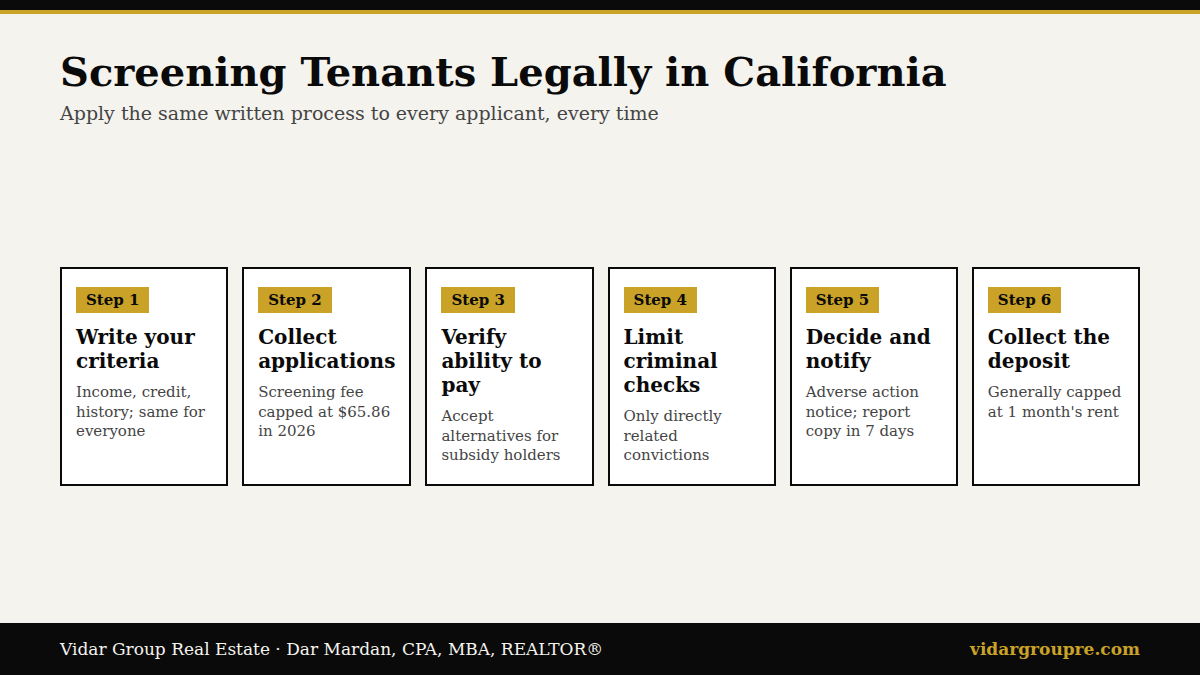
Consistency is your best protection. If every applicant gets the same criteria, the same questions and the same process, it is much easier to show that your decision was based on qualifications.
What Written Criteria Should Cover
- Minimum income, stated as a ratio of rent, and how you calculate it for applicants with subsidies.
- Credit standards, and the alternative evidence you accept.
- Rental history, including how you evaluate prior evictions under current law.
- How you consider criminal history, consistent with the state regulations.
- Occupancy and pet policies, with a note on reasonable accommodations.
- Whether you process applications first-come, first-served or refund unselected applicants' fees.
Keep Records
Keep the listing, applications, criteria, screening results, notices and your reason for each decision. If you use a property manager, confirm they follow the same written process.
Advertise Carefully
Describe the property, not the tenant you want. Avoid phrases that suggest a preference, such as "perfect for singles" or "no Section 8." If your property is in an HOA, check the association's leasing rules too. Our guide to HOA fees in Orange County explains how to read the CC&Rs and rules.
Where Screening Fits in Owning a Rental
Screening protects the income you counted on when you bought. If you are still deciding whether a property makes sense, our guide on how to evaluate a rental property in Orange County walks through rent comps, expenses and cash flow. If you came to renting after inheriting a home, our guide to what to do after inheriting a house in California covers that decision. If you are weighing keeping a long-held Newport Beach home as a rental, see our sell-or-keep tax math, and if you plan to trade into another rental later, our 1031 exchange guide explains the rules.
Frequently Asked Questions About Tenant Screening in California
How much can I charge for a rental application in California?
Civil Code Section 1950.6 allows a $30 base fee adjusted for inflation. The California Apartment Association calculated the maximum at $65.86 per applicant as of December 2025. You must itemize the costs and refund any unused portion.
Can I refuse an applicant with a Section 8 voucher?
No. Since 2020, vouchers have been part of California's source of income protection. You can apply your normal criteria, but income ratios must be based on the tenant's share of the rent.
Can I run a background check on applicants?
Yes, with limits. You cannot consider arrests without convictions, diversion, infractions, sealed or expunged records or juvenile records, and you cannot use blanket bans. You may consider only directly related convictions and must allow the applicant to present mitigating information.
Do I have to accept a reusable screening report?
No. Under Civil Code Section 1950.1, accepting one is optional. If you accept it, you cannot charge a screening fee or a fee to use the report.
Can I require a minimum credit score?
You can use credit standards if you apply them consistently. For applicants with a government rent subsidy, you must allow alternative evidence of ability to pay, such as benefit payments, pay records or bank statements.
What happens to the fee if I choose another applicant?
Unless you used a first-come, first-served process with written criteria, you must refund the entire fee to unselected applicants within 7 days of choosing a tenant or 30 days after they applied, whichever comes first.
Can I ask whether an applicant is a U.S. citizen?
No. Civil Code Section 1940.3 prohibits asking about immigration or citizenship status. You can ask for information needed to verify identity and financial qualifications.
When do I need to send an adverse action notice?
Whenever a consumer report contributes to denying an application, requiring a co-signer, requiring a larger deposit or charging higher rent. The notice must name the reporting agency and explain the applicant's rights.
How much security deposit can I collect?
Generally 1 month's rent. Small landlords who meet the Civil Code Section 1950.5 definition may collect up to 2 months' rent, except from service members.
Rent With Confidence in Orange County
A fair, written screening process protects your tenants and your investment at the same time. Dar Mardan, CPA, MBA, and REALTOR® with Real Broker, and the Vidar Group Real Estate team help property owners in Newport Beach, Corona del Mar, Newport Coast, Irvine and Mission Viejo buy, evaluate and plan for rental properties, with a CPA's eye on the numbers and a clear view of the rules that come with them.
Schedule a complimentary consultation with Dar Mardan.
This article is general information about California landlord-tenant and fair housing law, not legal advice. Laws, fee limits and regulations change, and local ordinances may add requirements. Consult a California landlord-tenant attorney or a qualified property management professional before adopting screening policies.
Categories
- All Blogs (102)
- Buy home (12)
- buy home insurance (2)
- buyer agent (1)
- divorce (6)
- downsizing (27)
- estate planning (20)
- Estate Real estate (6)
- First time home buyer (13)
- home buying advice (6)
- Home buying tips (24)
- Home inspection (3)
- Home Inspections and Repairs (2)
- home insurance (1)
- home selling advice (15)
- Home Selling Tips (54)
- Home upgrades (2)
- how to sell your home (13)
- Lower home insurance cost (2)
- Lower insurance premiums (1)
- market update (4)
- Newport Center (3)
- Orange county homes (82)
- Pre Listing Preparation (8)
- probate sale (5)
- proposition 19 (4)
- Realtor tips (13)
- Rental Income (1)
- retirement planning (20)
- ROI upgrades (2)
- seller agent (1)
- Selling tips (9)
- transfer tax basis (2)
Recent Posts