
How to Improve Your Credit Score Before Buying a Home in California
Photo: Dillon Pena on Unsplash

How can you improve your credit score before buying a home in California?
Pull your free reports, dispute errors, pay every bill on time and cut card balances well before you apply. Orange County buyers should start 6 to 12 months out and avoid new credit through escrow.
Your credit score does more than decide whether you get a mortgage. It helps set your interest rate, what you pay for mortgage insurance and how many loan options you have. On the loan sizes common in Orange County, a stronger score can mean thousands of dollars at closing and a lower payment every month for years.
The good news is that credit is one of the few parts of buying a home you control. This guide covers how scores are built, the minimums for conventional, FHA and jumbo loans, how score tiers change your costs, how to fix errors under federal and California law, and what not to do once you are in escrow on a home in Irvine, Mission Viejo or Newport Beach.
How Your FICO Score Is Built
Most mortgage lenders still rely on FICO scores. According to myFICO, the score is built from 5 categories with these general weights. The exact impact varies from person to person, but the weights tell you where to focus.
| FICO factor | General weight | What moves it |
|---|---|---|
| Payment history | 35% | On-time payments; late payments and collections hurt |
| Amounts owed | 30% | Card balances compared with your limits |
| Length of credit history | 15% | Age of your oldest and average accounts |
| Credit mix | 10% | Cards, installment loans, mortgages |
| New credit | 10% | Recent applications and new accounts |
Payment history and amounts owed make up 65% of the score between them. That is where a buyer 6 to 12 months from applying can make the biggest difference.
Credit Score Minimums by Loan Type
Conventional Loans
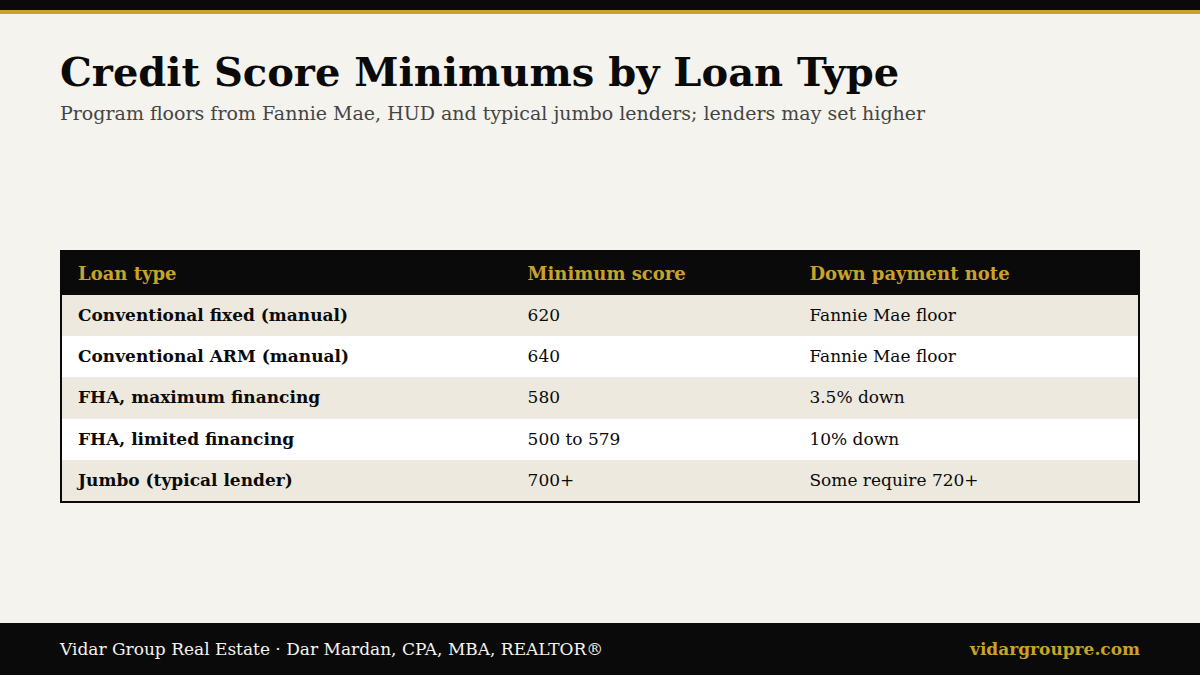
Fannie Mae's Selling Guide sets a minimum score of 620 for manually underwritten fixed-rate loans and 640 for ARMs. Loans run through its automated Desktop Underwriter system have no set minimum, though individual lenders usually add their own floors. These rules apply to conventional loans up to Orange County's 2026 high-balance limit of $1,249,125 for a 1-unit home, as set by the Federal Housing Finance Agency.
FHA Loans
Under HUD's Mortgagee Letter 2010-29, borrowers with a score of 580 or higher qualify for maximum financing, which today means 3.5% down. Scores from 500 to 579 are limited to 90% loan-to-value, meaning 10% down, and scores under 500 are not eligible. Individual lenders can set higher floors than HUD's minimum.
Jumbo Loans
Above $1,249,125, each lender sets its own standards. Experian notes that jumbo lenders typically will not go below a score of 700, and some require 720 or higher, along with cash reserves and a lower debt-to-income ratio. If you are shopping in Newport Beach, Newport Coast or Corona del Mar at jumbo price points, plan for those higher standards. Our guide to jumbo pre-approval in Newport Beach covers the rest of the file.
How Score Tiers Change Your Rate and PMI
Meeting the minimum gets you approved. A higher score gets you a better price. Fannie Mae charges loan-level price adjustments (LLPAs), which are fees based largely on your score and loan-to-value ratio. Lenders usually pass them on as a higher rate or as points at closing.
Fannie Mae's Loan-Level Price Adjustment Matrix dated September 9, 2026 shows the spread for a purchase loan over 15 years with 20% down (75.01% to 80% loan-to-value):
| Credit score | LLPA at 75.01% to 80% LTV | Cost on an $800,000 loan |
|---|---|---|
| 780 or higher | 0.375% | $3,000 |
| 740 to 759 | 0.875% | $7,000 |
| 700 to 719 | 1.375% | $11,000 |
| 660 to 679 | 1.875% | $15,000 |
| 640 to 659 | 2.250% | $18,000 |
The dollar column is our own illustration: the LLPA percentage times an $800,000 loan, such as 20% down on a $1,000,000 Irvine condo. Moving from the 640 to 659 tier to 780 or higher cuts that adjustment by $15,000. Lenders price LLPAs differently, and some fold them into the rate rather than charging them upfront, but the direction is the same everywhere.
PMI Is Priced by Score Too
If you put less than 20% down on a conventional loan, your credit score also drives your private mortgage insurance premium. Freddie Mac says PMI typically runs about $30 to $70 per month per $100,000 borrowed, with loan-to-value and credit score as the key factors. For the full picture, see our guide to PMI in California.
Step 1: Pull Your Free Credit Reports
Start by seeing exactly what lenders will see. The Federal Trade Commission confirms that the 3 nationwide bureaus, Equifax, Experian and TransUnion, have permanently extended free weekly reports through AnnualCreditReport.com. The FTC notes that this is the only site authorized for those free federal reports, so be wary of lookalikes.
Pull all 3 reports, since each bureau may have different information. Check your name, addresses, every account, balances, payment history and any collections or public records. Note anything you do not recognize.
Step 2: Dispute Errors
Your Federal Rights Under the FCRA
The federal Fair Credit Reporting Act gives you the right to dispute inaccurate information. The CFPB recommends disputing with both the credit bureau and the company that furnished the information, in writing, with copies of your supporting documents. According to the FTC, the bureau generally has 30 days to investigate, or 45 days if you send more information during that time. If the dispute results in a change, you get a free updated report.
Know the limits too. The FTC notes that most accurate negative information can be reported for 7 years, and bankruptcies for 10. Disputes fix errors. They do not remove accurate late payments.
California's Consumer Credit Reporting Agencies Act
California adds its own layer through the Consumer Credit Reporting Agencies Act. Under Civil Code Section 1785.16, a bureau that receives your dispute must notify the furnisher within 5 business days, finish its reinvestigation within 30 business days, and send you the results within 5 days after it is done.
California Keeps Medical Debt Off Credit Reports
California also passed SB 1061. As of January 1, 2025, it bars health care providers, and anyone else collecting medical debt, from reporting it to credit bureaus under Civil Code Section 1785.27. If you see a medical collection on your report, ask about it, especially one reported after that date.
Step 3: Lower Your Card Balances
Amounts owed is 30% of your score, and the biggest piece is how much of your available card credit you are using. myFICO notes that using a high share of your available credit can pull your score down, and that a low balance can help more than no activity at all.
- Pay balances down early, well before you apply, so the lower balances are reported to the bureaus.
- Spread balances instead of maxing out a single card.
- Keep older cards open. Closing them can shorten your history and raise your utilization.
- Avoid moving balances around with new transfer cards, which adds a new account and an inquiry.
Step 4: Protect Your Payment History
Payment history is the largest factor at 35%. Set every account to autopay at least the minimum, including store cards and small balances you rarely think about. A single 30-day late payment in the months before you apply can do more damage than almost anything else on this list. If you are buying with a spouse or partner, both of your reports matter. Our guide for couples buying their first Orange County home together covers how lenders look at 2 applicants.
Step 5: Ask Your Lender About a Rapid Rescore
Normally, creditors update the bureaus on their own monthly schedule. A rapid rescore speeds that up. Experian explains that only your mortgage lender can request one, and it usually takes 2 to 5 days once documents are submitted. It updates your file to reflect a paid-down balance or a corrected error.
Lenders cannot bill you directly for the rescore fee, though Experian notes you may pay for it indirectly through the loan's costs. A rescore is most useful when you are just below a pricing tier, since a small score change can move you into a better LLPA bracket.
Shop for Your Mortgage Without Fear of Inquiries
Many buyers avoid rate shopping because they worry about multiple credit pulls. According to the CFPB, multiple mortgage credit checks within a 45-day window are recorded as a single inquiry. Get Loan Estimates from several lenders within that window. Start with why pre-approval comes first in Orange County.
If you have a security freeze on your credit, the FTC notes that placing and lifting a freeze is free and does not affect your score. Ask your lender which bureau it will use and lift the freeze there temporarily.
What Not to Do During Escrow
Your loan is approved based on a snapshot of your credit and debts. Change that snapshot before closing, and the approval can fall apart. Fannie Mae has noted that borrowers sometimes take on new debt before closing without telling the lender, and that lenders who learn of new debt must recalculate your debt-to-income ratio and rerun the approval. The CFPB also advises avoiding new credit applications while you are getting a mortgage.
- Do not open new credit cards, even for a store discount on furniture for the new house.
- Do not finance a car or appliances until after the deed records.
- Do not close old accounts or consolidate debt without asking your lender first.
- Do not miss or pay late on any bill, including utilities that could go to collections.
- Do not co-sign a loan for anyone else.
- Do not move large sums between accounts without documenting them for your lender.
- Do not change jobs without telling your lender first.
Your loan contingency is what protects your deposit if financing falls through. Our guide to how escrow works in California explains the contingency timeline and what is at stake.
A Realistic Timeline
- 12 months out: pull all 3 reports, set up autopay, start disputes.
- 6 months out: pay card balances down and keep them low; do not open new accounts.
- 3 months out: recheck reports to confirm disputes were fixed; talk to a lender about where your score falls in its pricing tiers.
- Under contract: freeze your credit habits until closing.
Frequently Asked Questions About Improving Your Credit Before Buying
What credit score do I need to buy a house in California?
There is no single state minimum. Fannie Mae sets 620 for manually underwritten fixed-rate conventional loans, HUD allows FHA at 580 with 3.5% down, and jumbo lenders typically will not go below 700. Lenders can set their own higher floors.
How fast can I raise my credit score?
Paid-down card balances typically show up once creditors report them, which Experian describes as a 30 to 60 day cycle. Removing an error can take about 30 days under the FCRA. Recovering from late payments takes much longer.
Does checking my own credit hurt my score?
No. Pulling your own report at AnnualCreditReport.com does not affect your score. You can check each bureau weekly for free.
Will shopping for a mortgage hurt my credit?
Very little. The CFPB says multiple mortgage credit checks within 45 days count as 1 inquiry. Compare several Loan Estimates within that window.
Should I pay off collections before applying?
Talk to your lender first. Depending on the loan program and how the account is reported, paying, disputing or leaving a collection can affect your approval and score differently. Always dispute any collection that is not accurate.
Should I close credit cards I don't use?
Usually not before a mortgage. Closing a card lowers your available credit, which can raise your utilization, and closing an old card can shorten your history. Keep them open and use them lightly.
What is a rapid rescore?
It is a lender-requested update to your credit file that reflects recent changes, such as a paid-off balance, within about 2 to 5 days. Only your lender can request it.
Does California have its own credit reporting law?
Yes. The Consumer Credit Reporting Agencies Act, including Civil Code Section 1785.16, sets dispute and reinvestigation rules. Since January 1, 2025, California law also bars reporting medical debt to credit bureaus.
How much does a better score save on an Orange County home?
Under Fannie Mae's September 2026 pricing matrix, going from the 640 to 659 tier to 780 or higher cuts the price adjustment on an $800,000 loan with 20% down by $15,000 in our illustration. It can also lower your PMI if you put less than 20% down.
Can I buy a home in Orange County with less-than-perfect credit?
Often, yes. FHA loans allow lower scores, and many buyers improve their score enough in a few months to move into a better pricing tier. A lender can tell you exactly which changes will help most.
Get Your Credit and Your Home Search on the Same Timeline
The best time to work on your credit is before you fall in love with a house. Dar Mardan, CPA, MBA, and REALTOR® with Real Broker, and the Vidar Group Real Estate team help buyers in Newport Beach, Corona del Mar, Newport Coast, Irvine and Mission Viejo plan the financial side of a purchase months ahead, so your credit, down payment and pre-approval are ready when the right home comes up. For a full planning checklist, see our Orange County home buyer checklist.
Schedule a complimentary consultation with Dar Mardan.
This article is general information about credit and mortgage qualification, not lending, legal, credit counseling or financial advice. Lender requirements, pricing and laws change, and the dollar figures above are illustrations. Consult a licensed mortgage professional, attorney or financial advisor about your situation.
Categories
- All Blogs (105)
- Buy home (12)
- buy home insurance (2)
- buyer agent (1)
- divorce (6)
- downsizing (27)
- estate planning (20)
- Estate Real estate (6)
- First time home buyer (15)
- home buying advice (6)
- Home buying tips (27)
- Home inspection (3)
- Home Inspections and Repairs (2)
- home insurance (1)
- home selling advice (15)
- Home Selling Tips (54)
- Home upgrades (2)
- how to sell your home (13)
- Lower home insurance cost (2)
- Lower insurance premiums (1)
- market update (4)
- Newport Center (3)
- Orange county homes (85)
- Pre Listing Preparation (8)
- probate sale (5)
- proposition 19 (4)
- Realtor tips (13)
- Rental Income (1)
- retirement planning (20)
- ROI upgrades (2)
- seller agent (1)
- Selling tips (9)
- transfer tax basis (2)
Recent Posts