Your Home Didn't Sell? What Must Change Next
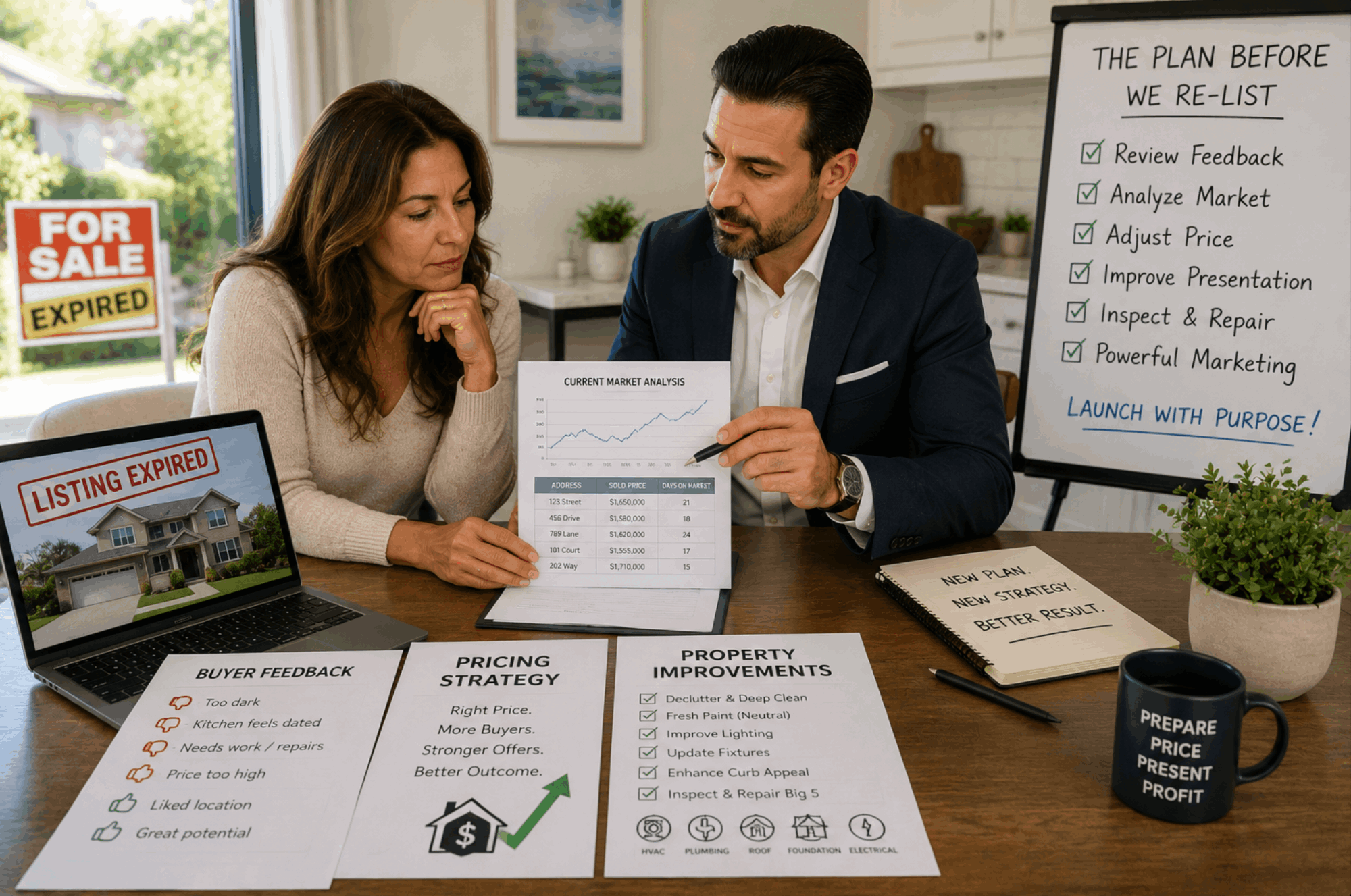
If your listing expired, was canceled, sat on the market without selling, or went into escrow only to have the buyer walk away, the most important question before you put it back on the market is:
What is going to be different this time?
Because changing the listing date without changing the strategy isn't really a new listing.
If the home comes back with:
-
The same price
-
The same photos
-
The same presentation
-
The same unresolved repairs
-
The same marketing
-
And the same assumptions about what buyers should be willing to pay
there is a good chance the market responds the same way.
That may be frustrating to hear, but there is also good news:
The first listing gave you information.
Buyers gave you information.
Showing activity gave you information.
Agents gave you information.
Offers—or the absence of offers—gave you information.
If a transaction fell apart, the inspection, appraisal, financing, disclosures, or negotiations may have given you even more information.
Your job before relisting is to use it.
When I evaluate a home that didn't sell the first time, I generally start with three major areas:
Presentation.
Pricing.
Preparation before inspection.
But there are several other questions underneath those three that can make the difference between repeating the first listing and creating a completely different result.
First: Don't Immediately Blame the Market
When a home doesn't sell, it is easy to say:
“The market was bad.”
Sometimes market conditions absolutely matter.
Interest rates matter.
Inventory matters.
Buyer confidence matters.
Competition matters.
Seasonality can matter.
But here's the question I would ask:
Did other comparable homes sell while yours was sitting?
If similar homes in your neighborhood sold during the same period, then the explanation probably isn't simply:
“Nobody is buying.”
The better question is:
Why did buyers choose those homes instead of yours?
Maybe they offered better value.
Maybe they showed better.
Maybe the photographs generated more interest.
Maybe they were easier to show.
Maybe buyers perceived yours as requiring too much work.
Maybe your price put the property into competition with homes buyers considered superior.
The market is not personal.
It simply reacts to the choices available.
Your first listing gives us a chance to study those reactions.
1. Start With the Evidence From Your First Listing
Before doing anything else, I would perform what amounts to an autopsy of the first listing.
Don't guess why the house didn't sell.
Look at what actually happened.
Ask:
-
How many days was the property on the market?
-
How many showings did it receive?
-
How many serious buyer inquiries?
-
How many open-house visitors?
-
How many offers?
-
Were there price reductions?
-
What happened after each reduction?
-
What comments did showing agents provide?
-
What objections came up repeatedly?
-
How did your listing compare with competing properties?
-
Which competing homes sold?
-
Which homes sat?
-
Did any buyers make offers and later cancel?
-
If so, why?
The most valuable information is often found in patterns.
One buyer saying the kitchen is dated doesn't necessarily mean you should remodel the kitchen.
But if 14 different buyers say:
“The house feels dark.”
pay attention.
If several agents say:
“Buyers like it but feel it is priced too close to remodeled homes.”
pay attention.
If buyers consistently say:
“We like the house but we're worried about the roof.”
pay attention.
Your first listing may have already told you exactly what needs to change.
2. Presentation Shapes How Buyers Perceive Value
Before we talk about reducing the price, we need to talk about whether the home was presented in the strongest possible way.
Because price and presentation are connected.
Buyers don't evaluate real estate using square footage alone.
They respond to:
-
Light
-
Space
-
Cleanliness
-
Flow
-
Furniture placement
-
Condition
-
Smell
-
Landscaping
-
Color
-
Kitchen presentation
-
Bathroom presentation
-
Lighting fixtures
-
Window coverings
-
Clutter
-
Photography
-
And the overall feeling they experience in the house
A buyer might walk into two homes with nearly identical square footage and objectively prefer one within seconds.
Why?
Because one feels better.
One looks brighter.
One feels more open.
One looks easier to move into.
One allows the buyer to imagine living there.
That emotional reaction affects perceived value.
A House Needs to Sell Itself
An agent should do much more than open the front door and explain:
“Here's the kitchen. Here's the bedroom. Here's the backyard.”
The buyer can see that.
The property itself needs to make the argument.
Ideally, a buyer walks in and thinks:
“I could live here.”
That is why preparation matters.
My wife, Vida, brings an exceptional design and presentation perspective to our listings. She often notices things homeowners stop seeing because they have lived with them for years:
-
Furniture that makes a room feel smaller
-
Heavy window coverings blocking natural light
-
Too many accessories
-
Dark paint
-
Outdated light fixtures
-
Cluttered counters
-
Spaces without a clear purpose
-
Landscaping that hides the architecture
-
Small cosmetic changes that can dramatically improve the overall impression
This doesn't mean every home needs a major renovation.
Quite often, it doesn't.
It means we need to look at your property through the buyer's eyes rather than the owner's eyes.
3. Don't Remodel Everything Just Because the First Listing Failed
This is where sellers can make a very expensive mistake.
The home didn't sell.
So the seller concludes:
“We need to remodel the kitchen and bathrooms before we relist.”
Maybe.
But probably not without doing the math first.
There is a big difference between:
Preparing properly
and
spending money emotionally.
Sometimes the correct changes are surprisingly simple:
-
Declutter
-
Remove excess furniture
-
Deep clean
-
Improve curb appeal
-
Trim landscaping
-
Increase lighting
-
Replace dated fixtures
-
Touch up damaged paint
-
Use lighter accessories
-
Neutralize strong colors
-
Repair visible defects
-
Improve staging
-
Professionally photograph the home again
Those improvements can completely change how a home photographs and feels without turning your property into a construction project.
Before spending heavily, read our guide to what not to fix before selling your home so you don't lose money.
The goal isn't to build the next buyer's dream house with your money.
The goal is to determine which changes improve marketability, buyer confidence, and your net proceeds.
4. Your Old Photos May Be Part of the Problem
Sellers sometimes make substantial improvements and then relist using photographs that look almost identical to the first listing.
That wastes the opportunity.
Your relaunch should visually communicate:
THIS IS DIFFERENT.
If you changed the presentation, show it.
That could mean:
-
New professional photography
-
New angles
-
Better lighting
-
Improved staging
-
Updated exterior photographs
-
Twilight photography when appropriate
-
Video
-
Drone photography when appropriate
-
A stronger property website
-
Better social-media content
Think about the buyer who saw the home online three months earlier.
If they see the same thumbnail photograph again, they may immediately think:
“Oh, that's the house that didn't sell.”
They may not even click.
But if the home looks dramatically better, you have a chance to create:
“Wait—is this the same house?”
That's the reaction you want.
5. Pricing May Be the Biggest Disconnect
Now we get to the subject sellers usually don't enjoy discussing:
Price.
When a home receives sustained market exposure but doesn't generate sufficient serious buyer interest, pricing is one of the first things I evaluate.
A home's value is not established by:
-
What you paid
-
How much you spent remodeling
-
What you owe
-
How much money you need for the next home
-
What Zillow says
-
What a neighbor says
-
What another agent promised to get the listing
The market ultimately determines what buyers are willing to pay relative to their alternatives.
And buyers compare aggressively.
If your house is priced at $1.8 million, buyers aren't evaluating it in isolation.
They're asking:
“What else can I buy for $1.8 million?”
That is your competition.
My Three Pricing Concepts
I often explain pricing using three broad approaches.
These aren't legal or industry-standard categories. They are simply an easy way I describe different seller mindsets.
Unicorn Pricing
This sounds like:
“Let's list high. We can always come down.”
The seller believes:
“Maybe the perfect buyer will come along.”
That imaginary buyer is what I call the unicorn.
The buyer who:
-
Isn't comparing your house with anything else
-
Doesn't care about comparable sales
-
Doesn't care about condition
-
Doesn't care how long it has been listed
-
And happens to be willing to pay significantly more than other buyers
Could an unusual buyer occasionally appear?
Of course.
But building your entire selling strategy around finding an exception can be extremely expensive.
Because while you wait for the unicorn, something else happens:
Time.
Why “We Can Always Reduce It Later” Can Backfire
Sellers often think there is little downside to trying high first.
The problem is that your strongest opportunity to create excitement is often when the home first enters the market.
That's when it is:
NEW.
Buyers notice it.
Agents notice it.
Saved searches trigger.
People who have been waiting for a home like yours see it.
If those buyers look at the price and immediately conclude:
“Too expensive for what it is,”
many won't come back simply because you reduce it later.
The property may eventually become viewed not as:
“The exciting new listing.”
but as:
“The house that's been sitting.”
Those are very different positions from which to negotiate.
Market Pricing
The second approach is pricing reasonably close to what the current comparable evidence supports.
That can work well.
The property competes more naturally with comparable homes and may attract serious buyers who recognize the value.
But depending on the seller's goals, property, competition, and market conditions, there may be another approach worth considering.
Value Pricing
Value pricing is about positioning the property so buyers see a compelling relationship between:
Price + condition + location + alternatives.
It doesn't mean arbitrarily underpricing every house.
And it doesn't mean giving the property away.
It means asking:
At what price does this home become difficult for qualified buyers to ignore?
Why does that matter?
Because when more qualified buyers become interested, you may create:
Traffic → interest → urgency → competition → negotiating leverage.
Pricing has to be tailored to the particular property, comparable sales, active competition, market conditions, and seller objectives.
There is no one formula that fits every home.
6. Don't Reduce the Price Without Fixing the Reason Buyers Rejected the Home
This is another mistake.
Imagine the feedback says:
“Too dark.”
“Too cluttered.”
“Shows poorly.”
“Needs too much work.”
The seller reduces the price $25,000.
But everything else stays exactly the same.
Maybe that works.
But maybe the buyer objection wasn't simply price.
If presentation is hurting value, fix presentation.
If the roof is frightening buyers, investigate the roof.
If the home photographs poorly, redo the photographs.
If the house smells like pets, address it.
If showing availability is extremely limited, fix access.
If the price is wrong, fix the price.
Solve the actual problem rather than automatically reaching for a price reduction.
Sometimes the best relisting strategy involves changing several things simultaneously.
7. If You Received an Offer and the Buyer Walked Away, Study Why
A failed escrow gives you extremely valuable information.
Don't just say:
“That buyer was difficult.”
Ask what happened.
Was it:
-
Inspection?
-
Roof?
-
Plumbing?
-
Foundation?
-
Electrical?
-
Insurance?
-
Appraisal?
-
Financing?
-
Disclosures?
-
HOA documents?
-
Seller-credit negotiations?
-
Property condition?
-
Something discovered during due diligence?
If the issue could affect the next buyer too, you need to understand it before relisting.
The worst approach is putting the house back on the market knowing the next buyer may discover exactly the same problem.
8. Consider a Pre-Listing Inspection
This is one of my preferred strategies for many homes, particularly when there may be deferred maintenance.
Why wait until you're already in escrow to discover what the buyer's inspector is likely to find?
A pre-listing inspection can help identify potential issues before the negotiating leverage shifts to a buyer who is already under contract.
California sellers have disclosure obligations, and a pre-listing inspection does not replace those disclosures or prevent a buyer from conducting independent inspections. You can review the California Department of Real Estate's information for home sellers and buyers.
The purpose of inspecting early is not to guarantee that nothing else will be found.
It is to reduce surprises.
Our detailed guide to doing a pre-listing inspection and fixing what matters explains this approach in greater detail.
9. Focus First on the “Big Five”
Inspection reports can be long.
Very long.
Buyers sometimes see dozens of pages and assume the house is falling apart.
But not every observation carries the same emotional or financial weight.
I generally pay particular attention to five major areas:
HVAC
Buyers worry about expensive replacement.
Have systems serviced where appropriate and understand their condition.
Plumbing and Water
Leaks create fear because buyers immediately start thinking about:
-
Mold
-
Wall damage
-
Flooring damage
-
Foundation issues
-
Hidden plumbing problems
Address known active leaks and investigate concerning moisture.
Roof
A roof problem can affect:
-
Buyer confidence
-
Future costs
-
Insurance
-
Negotiations
Understand the roof before the buyer does.
Foundation and Structural Concerns
A small crack and a significant structural problem are not the same thing.
If there is a legitimate concern, get the appropriate professional evaluation rather than allowing everyone to speculate.
Electrical
Electrical concerns can create both safety and insurance questions.
Known significant issues should be evaluated appropriately.
10. The Goal Is Not a Perfect Inspection
This distinction is important.
There is almost no such thing as a perfect home inspection.
Inspect a brand-new house and an inspector will probably still identify items.
Your goal shouldn't be:
“Make sure the inspection report has nothing on it.”
The goal is:
Reduce major surprises and eliminate obvious deal killers where doing so makes financial sense.
If a buyer already loves your home and then receives an inspection revealing a major roof problem, active leak, unsafe electrical condition, and broken HVAC system, the emotional tone of the transaction changes instantly.
The buyer stops thinking:
“I love this house.”
and starts thinking:
“What else is wrong?”
That uncertainty creates renegotiation pressure.
Preparation helps you maintain control.
11. Don't Hide Problems—Address and Disclose Them Appropriately
Preparing a home before relisting does not mean trying to hide defects.
Quite the opposite.
California requires important property-condition disclosures in many residential transactions. The California Department of Real Estate provides consumer guidance on seller disclosures and residential transactions.
If you know about an issue, talk with your real estate professional and, when appropriate, your attorney about the applicable disclosure obligations.
Sometimes the strongest selling position is:
“Here's the issue. Here's what we did. Here are the documents.”
Certainty can be valuable to a buyer.
12. Your Marketing May Need a Complete Reset
Presentation is what happens inside the house.
Marketing is how buyers discover it in the first place.
A beautiful home can still underperform if the marketing is weak.
Before relisting, review:
-
Photography
-
Video
-
Property description
-
Headline
-
Social-media strategy
-
Property website
-
Digital advertising
-
Open-house strategy
-
Neighborhood outreach
-
Agent-to-agent marketing
-
Showing access
-
Follow-up
Ask yourself:
Did the first marketing campaign communicate why this home was special?
Or did it simply put photographs into the MLS and wait?
A relisting should have a reason for buyers and agents to pay attention again.
13. Tell Buyers What's Different
If you have meaningfully improved the property, don't make buyers discover that by accident.
Your new marketing can legitimately highlight improvements such as:
-
Fresh interior paint
-
New lighting
-
Improved landscaping
-
Roof repair
-
HVAC servicing
-
Plumbing repairs
-
Electrical updates
-
New flooring
-
Improved staging
-
Deep cleaning
-
Termite work
-
Other meaningful improvements
You want people who saw the first version of the home to understand:
This isn't simply the same listing coming back again.
Something changed.
14. Make Showing the Home Easy
Sometimes sellers unintentionally sabotage their own listing.
They want:
-
24-hour notice
-
No mornings
-
No evenings
-
No weekdays
-
No children
-
No shoes
-
No overlapping appointments
-
No showings during dinner
-
No short-notice requests
Some restrictions may be necessary.
But remember:
Every barrier reduces the number of buyers who may see the property.
And buyers don't always reorganize their schedule around the seller.
Sometimes they simply see another house.
If your goal is traffic, make access as reasonable as your circumstances allow.
15. Study the Competition Again Before You Relist
The market you left may not be the market you're returning to.
New listings may have appeared.
Some competing homes may have sold.
Others may have reduced their prices.
Your best comparable sale may now be different.
A home that was reasonably priced three months ago may no longer be reasonably priced today.
Before relisting, rebuild the analysis from scratch.
Look at:
Recently sold homes
What did buyers actually pay?
Pending sales
What attracted buyers quickly?
Active competition
What will buyers compare against your property today?
Expired and canceled listings
Which properties failed—and why might they have failed?
Then position your home accordingly.
Before You Relist: A Simple Diagnostic
| What Happened the First Time? | What to Investigate Before Relisting |
|---|---|
| Very few showings | Price, photos, marketing, presentation |
| Many showings but no offers | Price-to-condition relationship, buyer objections |
| Buyers said home felt dated | Selective cosmetic preparation |
| Buyers said home felt dark | Lighting, window coverings, paint, staging |
| Buyers said home felt small | Furniture placement, clutter, photography |
| Buyers thought it needed too much work | Inspection, repairs, disclosures, presentation |
| Offer came in far below asking | Pricing and market perception |
| Buyer canceled after inspection | Review inspection findings carefully |
| Buyer had insurance problems | Investigate insurability early |
| Appraisal came in low | Review comparable support and pricing |
| Listing had repeated price reductions | Consider a true repositioning, not another small reduction |
| Home was difficult to show | Improve buyer access |
| Strong competition sold first | Study why buyers preferred those homes |
Your Relisting Should Look Like a Relaunch
I wouldn't think of the second listing as:
“Putting it back.”
I would think of it as:
RELAUNCHING THE PROPERTY
That means there should be a reason for the market to reconsider it.
The relaunch might include:
New presentation.
New photographs.
New video.
New pricing strategy.
Resolved repair concerns.
Improved access.
Stronger marketing.
Better buyer communication.
If nothing meaningful has changed, buyers may reasonably ask:
“Why should I think differently about this house now?”
You need to be able to answer that question.
What I Would Do Before Relisting: The 10-Step Reset
1. Review every piece of showing feedback
Look for repeated comments.
2. Analyze your showing and offer history
Separate lack of traffic from lack of conversion.
3. Reevaluate the price from zero
Don't anchor yourself to the old list price.
4. Study every relevant competing property
Especially the ones that sold while yours didn't.
5. Walk the property as if you've never seen it
Look at it through a buyer's eyes.
6. Conduct appropriate inspections
Especially where condition was previously questioned.
7. Fix the items that actually matter
Don't automatically remodel.
8. Restage and re-photograph
Create a visually different property.
9. Build a new marketing launch
Give buyers a reason to notice the home again.
10. Make access easy and measure the response immediately
The first days of the relaunch will provide important feedback.
Frequently Asked Questions About Relisting a Home That Didn't Sell
Why didn't my house sell?
There may be several reasons.
The most common areas to investigate are:
-
Price
-
Condition
-
Presentation
-
Marketing
-
Competition
-
Showing access
-
Location-specific objections
-
Inspection concerns
-
Buyer financing or insurance issues
Don't assume. Review the evidence from the original listing.
Should I lower the price before relisting?
Possibly, but don't automatically reduce the price without understanding why buyers rejected the home.
If the property was clearly overpriced relative to comparable choices, pricing needs to change.
But if presentation, condition, photography, access, or another correctable issue was hurting demand, address that too.
How much should I reduce the price?
There is no universal percentage.
The new price should be based on current comparable sales, active competition, property condition, market conditions, and your overall strategy.
A token reduction may accomplish very little if it doesn't change how buyers perceive the property's value.
Should I renovate before relisting?
Not automatically.
Major remodeling can consume significant money without producing an equivalent increase in sale proceeds.
Start with the market feedback and determine which improvements are actually likely to affect buyer perception.
Read our guide to what not to fix before selling before committing to major renovations.
Should I get a home inspection before putting the property back on the market?
For many properties, a pre-listing inspection can be useful because it identifies potential problems before a buyer is controlling the inspection timeline.
However, it does not eliminate seller disclosure obligations or prevent buyers from obtaining their own inspections.
Our guide to pre-listing inspections and fixing what matters explains the strategy.
What if my previous buyer canceled after the inspection?
Get the inspection report if it is available to you and discuss the findings with your agent and appropriate professionals.
Determine which findings are:
-
Significant
-
Cosmetic
-
Safety-related
-
Expensive
-
Likely to concern another buyer
Do not assume the next buyer won't find the same issue.
Should I use different photos when I relist?
If the house has been meaningfully repositioned, I strongly prefer new photography.
The objective is to communicate visually that buyers are seeing a different presentation—not simply the same unsuccessful listing again.
Is staging worth it for a relisted home?
It can be.
Staging isn't just about furniture.
It can affect:
-
Perceived room size
-
Flow
-
Brightness
-
Photography
-
Emotional appeal
-
How buyers understand unusual spaces
The right level of staging depends on the home.
Should I change real estate agents?
The answer isn't automatically yes or no.
Instead ask:
What is the new strategy?
If your agent can clearly explain:
-
Why the property didn't sell
-
What the market feedback means
-
What should change
-
How the pricing should change
-
How the presentation should change
-
How the marketing should change
then evaluate that plan.
If the only strategy is:
“Let's put it back and see what happens,”
I would want a better answer.
Does a long time on the market hurt my home?
Extended market exposure can influence buyer perception.
Some buyers may wonder:
“What's wrong with it?”
or:
“How motivated is the seller?”
That doesn't mean an older listing cannot sell.
It means the relaunch needs to create a compelling new value proposition rather than simply extending the original strategy.
What's the most important thing to change before I relist?
There is no single answer for every property.
But I would start with:
Presentation + pricing + inspection preparation.
Those three areas influence whether buyers come through the door, how they perceive the home when they arrive, and how confidently the transaction moves forward after an offer.
The Bottom Line
If your home didn't sell the first time, don't treat that experience as a failure.
Treat it as market research that you already paid for.
You now know more than you knew before the first listing.
You know:
-
How buyers responded
-
How much traffic you generated
-
What competing homes sold
-
What buyers complained about
-
What agents noticed
-
Whether your price created interest
-
Whether property condition became an issue
Use that information.
Don't simply change agents, reset the listing, and hope.
Don't automatically slash the price.
Don't automatically remodel the entire house.
And don't pretend the first listing never happened.
Instead ask:
What did the market tell us—and what are we going to do differently because of it?
For many homes, the successful relaunch comes down to three things:
PRESENTATION
Make the property look and feel like something buyers want.
PRICING
Position it to create value, traffic, and negotiating leverage.
PREPARATION
Reduce major inspection surprises before they threaten the transaction.
Our broader guide, Selling Your Home Isn't One Step—It's Three, explains why preparation, marketing, and successfully navigating escrow need to work together.
The second listing should not simply be another attempt.
It should be a better strategy.
Thinking About Relisting Your Orange County Home?
At Vidar Group Real Estate, when we evaluate a home that didn't sell, we don't begin by saying:
“Let's put it back on the market.”
We begin by asking:
Why didn't it sell?
We review:
-
Previous listing history
-
Buyer and agent feedback
-
Comparable sales
-
Current competition
-
Pricing
-
Presentation
-
Photography
-
Marketing
-
Showing accessibility
-
Inspection issues
-
Repairs
-
Failed escrow information, when available
Then we determine what actually needs to change.
That might mean significant changes.
Or it may mean five relatively inexpensive changes and a completely different pricing and marketing strategy.
The point is to know before you relist.
If your Orange County home expired, was canceled, sat without selling, or fell out of escrow and you want a second opinion, schedule a complimentary appointment with Dar Mardan and Vidar Group Real Estate.
We'll study what happened the first time, identify what needs to change, and build the second strategy around the evidence.
About Dar Mardan
Dar Mardan leads Vidar Group Real Estate, helping Orange County homeowners make informed decisions about preparing, pricing, marketing, and selling their homes.
Whether a property needs strategic repairs, improved presentation, a new pricing approach, help recovering from an expired listing, or hands-on coordination before going back on the market, Dar and the team take a detailed, full-service approach.
Working alongside Vida's design and presentation expertise, the team helps homeowners determine what should be improved, what should be left alone, and how to present the property so buyers see its strongest potential.
Vidar Group Real Estate
Real Broker
Dar Mardan, REALTOR® | DRE #02121982
714-612-3870
dar@vidargroupre.com
Equal Housing Opportunity. Dar Mardan is a licensed Realtor regulated by the California Department of Real Estate. This article is provided for general informational purposes only and is not legal, tax, inspection, construction, insurance, or financial advice. Property conditions, disclosure requirements, repair needs, market conditions, pricing strategies, and transaction circumstances vary. Consult the appropriate licensed contractor, inspector, engineer, attorney, insurance professional, tax professional, or other qualified specialist regarding your particular property and circumstances.
Categories
- All Blogs (86)
- Buy home (12)
- buy home insurance (2)
- buyer agent (1)
- divorce (6)
- downsizing (24)
- estate planning (17)
- Estate Real estate (6)
- First time home buyer (7)
- home buying advice (6)
- Home buying tips (16)
- Home inspection (3)
- Home Inspections and Repairs (2)
- home insurance (1)
- home selling advice (15)
- Home Selling Tips (46)
- Home upgrades (2)
- how to sell your home (13)
- Lower home insurance cost (2)
- Lower insurance premiums (1)
- market update (4)
- Newport Center (3)
- Orange county homes (66)
- Pre Listing Preparation (7)
- probate sale (5)
- proposition 19 (4)
- Realtor tips (13)
- Rental Income (1)
- retirement planning (19)
- ROI upgrades (2)
- seller agent (1)
- Selling tips (9)
- transfer tax basis (2)
Recent Posts